Table of Contents
Whether you are a weekend driver or a car enthusiast who wants to get the most out of your vehicle, car tuning has evolved from a niche hobby to a mainstream practice, with huge numbers of drivers who realize the potential of a well-tuned engine. Knowing what a car tuner is, how to properly tune a car and what are the advantages of tuning can help you recognize the transformative power of a well-optimized engine. In this guide we will walk you through everything you need to know from horsepower to ECU reflashing, ensuring you are equipped with the knowledge to make the best choices for your vehicle.
Understanding Horsepower and Torque in Car Tuning
Horsepower (HP)
Horsepower is the essence of any car tuning discussion. It is a measure of the capacity of an engine to do work over a period of time. The more horsepower, the greater the power to accelerate, overtake or maintain high speed. Horsepower can be expressed as HP, BHP (brake horsepower) or metric horsepower (PS).
Torque
While horsepower indicates the maximum speed of your car, torque indicates how much effort the car can exert when pulling. It’s the twisting force produced by the engine to rotate the wheels. Torque helps determine how fast the car can accelerate from a stop and how well the car performs when towing or climbing. Torque is usually expressed in either newton meters (Nm) or foot-pounds (ft-lb).
The table below showcases different tuning scenarios and shows you a brief comparison of two vehicle performance profiles:
| Vehicle Type | Horsepower Level | Torque Level | Best Use Case |
| Sports/Racing Car | High (400+ HP) | Moderate | Track racing, highway sprints |
| Pickup / Diesel Truck | Moderate | High (600+ Nm) | Towing, off-road, heavy loads |
| Daily Commuter | Low to Moderate | Low to Moderate | Fuel efficiency, city driving |
| Tuned Performance Build | High (optimized) | High (optimized) | All-around street/track use |
Core Elements of Engine Performance
Before we proceed further, it is very important to understand the three pillars of engine performance that every car tuner should focus on:
Air and Fuel Mixture — The optimum ratio of air to fuel ensures complete combustion, thereby maximizing power and minimizing waste. If there is too much fuel (rich mixture) or too much air (lean mixture), the engine will not perform well and can cause damage.
Ignition Timing — The timing of the spark plug’s firing needs to be just right for optimum combustion. Advanced timing can increase engine power, but it needs to be controlled carefully to avoid engine knocking and pre-ignition.
Exhaust Flow — Exhaust gases need to be removed efficiently after combustion. Restrictive exhaust pipes or poor-performance systems create back pressure which prevents the engine from breathing properly and can reduce power output.
All three are the building blocks for tuning a car, and optimizing each one requires a combination of accuracy, knowledge and appropriate diagnostic tools.
What Is a Car Tuner and What Does Tuning Involve?
A car tuner is a professional or enthusiast who adjusts a vehicle’s engine control unit (ECU) and other systems to optimize car performance. The ECU controls various parameters, such as fuel injection, ignition timing, and boost pressure—it’s essentially the brain of your car. These parameters can be modified to get a car to perform in a certain way, which is referred to as ECU reflashing.
Car tuning or software tuning basically follows this process when you hire a car tuner or use car tuning software:
- Baseline Data Logging — Tuner logs a set of data from the vehicle using a scanner or data logger.
- Diagnostic Analysis — Data is analyzed to pinpoint inefficiencies, lean/rich conditions, timing or boost inconsistencies.
- ECU Reflashing — The software in the ECU is replaced with new software containing optimized parameters for the vehicle configuration.
- Post-Tune Testing — Testing is repeated to check for improvements and reliability.
Understanding Performance Modifications and Engine Knowledge
Car tuning connects directly to understanding your vehicle’s fundamental specifications and capabilities. Similar to how knowing how many cylinders your car has helps identify baseline engine performance potential, car tuning optimizes that existing potential to maximum efficiency
When building or upgrading performance vehicles, quality components from suppliers like Tagore Auto Parts provide the foundation—reliable remanufactured engines and transmissions that can handle increased power output from professional tuning.
HP TUNERS: Professional-Grade Vehicle Tuning & Diagnostic Solutions
HP Tuners is one of the most renowned companies in the tuning world, offering a suite of software packages that help professionals as well as serious enthusiasts get the best out of their vehicles. Their flagship product is VCM Suite which has two powerful components:
VCM Editor
VCM Editor offers a sophisticated interface to reflash and tweak ECU parameters. Whether you’re improving fuel economy on a daily driver or squeezing out every last bit of horsepower from a dedicated track car, VCM Editor allows the car tuner to precisely control every variable of the engine.
VCM Scanner
VCM Scanner performs real-time diagnostics and data logging. It records the engine’s performance during actual use—whether accelerating, idling or under load—and supplies the information to help you make well-informed tuning decisions. This is the ‘see-it-to-fix-it’ end of car tuning.
The VCM Suite from HP Tuners is used by thousands of certified dealers and independent tuners all over the world and is considered the gold standard for performance tuning.
MPVI4/MPVI3
These are the latest generation interfaces that connect the vehicle’s diagnostic port to the VCM Suite software, allowing for reading, writing and logging.
Professional vs. DIY Tuning: Which Is Right for You?
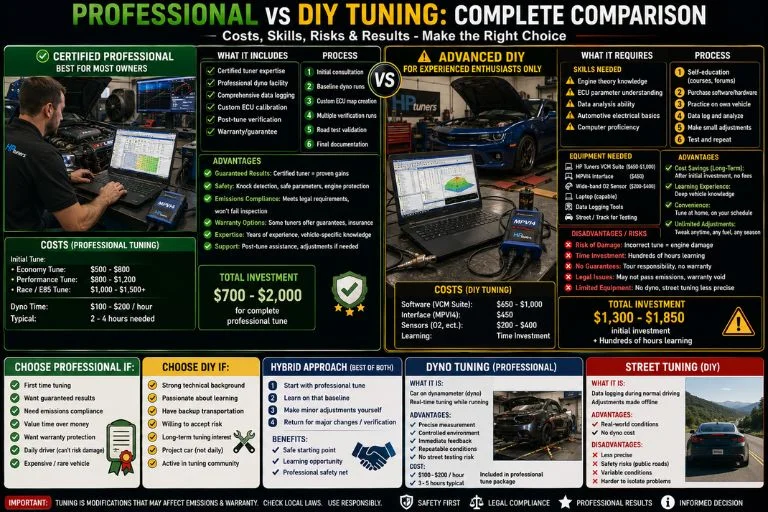
When considering tuning services, the question arises: should it be done by a professional or DIY? Knowing how to tune a car is one thing, but knowing when and how to proceed is another. Below is a quick rundown:
Do It Yourself Tuning — Suitable for advanced enthusiasts with knowledge of engine parameters. Software such as HP Tuners’ VCM Suite is accessible enough that one can teach oneself to use it, but the cost of mistakes is high.
Professional Car Tuner — The best choice for people who want guaranteed results and peace of mind. A certified car tuner will make sure that your car conforms to emissions requirements and will help you achieve more reliable gains.
Dyno Tuning — A standard tuning method which involves the car being run on a dynamometer while the tuner fine-tunes the parameters in real-time.
Regardless of the type of tuning, it’s important that the tools used are of quality and the data used is verified. Optimizing and tuning a car requires precision, not guesswork.
Conclusion
Car tuning is not just about upgrading your car—it’s a technique of bringing your car to its optimal state. Whether you’re learning about the relationship between horsepower and torque, or getting to know the use of industry-standard tools such as HP Tuners’ VCM Suite for ECU reflashing, every stage of the tuning process brings you closer to a vehicle performing exactly how you want it to. Car tuning can seem daunting, but even beginners can start exploring what they can do provided they get the right guidance. Looking to move up to the next level? Try HP Tuners‘ VCM Suite and take control of tuning your car.
Frequently Asked Question’s
What is car tuning?
Car tuning is the process of modifying a vehicle’s engine control unit (ECU) and mechanical components to improve performance, fuel efficiency, or throttle responsiveness. It involves optimizing parameters like air-fuel ratio, ignition timing, and boost pressure.
What does tuning do for a car?
Tuning optimizes your vehicle’s performance by making adjustments to various components and software. Benefits include increased horsepower and torque, improved throttle response, better fuel economy (when tuned for efficiency), and smoother power delivery.
Is tuning a car good for it?
When done properly by a professional car tuner or with quality software, tuning can increase engine durability and reliability by optimizing combustion efficiency. However, aggressive tuning for maximum performance can increase wear if not accompanied by supporting modifications and maintenance.
Will tuning a car void my warranty?
In many cases, yes—reflashing the ECU may void the manufacturer’s warranty on powertrain components. It is important to check your warranty terms and consult with a certified car tuner before proceeding with any modifications. Some manufacturers offer performance warranties for approved tuning.
Can tuning improve fuel economy?
Absolutely. Car tuning is not just about performance gains. By optimizing the air-fuel mixture and ignition timing for everyday driving conditions, a skilled car tuner can improve fuel efficiency noticeably, sometimes by 10-20% depending on the vehicle and driving habits.
How much horsepower can I gain from tuning?
Gains vary widely depending on the vehicle. Naturally aspirated engines typically see 5-15% gains, while turbocharged engines can see 20-40% or more due to boost pressure optimization. A professional dyno tune provides the most accurate measurement of actual gains.