Table of Contents
Whether you are a first-time driver that’s about to take your driver’s license or a seasoned driver relocating to a new state, you need to know the rules of the road in order to be safe and keep everyone around you safe. More than 4 million miles of public roads are maintained by American roadways, which have significantly complex traffic laws, uniform traffic signs, speed limits, and other rules that enable order. Know all the rules of the road, all the meaning of US traffic signs and signals, and what information they are trying to tell you to drive safely and legally.
Why the Rules of the Road Matter More than Ever
More than 40,000 traffic fatalities were a common occurrence in the United States each year. A great majority of them could have been prevented had drivers been more diligent in following the rules of the road. In addition to personal safety, failure to follow traffic laws can lead to fines, license suspension, increased insurance rates and even criminal charges. Each road user—be it a car, truck, motorcycle, bicycle, or pedestrian—is a participant in the same environment and each user should be familiar with and respect the same basic rules.
Understanding US Traffic Signs and Meanings
Traffic signs and their components play an important role in the traffic system as they facilitate the safety and order of traffic on the road. It is important to note that traffic signs play a crucial role in ensuring the safety and order of drivers on the road. Signs communicate road rules and traffic laws to assist the driver in making decisions in a safe manner. Knowing the interpretation and meaning of United States traffic signs can help drivers know when they are in danger, what the rules are, and how to navigate traffic safely.
Types of Traffic Signs
Regulatory Signs communicate to drivers what their actions are required by law. These signs include stop signs, yield signs, speed limits, and turn restrictions.
Warning Signs provide drivers with information about potential risks such as sharp turns, pedestrian crossings, school zones or merging roadways ahead.
Guide Signs give directions, distances and information about services such as hospitals, gas stations, and rest areas.
Construction Signs indicate to motorists that road work is being carried out, detours and temporary traffic conditions are in place.
Knowing the meaning of various traffic signs and what they mean will help drivers follow the rules of the road better, minimize accidents, and make travel safer.
American Road Speed Limits: A State-by-State Overview
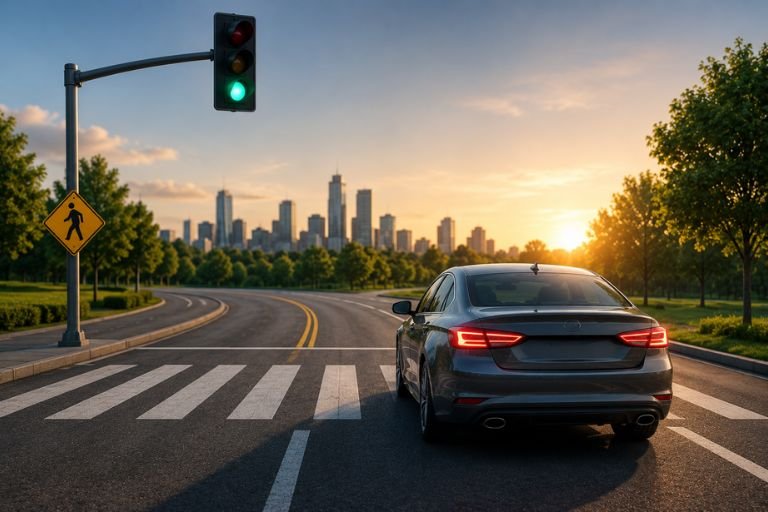
Speed limits are one of the most obvious aspects of the rules of the road. The U.S. has no single national speed limit, but rather federal guidelines that help create a general standard for speed limits in all states. Such limits depend on the type of roadway, traffic level and the environment. For longer trips, such as on highways and interstates, speed limits are raised to accommodate faster travel, but for residential areas they are lower in order to protect pedestrians and cyclists.
Understanding the meaning of speed restrictions is essential when learning the rules of the road, as they are in place to promote safe driving, reduce accidents and enable efficient traffic flow. Drivers that obey the speed limits and stay alert of road conditions are more likely to drive responsibly and stay out of tickets and accidents.
| Road Type | Typical Speed Range | Notes |
| Residential Streets | 25–30 mph | Lower near schools and playgrounds; pedestrian priority zones |
| Urban Arterials | 35–45 mph | Varies widely by city ordinance and intersection density |
| Rural Highways | 55–65 mph | Open roads with fewer intersections; watch for farm crossings |
| Interstate Highways | 65–85 mph | Texas holds the highest posted limit at 85 mph (SH 130) |
| School Zones (active) | 15–25 mph | Enforced when flashing lights are active; heavy fines for violations |
| Construction Zones | 45–55 mph (reduced) | Fines often double; worker presence increases penalties further |
It is important to note that posted American road speed limits represent the maximum under ideal conditions. Rain, fog, ice, or heavy traffic may require driving well below the posted limit—this is enshrined in the “basic speed law” found in nearly every state’s traffic code.
How Signs Reinforce the Rules of the Road
A common misunderstanding is that the meaning of US traffic signs is purely informational, i.e., nice to know but not mandatory to follow. In reality, signs provide information about road rules and traffic laws which is legally enforced. A “No Left Turn” sign is not optional; a “Do Not Enter” sign is not a suggestion; a flashing red signal is a stop sign and should be obeyed as such on one-way streets.
Applying the rules of the road in real conditions includes knowing all the vocabulary and meanings of US traffic signs, including pavement markings (solid yellow, dashed white, crosshatching). Yellow center lines indicate no passing zones. Double solid yellow lines mean DO NOT PASS under any circumstances. For good reason, these markings are part of traffic laws and are included in all state driver’s tests.
Understanding Safe Driving Beyond Traffic Rules
Following the rules of the road connects to broader vehicle safety and maintenance knowledge. Just as understanding how many cylinders your car has helps you understand engine performance capabilities and limitations, knowing traffic laws helps you operate your vehicle safely within legal parameters.
Similar to how the oil pressure gauge provides critical engine health warnings, traffic signs provide critical road safety warnings that demand immediate attention and response. Understanding dashboard instruments like the tachometer helps monitor engine RPM to prevent over-revving, while speed limit signs help prevent excessive speeds that cause accidents.
Regular vehicle maintenance following a comprehensive car maintenance checklist ensures your vehicle can safely respond to traffic situations—brakes work when you need to stop at signs, steering responds when navigating turns, and lights function for visibility.
When vehicle components fail or require replacement after accidents or wear, quality aftermarket suppliers like Tagore Auto Parts provide reliable remanufactured engines, transmissions, and safety-critical components to restore your vehicle to safe, legal operating condition.
Special Situations: When Standard Rules Shift
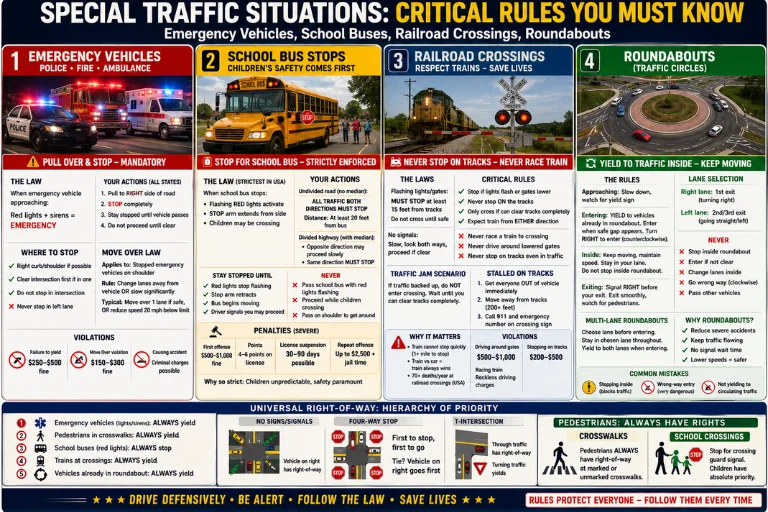
Experienced drivers know that there are rules of the road that also involve being aware of circumstances that change the standard rules:
Emergency Vehicles
All states mandate that drivers pull over and stop for emergency vehicles when red lights and sirens are active. Move Over Laws also apply to passing stopped emergency vehicles—requiring drivers to change lanes or slow down significantly.
School Buses
One of the most strictly enforced traffic laws in the country is the requirement to stop all traffic on undivided roads for school buses when they are stopped with their flashing red lights on and their stop arm in the “STOP” position.
Railroad Crossings
Do not stop on railroad tracks. Do not attempt to cross while traffic is congested in order to avoid being stranded on the tracks.
Roundabouts
Give way to vehicles already in the roundabout. Never stop within the roundabout—keep circulating until your exit.
The basic structure of US traffic signs and their meanings are federally standardized in the Manual on Uniform Traffic Control Devices (MUTCD), ensuring consistency across the country. Regulatory and warning signs are universal, but some states supplement with additional signs of a different color or type for informational purposes.
Conclusion
The rules of the road are not arbitrary—they are designed to ensure safety for millions of individuals. From understanding road rules and laws to respecting American road speed limits and obeying core traffic laws, every driver has a responsibility. Staying updated matters too, as new laws evolve: states are adding hands-free requirements, speed limits are being revised in school zones, and roundabouts are replacing conventional intersections. It’s important to check your state’s driver’s handbook regularly and always set a positive example for those around you.
Frequently Asked Question’s
What is the maximum road speed in the USA?
The maximum posted road speed in the USA is 85 mph (137 km/h) on State Highway 130 in Texas. However, most interstate highways have speed limits between 65-75 mph, and residential areas typically range from 25-30 mph.
How many traffic laws are there in America?
There is no single number of traffic laws in America, as the legal system consists of federal guidelines, state laws, and local ordinances. Each state has its own vehicle code with hundreds of specific traffic regulations, and local jurisdictions add additional rules.
What are the basic rules of driving in America?
Basic rules of driving in America require drivers to: stay on the right side of the road, obey posted speed limits (typically 25-30 mph residential, 55-70 mph highways), stop completely for pedestrians in crosswalks, yield to emergency vehicles, and stop for school buses with flashing red lights.
What is the turn on red light rule in the USA?
The turn on red rule allows drivers to turn right at a red traffic light after coming to a complete stop, as long as the road is clear and safe, and there is no “No Turn on Red” sign posted. Drivers do not have to wait for the green light before turning. Some states also allow left turns on red when turning from a one-way street onto another one-way street.
Are traffic laws the same in all US states?
While most traffic laws are standardized across states through the MUTCD (Manual on Uniform Traffic Control Devices), individual states can set their own speed limits, hands-free requirements, and specific regulations. Always check the driver’s handbook for the state you’re driving in.
What are the consequences of not following traffic laws?
Consequences include traffic tickets and fines, points on your driving record, increased insurance rates, license suspension or revocation, mandatory traffic school, and in severe cases (DUI, reckless driving), criminal charges and jail time.