Table of Contents
For most drivers, the first words that spring to mind regarding suspension systems are coil springs and leaf springs. However, there’s a third type of spring to consider, and that is torsion bar suspension. It’s no wonder there’s a loyal fan base for torsion bar suspension, with systems found on everything from vintage American muscle cars to military combat vehicles and racing cars. This guide will demystify what a torsion bar is, what it does and why it still plays an important role after major automakers have phased it out.
Whether you’re restoring a classic truck or replacing worn suspension components, Tagore AutoParts — your nationwide autoparts supplier — stocks quality used parts to keep your build on track.
What Is a Torsion Bar?
Before learning how the system works, let’s first understand what is a torsion bar? A torsion bar is a curved, hard spring steel rod used to provide a suspension spring which opposes twisting forces rather than compression forces. The difference between a coil spring and a torsion bar is that a torsion bar stores energy as a result of rotating along its axis, and then springs back to its original configuration when it is unloaded. It’s very easy to imagine: a coil spring is merely a torsion bar coiled into a spiral.
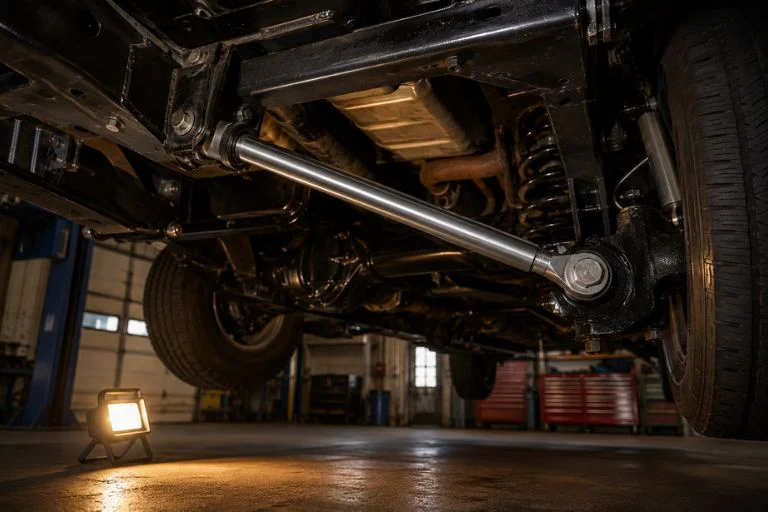
They both operate on the same physical principle. Take the tension out of a coil spring and you get a torsion bar. The only difference is in shape. A torsion bar suspension system uses one end of the bar to attach to a fixed point on the vehicle’s frame, and the other end to the lower control arm. The wheel rolls across bumps and dips moving the control arm, which twists the bar. The bar flexes and springs back just like any other type of suspension spring.
Torsion Bar Suspension Diagram: How It All Connects
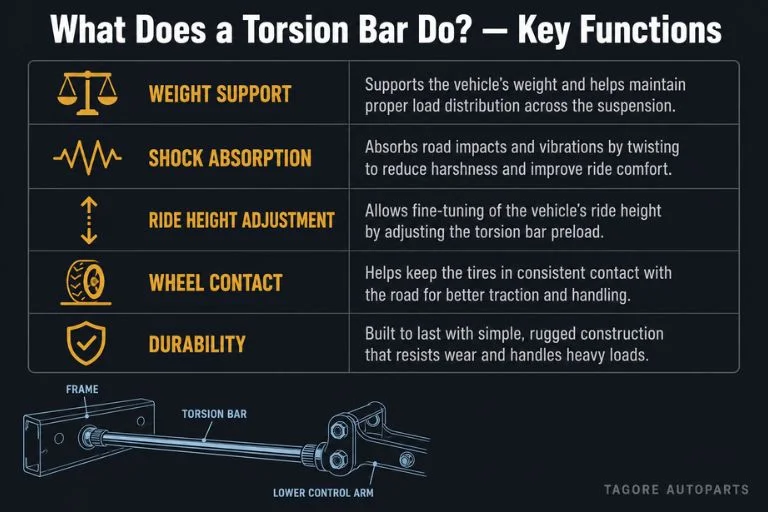
One of the quickest ways to get the idea of the layout is to look at the torsion bar suspension diagram. A typical torsion bar suspension diagram will include:
- A long, steel bar that is either aligned lengthwise (front to back), or crosswise (side to side) under the vehicle.
- One end securely connected in a rigid manner to a frame or cross member.
- The other end is connected to the lower control arm by a torsion key.
- An adjusting bolt in the vicinity of the torsion key anchor point.
The torsion bar suspension diagram is clean because it doesn’t include any bulky spring perches or complicated shock mounting gear. This is an elegant, simple solution with a single steel rod to carry the entire spring function.
What Does a Torsion Bar Do? Key Functions Explained
So what does a torsion bar do beyond just looking like a plain metal rod? Quite a lot, actually. Here’s a breakdown:
| Function | How Torsion Bar Handles It |
| Weight support | Resists twist to hold vehicle ride height |
| Shock absorption | Twists and rebounds to absorb road impacts |
| Ride height adjustment | Torsion key bolt changes preload on the bar |
| Wheel contact | Pushes control arm down to keep tire on road |
| Durability | Spring steel resists fatigue for decades |
Understanding what a control arm does in this system is just as important as the bar itself. Our guide on What Is a Control Arm breaks down how the lower control arm connects to the torsion bar and why its condition directly affects your suspension geometry and ride quality.
The Torsion Key: The Unsung Hero of the System
The torsion key is the interface between the torsion bar and the control arm or chassis anchor. It’s typically hex-shaped or splined to prevent the bar from spinning freely. The torsion key is where an adjusting bolt applies or releases preload on the bar.
Benefits of upgrading the torsion key:
- Allows greater bar rotation for increased ride height range
- Enables front-end leveling on trucks without buying new springs
- Affordable modification compared to full suspension upgrades
- Works in conjunction with a torsion bar suspension diagram layout to maintain proper geometry
Many truck owners replace the factory torsion key as a first step toward leveling their front end it’s one of the most cost-effective suspension mods available.
Advantages and Disadvantages of Torsion Bar Suspension
Advantages:
- Exceptional durability — original bars from 1960s vehicles still function today
- Adjustable ride height via the torsion key bolt
- Compact and lightweight compared to coil setups
- Low maintenance with virtually no service intervals
- Still used in F1, sprint cars, and military vehicles
Disadvantages:
- Fixed (non-progressive) spring rate limits tuning flexibility
- Vulnerable to nicks and surface damage from road debris
- A damaged bar can fail suddenly under stress
- Less compatible with modern independent suspension geometries
If your torsion bar suspension has failed and you’re exploring a full front-end rebuild, browse our range of used engines for sale and used transmissions for sale — because a suspension rebuild is often the right time to service the drivetrain too.
Where Is Torsion Bar Suspension Still Used?
Today, torsion bar suspension has been mostly phased out of mainstream passenger car applications, but it is still used in a few applications:
- Classic cars: such as Chrysler muscle cars or early Dodge trucks
- Military vehicles: are renowned for their durability, so they are worth considering for extreme conditions.
- Motorsport: Sprint, stock car, and Formula 1 vehicles continue to rely on torsion systems as do motorsports.
- Off-roads: Older GM and Dodge 4×4 platforms are used for off-road trucks.
Conclusion
There is a time-tested solution to every problem, and that is torsion bar suspension. If you are deciding to learn more about it for the first time or think about upgrading the torsion bar on your truck, having a knowledge of what is a torsion bar, reading a torsion bar suspension diagram and knowing what does a torsion bar do will definitely give you a head start as a vehicle owner or enthusiast.
It’s as durable, as adjustable, and as mechanical as you can get and its technology that is still used by Formula 1 teams and military engineers. Whether you are leveling a pickup, working on a classic Mopar, or simply curious, it’s well worth understanding the torsion bar suspension inside and out.
Frequently Asked Question’s
What is a torsion bar and how is it different from a coil spring?
A torsion bar is a straight or tubular metal rod that acts as a suspension spring by twisting along its length.
What does a torsion bar do when it breaks?
A broken torsion bar causes one corner of the vehicle to drop significantly, making the car unsafe to drive. It must be replaced immediately.
Can I adjust ride height with a torsion bar suspension?
Yes, you can adjust ride height with a torsion bar suspension by turning the adjuster bolts.
How long do torsion bars last?
With no damage from road debris, torsion bars can last the lifetime of a vehicle. Many classic cars still run on their original bars installed 50+ years ago.
What type of suspension is best for off-roading?
The best suspension for off-roading is the Independent Front Suspension (IFS).