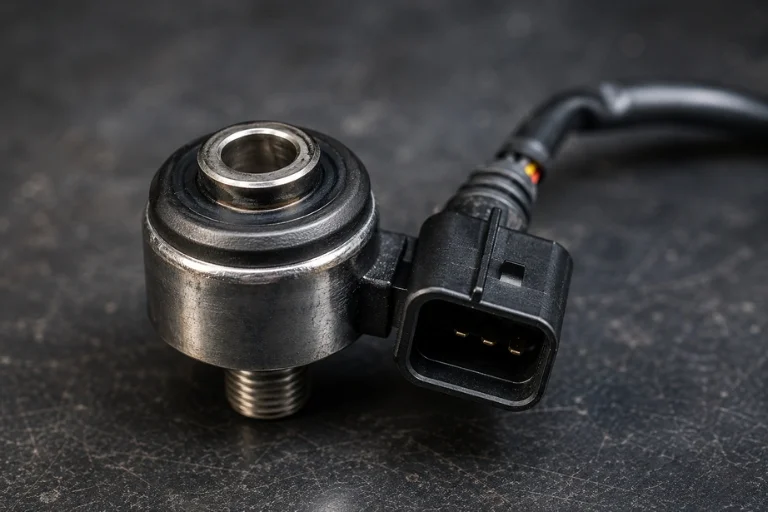
If you are wondering why your check engine light just came on and a quick scan turned up a knock sensor code, you’re probably wondering this is a five-minute fix or a full afternoon under the hood. The answer to this question depends on your vehicle. On few cars, swapping a knock sensor is a 20-minute job. This knock sensor is the main device whose function is to remove any unusual sound coming from the engine. In this guide we will walk you through what a knock sensor actually does, how to spot a failing one and what are the common symptoms of the knocking sensor.
QUICK ANSWER: What Does a Knock Sensor Do?
A knock sensor is a device that detects engine vibrations and converts them into electrical signals and helps the car computer adjust ignition timing to prevent damage. When this sensor picks up the vibration it sends the voltage signal to the engine control module (ECM). The ECM then adjusts the timings and protects the motor. From there the computer system pulls back the ignition timing on the fly to stop the knocking before it does real damage.
In other words, a knock sensor doesn’t prevent detonation on its own — it’s the early warning system that lets the computer correct for it in real time. Without a working knock sensor, the ECM often defaults to a more conservative timing map to protect the engine. That’s safe, but it usually costs you fuel economy and a noticeable drop in power.
A failing knock sensor left unaddressed can eventually allow detonation to damage pistons, rings and cylinder walls — at which point the repair goes well beyond a simple sensor swap. For vehicles where prolonged knock sensor neglect has contributed to internal engine damage, Tagore AutoParts stocks a full range of used engines for popular makes and models across the USA.
Common Knock Sensor Symptoms
There are some of the most common symptoms that indicate knock sensor failure:
- Check engine light with a stored knock sensor code (commonly P0325, P0327, P0328 or P0330 depending on bank).
- Loss of sluggish acceleration
- Noticing reduced fuel economy, sometimes less than 1–3 MPG.
- You can hear the unusual knocking or pinging metallic sound from the sensor.
How to Diagnose a Knock Sensor Code
Before replacing anything, pull the actual code with an OBD-II scanner. A knock sensor code points to a wiring or sensor problem, but it doesn’t always mean the sensor itself is dead. If you want to diagnose knock sensor code than you must need to undergo through such steps:
- You must test with a multimeter, use this to check the wiring of the sensor to the control unit.
- Connect the wiring of the sensor to the control unit.
- Wiring harness continuity, especially at connectors prone to corrosion.
For vehicles where a knock sensor diagnosis has also flagged transmission control module codes alongside engine codes, Tagore AutoParts carries reliable used transmissions to support complete drivetrain repairs at competitive prices nationwide.
Knock Sensor Replacement Cost
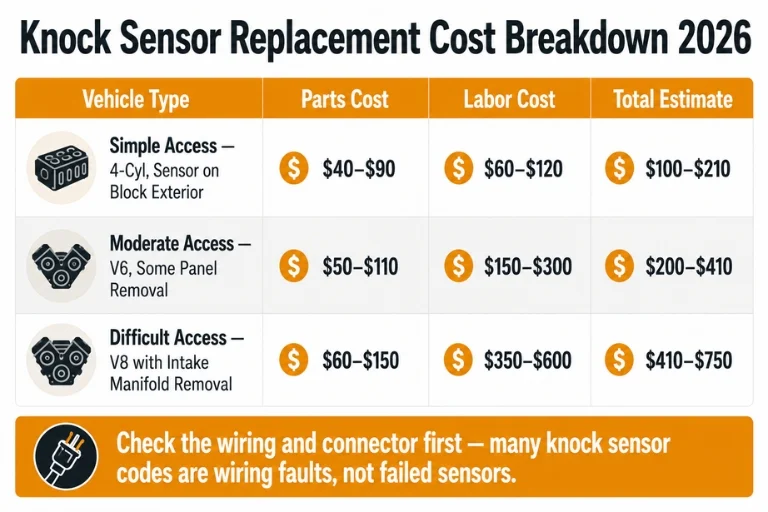
Here’s a realistic breakdown of what you should expect to pay in 2026, whether you’re doing it yourself or paying a shop:
| Vehicle Type | Parts Cost | Labor Cost | Total Estimate |
| Simple access (4-cyl, sensor on block exterior) | $40–$90 | $60–$120 | $100–$210 |
| Moderate access (V6, some panel removal) | $50–$110 | $150–$300 | $200–$410 |
| Difficult access (V8 with intake manifold removal, e.g., Sequoia/Tundra) | $60–$150 | $350–$600 | $410–$750 |
For vehicles where knock sensor replacement labor costs are approaching or exceeding the vehicle’s value — particularly older high-mileage V8 trucks requiring full intake manifold removal — sourcing a quality used engine is often the more financially sound decision. Tagore AutoParts stocks used Toyota Sequoia engines specifically, making it a practical option for Sequoia owners facing exactly this situation.
2006 Toyota Sequoia Knock Sensor Connector Notes
The 2006 Sequoia’s 4.7L V8 is notorious in DIY circles for two things: the knock sensors sit beneath the intake manifold, and the factory connectors are prone to heat-related brittleness after years in the engine bay. When you finally get access, inspect the connector housing closely — a lot of “sensor failure” cases on this engine turn out to be a cracked connector or corroded pins rather than a dead sensor. If you’re already elbow-deep in the intake for this job, it’s worth replacing both knock sensors and the connector pigtails at once, since round two on this engine is not something you want to repeat in a year.
2004 Chevy Avalanche Intake Manifold Knock Sensor Wire Routing
On the 2004 Avalanche’s Vortec engines, the knock sensor wiring runs along the back of the intake manifold before dropping down toward the harness connector. These routing matters: if the wire gets pinched, rubbed through insulation, or routed too close to the exhaust manifold heat shield during reinstallation, you’ll get an intermittent code that looks exactly like sensor failure. When reassembling, follow the factory routing path exactly and use the original wire loom clips — don’t zip-tie the harness somewhere “close enough.”
That shortcut is a common source of repeat comebacks on this platform. For Chevy Avalanche and Vortec V8 owners whose knock sensor job has uncovered deeper engine wear, Tagore AutoParts also carries used Chevy Tahoe engines — sharing the same Vortec platform — as a cost-effective engine swap solution.
For official technical guidance on vehicle emissions control systems and engine sensor standards, the U.S. Environmental Protection Agency’s official vehicle and engine certification page is the most authoritative USA government reference available for understanding how engine management sensors like the knock sensor interact with emissions compliance systems.
Conclusion
Your knock sensor might be small, but it’s doing a lot of heavy lifting under the hood. Its job is to catch detonation that harmful “pinging” inside your engine before it does real damage. When it’s working right, you get better performance, better fuel economy, and an engine that just runs the way it should. The problem arises when it starts failing as the symptoms aren’t always obvious. Maybe it’s just a check engine light. Maybe you notice your car feels sluggish, or you’re filling up at the pump more often than you used to. Sometimes you’ll actually hear it that telltale knocking sound from the engine bay.
Whatever the sign, don’t ignore it. Knock sensor issues have a way of turning into bigger, costlier problems if you let them sit. Here’s the thing a lot of people miss, though: before you go out and buy a replacement sensor, check the wiring first. Seriously a huge chunk of knock sensor codes trace back to a damaged harness or a bad connector, not an actual failed sensor. It’s an easy thing to overlook, and it can save you money if you catch it early.
Whether you’re the type to pop the hood and handle it yourself, or you’d rather leave it to a mechanic, it helps to understand what this sensor actually does and how to spot the warning signs. That knowledge puts you in a better position to make the right call and keeps your engine running the way it’s supposed to.
Frequently Asked Questions
Can I drive with a bad knock sensor?
Yes, for a short term you can drive with a bad knock sensor but generally it is not recommended to drive with a bad sensor in a long run.
Will a bad knock sensor cause actual engine damage?
Yes, a bad knock sensor can cause real damage as it can lead to destructive pre-ignition, severe cylinder pressure and cracked pistons.
How long does knock sensor replacement take?
Usually replacing a knock sensor might take up to 1 to 4 hours, depending on where the sensor is located.
What is the lifespan of a knock sensor?
Typically, a knock sensor might last up to 100,000 and 150,000 miles, depending on the trim level and engine type.