Table of Contents
- What Does a Slipping Transmission Actually Mean?
- Top Transmission Slipping Signs to Watch For
- Common Causes of a Slipping Transmission
- Transmission Failure Symptoms vs. Slipping: Key Differences
- What to Do If You Suspect a Slipping Transmission
- Preventing Transmission Slipping Before It Starts
- Conclusion
- Frequently Asked Question’s
Have you wondered what make your car adjust speed, deliver power and ensure smooth acceleration. The answer to it lies in the transmission system one of the most crucial yet often overlooked components of your modern vehicles. The transmission system acts as a bridge between the engine and wheel, the transmission regulates power to deliver optimum performance and fuel efficiency. Transmission technology has transformed over the years. In this blog, we’ll explore everything you need to know to explore the role of transmission system, their different types and how going innovation.
What Does a Slipping Transmission Actually Mean?
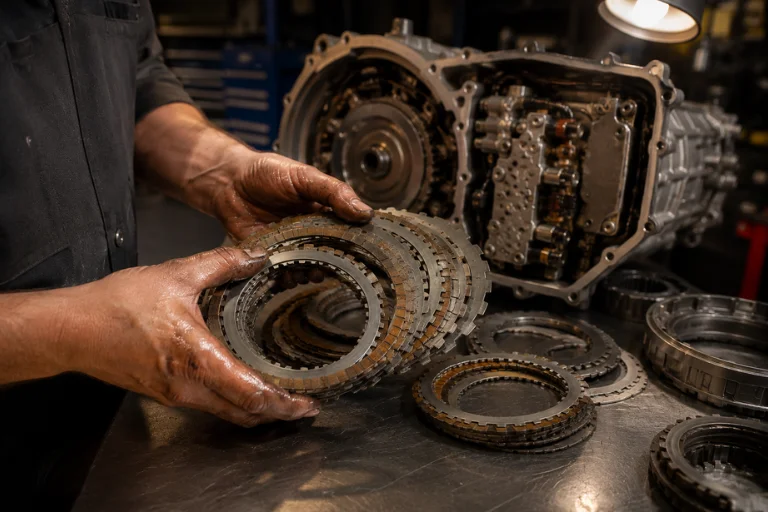
A slipping transmission is when the transmission suddenly changes gears, it does not engage correctly, or it does not transfer power to the wheel without the driver changing gears. It’s similar to losing traction within the drivetrain itself. This is because the clutch packs, bands, torque converter and other components inside an automatic work in perfect synchronization. In case if any of the element doesn’t work properly or becomes damaged, it can lead to various issues including slipping gears or unusual behavior.
If your vehicle is showing these signs, the first step is getting the right replacement part quickly. As a leading leading used parts supplier across the USA, Tagore AutoParts stocks quality used transmissions for sale to get you back on the road without breaking the bank.
Top Transmission Slipping Signs to Watch For
The sooner you can see the signs of transmission slipping, the more likely you can save on the repairs. What to check (and listen) for:
- Changes in the gear ratio
- Delay in acceleration
- Check the engine light
- Burning odor under the hood
- Check if the transmission fluid is burnt
- Check if the fluid is in dark brown or black colour
- Clunking noises or humming sound while shifting the gear is the red flag
Common Causes of a Slipping Transmission
| Cause | Description | Severity |
| Low or dirty transmission fluid | Insufficient hydraulic pressure to engage clutches and bands | Moderate |
| Worn clutch packs or bands | Loss of friction material causes ineffective gear engagement | High |
| Faulty solenoid | Disrupts fluid distribution and pressure | Moderate–High |
| Torque converter failure | Breaks the connection between engine and transmission | High |
| Worn gears | Teeth fail to mesh properly, causing power loss | Very High |
| Software/sensor errors | Incorrect signals cause erratic shifting behavior | Moderate |
Sensor and software faults that trigger slipping often overlap with ECM problems. Our blog on Symptoms of a Bad ECM explains how a failing engine control module can mimic or worsen transmission issues — worth reading before spending money on transmission repairs.
Transmission Failure Symptoms vs. Slipping: Key Differences
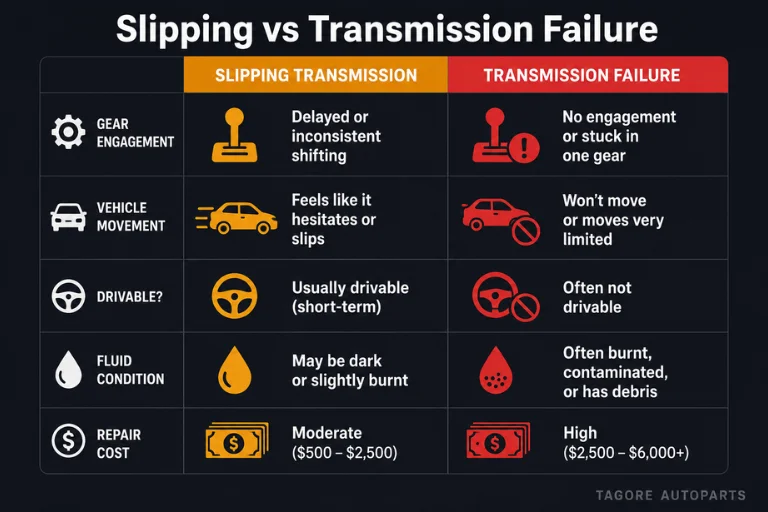
It’s important to distinguish between early-stage slipping and advanced transmission failure symptoms:
| Symptom | Slipping Transmission | Transmission Failure |
| Gear engagement | Inconsistent | None or severely impaired |
| Vehicle movement | Present but erratic | Absent in severe cases |
| Driving possible? | Usually yes, with caution | No |
| Fluid condition | Degraded or low | Often severely burnt or depleted |
| Repair cost (est.) | $150–$900 (fluid/solenoid) | $1,500–$5,000+ (rebuild/replace) |
For a deeper understanding of what happens inside the gearbox during failure, our guide on CVT Transmission Explained breaks down how different transmission types respond to wear — helpful whether you drive an automatic, CVT, or manual.
What to Do If You Suspect a Slipping Transmission
- Step 1: Thoroughly check the fluid level and condition.
- Step 2: Make note of the instance of slipping.
- Step 3: Do not drive rashly.
- Step 4: Don’t flash out the fluid immediately.
- Step 5: Visit an authorized store to accurately read the fault codes and look for any internal issues.
Preventing Transmission Slipping Before It Starts
Prevention is dramatically cheaper than repair. Here’s how to keep your transmission healthy long-term:
- Make sure to change the transmission fluid after every 30,000–40,000 miles.
- Avoid towing beyond your vehicle capacity.
- Make sure to warm up the engine in cold weathers before driving.
- Watch for early warning signs.
- Don’t ignore the check engine light.
Staying on top of fluid changes is one of the easiest ways to extend transmission life. Our detailed post on Transmission Fluid Change walks you through exactly when and how to do it correctly for your vehicle type.
Conclusion
One of the most important things to know when driving is how to find out if they are having a transmission slip. The signs may be as subtle as a rise in RPM or as dramatic as losing gears, but if you know where to look and what to listen for, you can spot them. The lesson: Do not wait to take action, do not drive recklessly and never ignore a strange pattern of events or a strangely lit Check Engine Light.
If you detect any of the transmission slip transmission symptoms listed in this guide, make sure to get a diagnostic check done right away. If you detect the symptoms of potential transmission failure in the slipping phase, instead of the failure phase, you may be able to save hundreds or even thousands of dollars.
Frequently Asked Question’s
Can I drive with a slipping transmission?
No, it is not recommended to drive a slipping transmission as it is completely unsafe leading to unexpected loss of power and performance.
Is a slipping transmission always expensive to fix?
No, it is not necessary that a slipping transmission will always be expensive while replacing it can lead to costly repairs.
How long will a slipping transmission last without repair?
A slipping transmission can last anywhere from a few miles to several years without repair. Because the timeline is unpredictable, mechanics consider it an emergency. Driving on a slipping transmission accelerates internal friction and heat, rapidly turning a simple, cheap fix into a total transmission replacement.
Does transmission slip only happen in automatic vehicles?
Slipping transmission can also slip if the clutch disc wears, but manual transmission can also slip if the clutch disc wears down or the pressure plate fails.