Table of Contents
Developing rechargeable batteries to the record-setting EVs, BYD has acquired one of the strongest players in the automotive sector at the international level. Being both a fan of the EVs and a person who has just tried to enter the world of electric transportation, one should get to know more about the BYD car brand to understand where the future of transportation is leading us. This paper further examines why BYD is hitting on all 8 cylinders, its background, its cars, how it prices its car and why it is gaining so much attention despite being in the crowded American market.
What Is BYD? The Story Behind the Brand
BYD (Build Your Dreams) is a company based in China, in Shenzhen established in 1995 by Wang Chuanfu to produce rechargeable batteries competing with those of the Japanese brands. The company soon grew to be one of the largest manufacturers of battery in the world, not just NiCd but lithium-ion technology. BYD joined auto business in 2003 through the acquisition of Qinchuan Automobile Company.
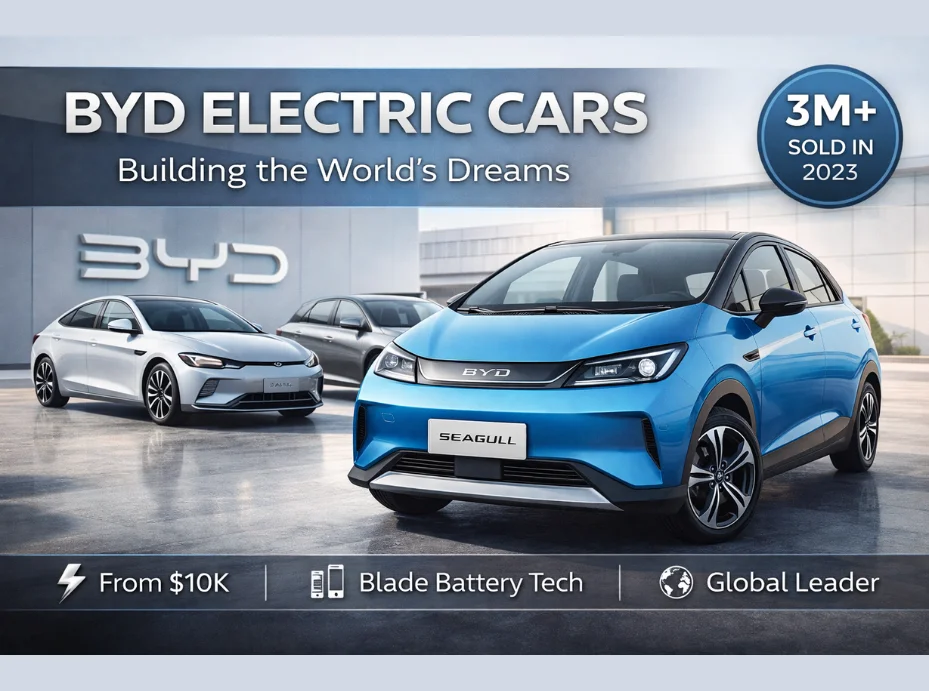
It was vertically integrated unlike other competitors since it manufactured its own batteries, motors, and semiconductors. It has enhanced its leadership in the world through its innovative Blade Battery (LFP chemistry) which enhanced the safety and durability of EVs. By 2023, BYD sold more than 3 million new energy vehicles (NEVs) and is still the pioneer in electric mobility and renewable energy innovation on the global stage.
BYD Cars: A Lineup Built for the Electric Age
The BYD car lineup spans a wide range of segments, from affordable city commuters to high-performance luxury EVs. Here’s a snapshot of some of the most notable BYD cars currently available globally:
| Model | Type | Range (approx.) | Key Highlight |
| BYD Seagull (Dolphin Mini) | Compact Hatchback | 305–405 km (190–252 miles) | Ultra-affordable EV (~$10K), Blade LFP battery, 10.1-inch rotating screen |
| BYD Dolphin | Hatchback | 427–490 km (265–304 miles) | 12.8-inch rotating touchscreen, ADAS, 360° camera |
| BYD Atto 3 | Compact SUV | 260 miles | Spacious interior, Blade battery |
| BYD Seal | Sedan | 310 miles | Sport-oriented, sleek design |
| BYD Han | Full-size Sedan | 360 miles | Premium feel, ultra-fast charging |
| Yangwang U9 | EV Supercar | 280 miles | Can jump and operate on 3 wheels |
Each BYD electric car in this lineup is powered by the Blade Battery technology a lithium iron phosphate (LFP) innovation that has been praised for its thermal stability, longevity, and cost efficiency. Independent teardown comparisons have even shown BYD’s battery system outperforming Tesla’s in areas like overall efficiency and manufacturing cost.
BYD Seagull
Other markets have a very cheap miniature 5-door electric hatchback, the BYD Seagull or Dolphin Mini, which has BYD e- Platform 3.0 and a Blade LFP battery. It costs approximately 10,000, and it functions in the low-end EV unit in China, where it has two battery options, with a range of 305 km to 405 km (CLTC/NEDC), 75-100 PS front-mounted electric motor and less than 160 Nm of torque. It features a 10.1-inch rotating touchscreen infotainment within and 4/6 airbags, depending on the model, and its DC fast charging capability makes it usable in the daily urban setting, which qualifies it to be one of the most viable low-end EVs in the global market.
BYD Dolphin
The BYD Dolphin is an electric hatchback 5-door, which is based on BYD e-Platform 3.0, with the Blade LFP battery 44.9 kWh or 60.48 kWh and is front-wheel driven. It covers a range of up to 427-490 km based on the type of battery and the test cycle as well as power output of about 95 PS- 204 PS. It features a distinct rotating touchscreen of 12.8 inches, inboard cameras and driver assistance systems (ADAS) of 360 degrees, and is a more technology-oriented brand in the low-price EV category and a step higher than its small brother, the Seagull/Dolphin Mini.
BYD SEAL
BYD Seal is a high-end all-electric sedan combining a long range, high performance and high tech. It has two Blade Battery capacity, which are 61.44 kWh (Dynamic) and 82.56 kWh (Premium and Performance) with an impressive range of 510 km to 650 km (NEDC). Dynamic and Premium models have Rear-Wheel Drive, and the outputs are 201bhp and 308bhp, respectively, and the top-spec Performance model has an All-Wheel Drive configuration with an enormous 523bhp and 670 Nm and a 0-100 km/h time of 3.8 seconds.
It charges up to 150 kW DC fast charging, and can charge 10 to 80 percent in about 37 minutes. Long at 4,800 mm and with a wheelbase of 2,920 mm, the Seal has a roomy cabin and useful 400-litre rear boot and a 53-litre frunk. It has a 15.6 inch rotating touchscreen, 10.25-inch digital cluster, panorama sunroof, Nappa leather seats and a head-up display inside. The safety is also strong enough with 9 airbags, ADAS, and 5-star rating, and suspension is the Double Wishbone in the front and Multi-Link in the back. Offered as a Dynamic, Premium, and Performance, the BYD Seal car offers itself as a strong and technological electric sedan within its industry.
What Makes BYD Electric Cars Stand Out?
The BYD electric car categories are not competitive, but disruptive in the market, in real and measurable solutions. The factors that make it distinctive are:
- Vertical integration: BYD manufactures its batteries, semiconductors and motors, and this gives it the level of quality and cost control unlike other companies.
- Blade Battery technology: This is the technology that eradicates fire hazards and increases the density of energy without cobalt which is a rare mineral.
- Cheap and cheap quality: BYD cars have quality products at affordable prices that most of its competitors cannot afford.
- Advanced safety: A Yang Wang U9 supercar that was the most popular was the ability to maintain activity even when a wheel was lost in its possession, i.e. what the company can come up with.
- Various Powertrain choice: BYD offers full electric and plug-in hybrid (PHEV) cars, which are appealing to the largest number of the audience.
BYD Cars Price: What Should You Expect to Pay?
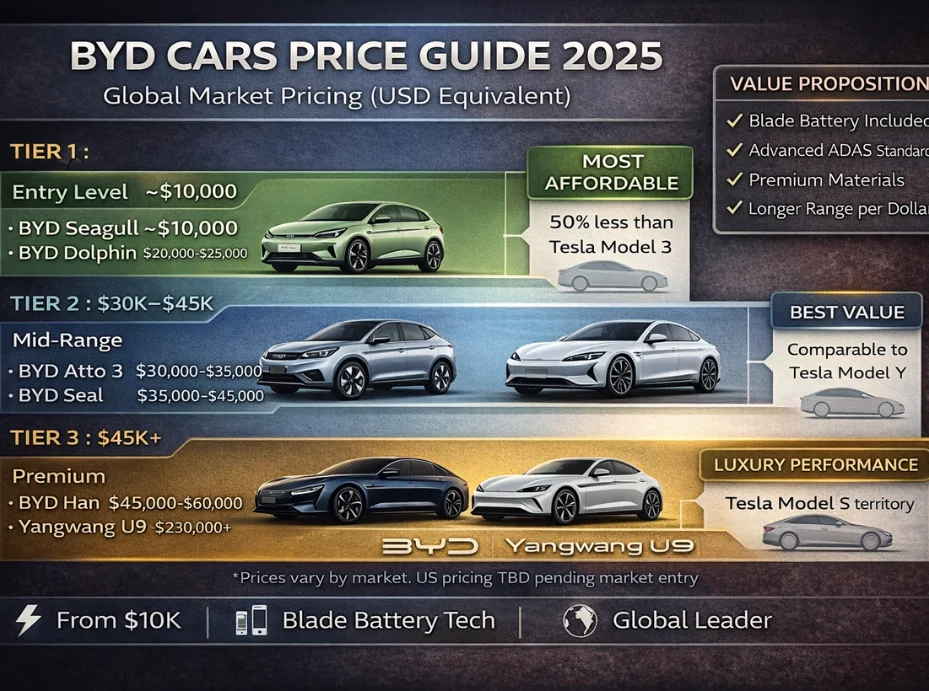
The pricing strategy of BYD is one of the strongest reasons to pick this car. With specific prices depending on the region and the model, but in this case, the approximate cost of BYD cars in foreign markets is as follows:
- Entry-level models (e.g., BYD Dolphin): Starting at about 20,000-25,000 USD equivalent.
- Models in the middle range (e.g., BYD Atto 3, Seal): in the range of about 30,000-45,000 USD equivalent.
- Premium/flagship models (e.g., BYD Han, Yangwang U9): Between $45,000 and much more than that.
This costing strategy has directly competed with companies such as Tesla with cheaper models that have not been able to sustain market momentum as BYD records record sales across the globe annually.
BYD Cars in USA: Is the Brand Available in America?
One of the most frequently searched question among the EV buyers is the availability of BYD cars in the USA. As of today, BYD does not officially trade in passenger cars through retail dealership in the United States, primarily due to the trade tariffs and geopolitical tensions between the United States and China that have highly complicated market entry. However, BYD has a strong presence in the U.S. through its electric bus and commercial vehicle segment.
The company has provided electric buses to various agencies in America and proving its engineering availability on roads. With the ever-changing dynamics in the trading environment, including recent tariff policies affecting automotive manufacturers, the industry analysts truly believe that the BYD car band can step into the American consumer market in the years to come.
Conclusion
Since its modest beginnings as a battery producer and its present success as a worldwide EV giant, BYD is one of the most interesting narratives in the history of the automobile industry. BYD car brand has shown that innovation and affordability are not the two opposite sides of one coin and the rest of the industry has noticed.
Whether you are planning to buy an electric car in the near future and decide to purchase the BYD or you are simply following the development of the EV market, one thing is evident: BYD is not only producing cars, it is producing the future. For more insights on the evolving automotive industry, explore our coverage of automotive industry news and emerging car brands. If you’re maintaining an existing vehicle while watching the EV revolution unfold, Tagore Auto Parts offers quality components to keep your current ride running smoothly. Follow the news, visit the possibilities, and monitor the way BYD vehicles keep transforming the transport at the global level.
Frequently Asked Questions
What does BYD stand for?
BYD is an abbreviation that means Build Your Dreams. There was no particular meaning of the acronym when the company was established but was later standardized to indicate the ambitious vision of the brand.
Is BYD a reliable car brand?
Yes. Its proprietary battery and powertrain technology have given the BYD car brand good reliability ratings in other European, Asian and Australian markets.
Does BYD have electric cars in the USA?
BYD cars in USA are at present restricted to commercial vehicles, such as buses. The current trade tariffs are preventing the sale of passenger cars through the U.S. dealerships.
How does BYD compare to Tesla?
BYD and Tesla are harsh competitors. BYD has already overtaken Tesla in the number of EVs in the world and has competitive range and features, frequently at lower BYD vehicles pricing.
Who owns BYD?
BYD has a majority stakeholder, Wang Chuanfu. Berkshire Hathaway, a company owned by Warren Buffett is a significant investor, as well as BlackRock.