The Automotive industries have witnessed significant changes in the technological world and during the last few decades the continuously Variable Transmission has transformed the game in the industry. With increasing manufacturers adopting this technology in their cars, it has become necessary to know what is CVT transmission and how it differs from the traditional gearboxes. In this guide will discuss what is CVT, how it works, its benefits and why it is gaining a lot of popularity in the current automotive market.
What is CVT Drive? Decoding the Technology
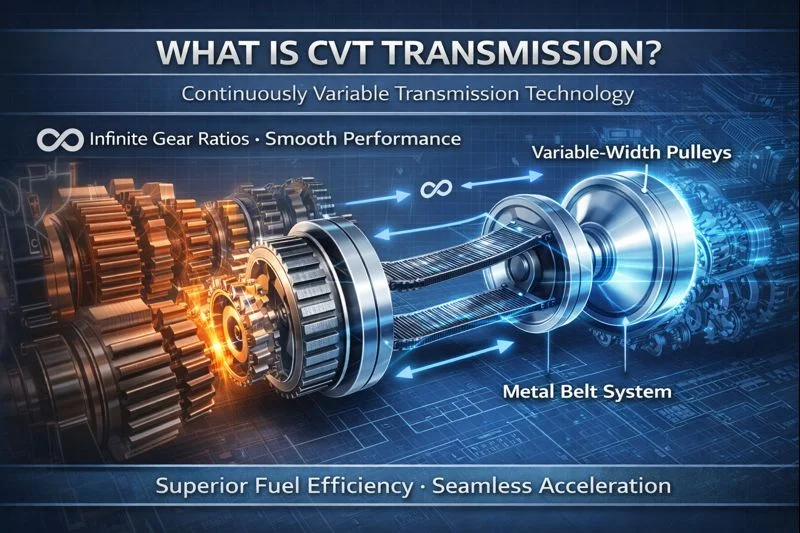
A CVT (Continuously Variable Transmission) transmission system incorporates variable-width pulleys and a belt or chain to offer an interminable array of gear ratios as compared to a conventional transmission with fixed gears, which causes smooth, fluid acceleration, better fuel economy, and retains the engine in its most efficient operating range. It is used by constantly varying the diameter of the pulleys so that it varies the engine (input) to wheels (output) proportions, which gives improved performance in changing driving conditions, particularly in city driving.
How Does a CVT Gearbox Work?
To know how does a continuously Variable Transmission functions, one has to look at its main components. The main common type of CVT design uses two cone-shaped pulleys that are linked together by a chain or a metal belt. The driving conditions changes these pulleys vary in width thereby changing the gear ratio not in discrete steps:
The main parts of a continuously Variable Transmission System include:
- Primary Pulley: This is the part associated with the engine, and is powered by the crankshaft.
- Secondary Pulley: This passes the power to the drive wheels via the differential.
- Metal Belt or Chain: Connects both the pulleys and power transmission.
- Hydraulic System: Adjusts width of pulleys by automation depending on the driving condition.
- Electronic Control Unit (ECU): Controls and regulates performance of transmission. For more on ECU technology, check out our guide on Toyota Corolla ECU.
As acceleration occurs, the pulleys will perfectly change their diameter ratio, allowing the engine to maintain optimal RPM while the vehicle gains speed. This is done in such a way that drivers hardly feel any form of traditional action of shifting sensation.
What are the advantages of CVT Technology?
The growing popularity of continuously Variable Transmission stems from numerous benefits that enhance both performance and efficiency:
Performance Benefits:
- Smoother acceleration without gear shift interruptions
- Optimal engine performance across all driving conditions
- Improved power delivery, especially in smaller engines
- Better climbing ability on inclines
Efficiency Advantages:
- Superior fuel economy compared to traditional automatics
- Reduced emissions through optimized engine operation
- Lower maintenance requirements due to fewer moving parts
- Quieter operation during highway cruising
Driving Experience:
- Seamless power delivery for city driving
- Predictable acceleration patterns
- Reduced driver fatigue in stop-and-go traffic
- Simplified driving experience similar to conventional automatics
CVT vs. Traditional Transmissions: A Comparative Analysis
| Feature | CVT Transmission | Automatic Transmission | Manual Transmission |
| Gear Ratios | Infinite within range | Fixed (4-10 gears) | Fixed (5-6 gears) |
| Fuel Efficiency | Excellent | Good | Very Good |
| Acceleration | Smooth, continuous | Stepped shifts | Driver-dependent |
| Maintenance | Moderate | Moderate-High | Low-Moderate |
| Driving Engagement | Low | Low | High |
| Cost | Moderate-High | Moderate-High | Low-Moderate |
| Reliability | Good (improving) | Excellent | Excellent |
Many popular vehicles utilize continuously Variable Transmission technology effectively. For instance, the Nissan Altima transmission and Honda Accord transmission are excellent examples of modern continuously Variable Transmission applications. Similarly, the Toyota Camry transmission offers drivers the benefits of continuously Variable Transmission efficiency.
Common Misconceptions About CVT Drive Systems
Despite their advantages, CVT transmissions face certain criticisms, many of which stem from misconceptions or experiences with earlier continuously Variable Transmission models. Modern CVT technology has addressed many initial concerns through advanced engineering and refined control systems. One common complaint involves the “rubber band” effect, where the engine revs seem disconnected from vehicle speed. However, many manufacturers now program CVT systems with simulated shift points to provide a more familiar driving feel while maintaining efficiency benefits.
Maintenance and Longevity Considerations
Proper maintenance is crucial for continuously Variable Transmission longevity. Unlike traditional automatics, continuously Variable Transmission systems require specific transmission fluid formulated for their unique operating characteristics. Following manufacturer-recommended service intervals ensures optimal performance and extends transmission life. To learn more about proper transmission care, read our guide on transmission fluid change.
Essential CVT Maintenance Tips:
- Use only manufacturer-specified CVT fluid
- Change transmission fluid every 30,000-60,000 miles
- Avoid aggressive driving habits that stress the transmission
- Monitor for unusual noises or performance changes
For comprehensive vehicle upkeep beyond transmission care, explore our car maintenance checklist 2025 to keep your vehicle running smoothly.
Conclusion
Knowing all about what CVT transmission technology is can make consumers have lot of power in making informed decision while purchasing the car. The continuously Variable Transmission represent a thoughtful engineering solution that prioritizes optimal engine performance. Although it might not be appealing to the enthusiasts who wants to have traditional-gear shifting experience, The CVT gearbox can achieve some practical advantages in its daily commuting and family transportation.
As the automotive industry continues to evolve the continuously Variable Transmission system also more advanced and more sophisticated. No matter whether you are deciding on whether to buy a vehicle with a continuously Variable Transmission or you are just interested in learning more about this technology, it is better to know its advantages and features and understand why this type of innovation can push modern automotive engineering to the next level.
Frequently Asked Questions
Is a CVT transmission reliable?
Modern CVT transmissions have proven reliable when properly maintained. While early models faced durability concerns, current technology has significantly improved longevity and performance consistency.
Can a CVT handle high-performance applications?
Traditional CVTs are best suited for economy and moderate performance vehicles. However, some manufacturers have developed reinforced CVT systems capable of handling higher power outputs.
Does a CVT require special driving techniques?
No special techniques are required. Drive a continuously Variable Transmission -equipped vehicle like any automatic transmission, though avoiding aggressive acceleration can extend transmission life.
Why does my CVT-equipped car sound different during acceleration?
The engine maintains higher RPMs during acceleration to optimize power delivery, creating a distinctive sound pattern different from traditional transmissions.
Are CVT transmissions more expensive to repair?
Repair costs can be comparable to or slightly higher than conventional automatics, though the reduced number of moving parts often means fewer potential failure points.