Table of Contents
Have you ever wondered to see a Tesla Cybertruck rolling into a military training field? It sounds like something out of a sci-fi movie but it’s happening in real life. In August 2025, the U.S. Air Force confirmed that it will be training battlefield and use Cybertrucks. And one question that has triggered the discussion was: Is Silicon Valley becoming the new backbone of American defense?
The answer to this question seems to be Yes! Moreover, the pentagon is shifting to high-tech industry to provide tools of modern warfare from rockets and AI software to EVs. Billion dollars are pouring in Silicon Valley, that is reshaping the military prepares for future conflicts. So, in this blog we will understand the growing bond between Big Tech and the U.S. military? As this story goes far beyond one electric pickup it shows how national security and commercial innovation are becoming more connected than ever before.
The Air Force Cybertruck Acquisition: More Than Target Practice
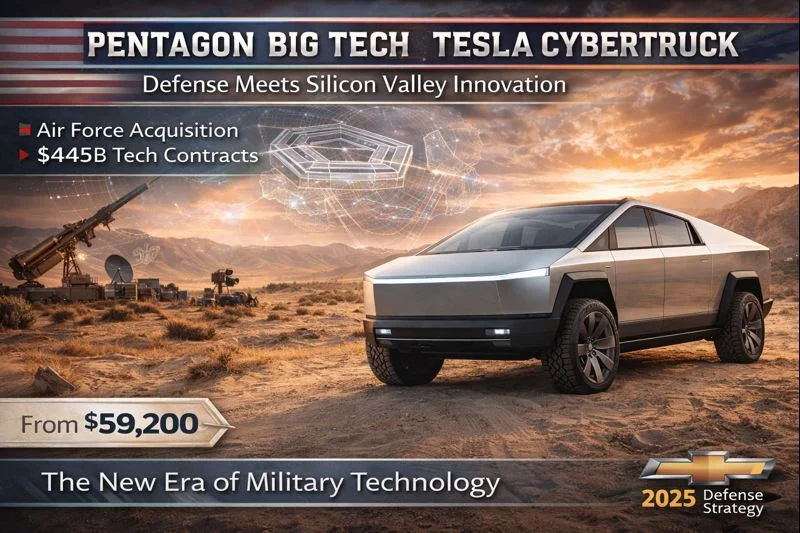
The U.S. Air Force Material Command recently filed documents with the System for Award Management seeking to acquire two Tesla Cybertrucks for target vehicle training flight test events at White Sands Missile Range in New Mexico. While the vehicles are destined for destruction during live missile fire testing, the decision to specifically request the Tesla brand carries significant implications. According to official procurement documents, the Air Force cited the Cybertruck’s distinctive characteristics as the primary reason for selection.
Market research conducted in February 2025 determined that the vehicle’s angular, futuristic design and unpainted stainless steel exoskeleton differentiate it from traditional trucks. The vehicles do not need to be fully operational but must remain intact and capable of rolling on their wheels. The justification document revealed a compelling rationale: military planners anticipate that adversaries may adopt vehicles similar to the Cybertruck in future combat scenarios. For enthusiasts interested in the Cybertruck’s innovative design, learn more about the Tesla Cybertruck and its groundbreaking features.
Pentagon Big Tech Partnerships: A Growing Trend
The Cybertruck deal is just one example of how the Pentagon is working more and more with big tech companies. Over the past ten years, government spending on private tech firms has grown a lot now adding up to over $445 billion out of roughly $755 billion in total federal contract spending. Gordon Adams, a defense spending expert at American University, said the Air Force’s choice reflects a larger trend. According to him, the partnership between tech companies and the Department of Defense is changing quickly, with tech firms now playing a major role in national security.
Major Tech Contracts Shaping Defense
| Company | Contract Value | Purpose |
| SpaceX | $22 billion | Launch services and Starlink connectivity |
| Palantir | $10 billion | 10-year Army software contract |
| OpenAI | $200 million | AI capabilities for defense applications |
| xAI (Grok) | $200 million | Agentic AI workflows |
| $200 million | Military AI development | |
| Anthropic | $200 million | National security AI solutions |
The Trump administration has accelerated this trend, with defense spending increases of $150 billion creating opportunities for technology companies to expand their military portfolios. The Department of Defense has actively pursued AI tools from major providers, recognizing that commercial technology often outpaces traditional defense contractor innovations. To understand more about recent political impacts on the automotive industry, explore our coverage on Trump tariffs and their effects on vehicle manufacturing.
Pentagon Big Tech Tesla Cybertrucks: From Boardrooms to Battlefields
The story of the pentagon big tech Tesla Cybertrucks extends beyond American military procurement. In 2024, Tesla Cybertrucks appeared in an unexpected theater when Chechen leader Ramzan Kadyrov showcased modified vehicles equipped with heavy machine guns, claiming they would support Russian forces in Ukraine.
These developments raised important questions about civilian technology in military contexts. The Cybertruck’s stainless steel construction, electric powertrain, and connected vehicle systems present both opportunities and vulnerabilities in combat environments. Military analysts noted that while the vehicle offers mobility and stealth advantages from its quiet electric motors, it was never designed for battlefield conditions.
Key Cybertruck Characteristics Relevant to Military Use
The Air Force’s interest in the Cybertruck stems from several distinguishing features:
- Angular stainless steel exoskeleton providing distinctive visual profile for targeting practice
- 48V electrical architecture offering superior power efficiency compared to conventional vehicles
- Futuristic design aesthetic representing potential adversary vehicle evolution
- Connected vehicle technology enabling remote monitoring and potentially remote control
- Electric powertrain providing quiet operation beneficial for stealth applications
The Broader Defense Technology Landscape
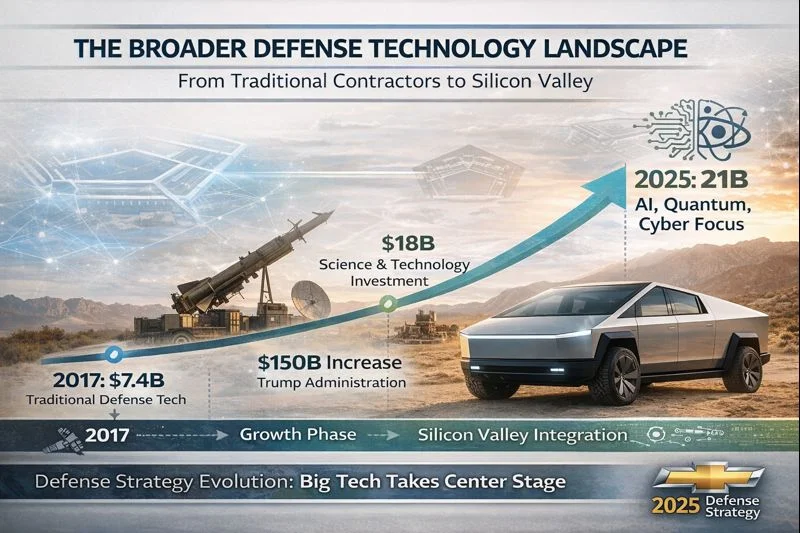
The Pentagon’s embrace of Silicon Valley reflects fundamental changes in military technology strategy. The investment used in the communication, computer and intelligence system has grown from $7.4 billion in 2017 to $21 billion in 2025. Science and technology activities receives $18billion, prioritizing artificial intelligence, machine learning, Quantum Sciences, and cyberwarfare capabilities. Defense Secretary Pete Hegseth has pledged to redirect approximately towards innovative weaponry and emerging technologies. Vice President JD Vance, speaking at a technology conference, emphasized the administration’s vision for embracing productive new technologies and achieving technological dominance. This philosophy has opened doors for startups including Anduril Industries, Shield AI, and Saronic Technologies to compete alongside established defense contractors.
Implications for the Automotive and Defense Industries
The convergence of automotive innovation and military requirements creates new considerations for vehicle manufacturers and defense planners alike. Electric vehicles offer advantages including reduced logistical burdens from fuel supply chains, quieter operation for tactical situations, and advanced sensor integration capabilities. However, connected vehicle technology introduces cybersecurity concerns that military applications must address. The controversy surrounding alleged remote deactivation of Cybertrucks highlights potential vulnerabilities when civilian platforms operate in conflict zones without modification for disconnected operations.
For the automotive industry, military interest validates certain design philosophies while encouraging consideration of how commercial vehicles might serve dual purposes. Manufacturers developing rugged, durable platforms may find unexpected government customers evaluating their products for unconventional applications. Whether you’re looking for advanced automotive technology or reliable replacement parts, explore our extensive inventory of used engines, used transmissions, and components from leading brands like Ford.
Conclusion
The Pentagon big tech Tesla Cybertruck acquisition narrative depicts basic changes in the American approach to national security. What started as an ordinary acquisition of training equipment has turned out to be representative of the further integration between Silicon Valley innovation and military demands. With defense spending being increasingly directed at the technology firms as opposed to the old contractor, demarcation between civilian and military application is becoming blurred.
To the industry observers, investors and the technology experts, an insight into these emerging relationships will provide details of the future defense priorities and market opportunities. The Cybertruck serving as a missile target at White Sands may seem bizarre, yet it shows a military organization gearing up to fights where high-tech commercial equipment characterizes the core of the battle. Be it the AI systems that facilitate logistics, the electric vehicles that can deliver tactical mobility, or the satellite networks that facilitate communications, the Big Tech has become an inseparable part of the American defense strategy.
Frequently Asked Questions
-
Why does the Air Force specifically want Pentagon Big Tech Tesla Cybertruck for target practice?
The Air Force determined that the Cybertruck’s unique angular design and stainless steel construction differentiate it from conventional vehicles.
-
How much is the Pentagon spending on Big Tech partnerships?
Government contract obligations with the private sector reached $445 billion in fiscal 2024.
-
Have Tesla Cybertrucks actually been used in military operations?
Chechen forces allied with Russia have deployed modified Cybertrucks equipped with heavy machine guns in the Ukraine conflict.
-
What technologies is the Pentagon prioritizing for future defense applications?
The Department of Defense is focusing investments on artificial intelligence, autonomous systems, cloud computing, satellite communications, quantum sciences, hypersonic systems, and cyberwarfare capabilities.