Table of Contents
Have you ever opened the door of your car and felt a strong smell of gasoline and has this made you wonder why does my car smell like gas? Well, most of the drivers come across this common as well as concerning issue quite often. And this can be an indication that your vehicle is trying to tell something. In this guide you will understand what are the reasons behind this issue, what’s triggering it and what precaution is to be taken.
Why Does My Car Smell Like Gas? Common Causes
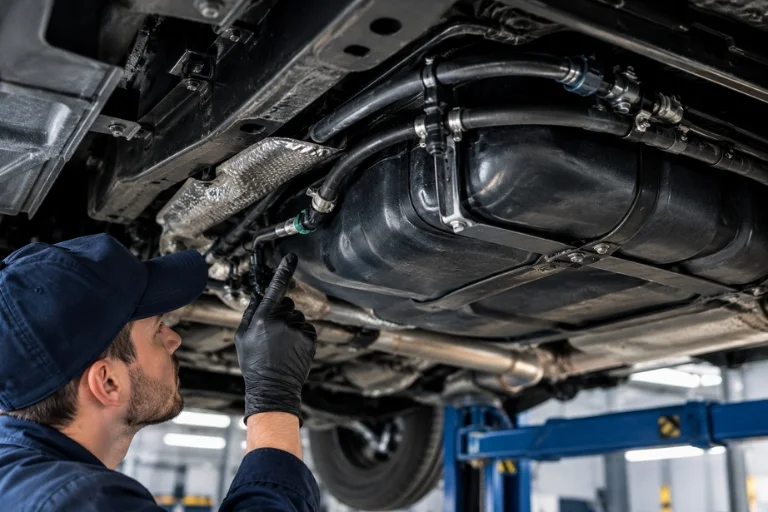
Here are some of the common causes that might help you understand what causes your car to smell like a gasoline:
- Loose or damaged gas cap — Fuel vapors can escape if the cap is loose or damaged. Leak in fuel injectors – Camper seals or broken fuel injectors may allow raw fuel to seep into the engine compartment.
- Fuel line or fuel hose damage — Fuel leaks through cracks in the fuel hose or fuel line due to age, heat or road debris.
- Damage to fuel tank — Corrosion or impact damage can cause small leaks.
- Cracked or filled charcoal canister — This part absorbs fuel vapors; if it is cracked or filled, then there will be odors.
- Overfilled fuel Tank — Using too much fuel than the automatic shut-off allows, can lead to fuel spillage in the vapour recovery system.
- Failure of fuel pressure regulator – If the fuel pressure regulator gets worn out, it allows excess fuel to be fed to the engine.
A persistent fuel smell that traces back to engine compartment leaks can sometimes mask deeper issues including intake manifold seal failures and injector o-ring deterioration. For vehicles where fuel system faults have contributed to internal engine damage, Tagore AutoParts stocks a full range of used engines for popular makes and models across the USA.
Fuel Odor Inside the Car vs. Outside the Car
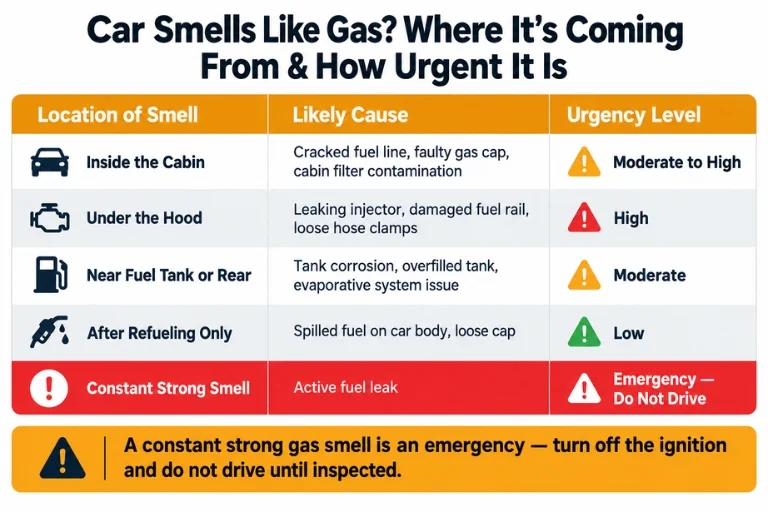
Identifying where the smell is coming from helps narrow down the issue faster.
| Location of Smell | Likely Cause | Urgency Level |
| Inside the cabin | Cracked fuel line, faulty gas cap, cabin filter contamination | Moderate to High |
| Under the hood | Leaking injector, damaged fuel rail, loose hose clamps | High |
| Near the fuel tank/rear | Tank corrosion, overfilled tank, evaporative system issue | Moderate |
| After refueling only | Spilled fuel on car body, loose cap | Low |
| Constant, strong smell | Active fuel leak | Emergency |
Bad Gasoline Symptoms in a Car to Watch For
A persistent gas smell rarely travels alone. Watch for these accompanying bad gasoline symptoms in a car:
- Rough idling or engine misfires
- Reduced fuel efficiency
- Visible fuel stains under the vehicle
- Engine warning light illuminated
- Problem in starting the engine
- Poor acceleration
These symptoms combined with a persistent fuel odor can sometimes point to fuel pressure issues affecting the transmission’s torque converter and automatic transmission fluid through heat soak. For vehicles where fuel system faults have also revealed transmission wear, Tagore AutoParts carries dependable used transmissions for a wide range of makes and models to support complete drivetrain repairs affordably.
Is It Safe to Drive With a Gas Smell?
No, it is not recommended to drive with a gas smell as the Gasoline vapours are highly flammable and can cause headaches, dizziness or nausea. In case if the smell is strong and comes with no warning signs that it is a serious concern. Make sure you look for these signs if you are figuring out these signs:
- Make sure you roll down the window so that the fumes may flush out.
- Make sure to turn off the ignition system immediately.
- Check whether the gas cap is loose or tight.
- Check out for any fuel leaks or wet spots.
- If still you are getting a strong smell, make sure to visit to a nearby professional and inspect it.
For Jeep Grand Cherokee and SUV owners where fuel line damage from off-road use is a known cause of persistent fuel odor, Tagore AutoParts stocks used Jeep Grand Cherokee engines for drivers whose fuel system inspection has also revealed engine damage requiring full replacement.
How Do You Get Gas Smell Out of Car?
Once the underlying issue is repaired, you’ll want to eliminate lingering odors. Here’s how do you get gas smell out of car interiors and surfaces effectively:
- Ventilate thoroughly – Roll down windows and let the cabin air out for several hours.
- Clean fabric and upholstery – Use a mixture of baking soda and water, let it sit, then vacuum.
- Wipe hard surfaces – Clean dashboards and door panels with a mild detergent solution.
- Use activated charcoal – Place charcoal bags in the cabin overnight to absorb odors.
- Replace the cabin air filter – A fuel-soaked filter will keep circulating the smell.
- Professional detailing – For deep-set odors, an ozone treatment or professional cleaning may be necessary.
For official guidance on gasoline vapor safety, fuel system hazards and vehicle fire prevention standards, the U.S. Fire Administration’s official vehicle fire safety and prevention page is the most authoritative USA government reference available for car owners dealing with fuel odor and potential fire risks.
Preventing Future Fuel Odors
- Tighten the gas cap until it clicks after every fill-up.
- Avoid overfilling the tank past the automatic shutoff.
- Schedule regular fuel system inspections.
- Address minor leaks immediately rather than waiting for them to worsen.
For Dodge Charger and muscle car owners where fuel pressure regulator failure is a known high-mileage issue that causes both fuel odor and engine performance problems, Tagore AutoParts also stocks used Dodge Charger engines for drivers whose fuel system diagnosis has revealed engine damage worth addressing with a quality used replacement.
Conclusion
A gas smell in your car is something that is worth considering. Whether it is about a simple fix, or repairing — replacing a fuel line, addressing the issue early can you save you from costly repairs and increase the life of your vehicle. If you are still wondering why your car smells like gas, don’t delay — visit the nearby trusted mechanic and know what’s the exact cause triggering it.
For all your vehicle parts needs — from fuel system components to complete used engines and transmissions — trust Tagore AutoParts, your reliable autoparts supplier serving customers nationwide.
Frequently Asked Questions
Why does my car smell like gas but there’s no leak?
The reasons why your car is smelling like a gas but has no leaks is because of the following factors including: loose gas cap, a saturated charcoal canister or fuel vapour.
Is a gas smell always a serious problem?
No, gas smell is not always a serious issue as it indicates your vehicle has a fuel system issue that needs attention.
Can a gas smell damage my engine?
No, the gas smell damage doesn’t cause damage, but the underlying leaks or malfunction can lead to poor performance and reduced efficiency.
How much does it cost to fix a gas smell in a car?
Generally, it would cost around $10 to over $1,500 depending on the issue that’s causing it.