Table of Contents
Think of the car’s brain as a quiet worker behind the scenes, handling things like fuel flow, spark timing and pollution control. If that part starts acting up, strange glitches pop up in different areas, confusing anyone trying to pin down the cause. You might see the warning light stay on, with odd error messages piling up- misfires happen, gas mileage drops, the engine hesitates when turning over, even cuts out without notice. That happens because signals get scrambled or sensor info gets ignored.
Power spikes, wet conditions too much heat, or frayed wires usually lie at the root of it breaking down. Spotting trouble fast – then digging deep into checks-stops big repair bills while keeping your car moving right. This guide will walk you through the Engine Control Module (ECM), typical red flags when it fails, why those happen, and ways to catch problems before they grow, so you ride safe.
What Is an ECM in a Car?
The ECM which is also known as the engine control unit (ECU) – handles how the engine runs making it a main computer that operates various aspects of engines operation. From moment to moment, it pulls info from many sensors: ones tracking oxygen levels, throttle movement, air mass flow, even where the camshaft position sensor sits; based on this stream, it adjusts when fuel sprays into cylinders, sparks fire from the ignition coil, exhaust gets managed, and how fast the motor idles when stopped.
Imagine this part as what thinks for the drivetrain. If it fails to work right, correct mixtures of air and gas fall apart, spark moments drift off target, pollution limits get missed. When damaged, it might issue wrong signals, trigger error codes, which makes the true fault hiding somewhere under the hood.
Common Symptoms of a Bad ECM
A vehicle might run rough or not at all when the ECM is failing. Since it manages multiple functions at once, problems can look like something else entirely – pinpointing the real issue becomes essential.
1. Check Engine Light with Multiple Fault Codes
One of the earliest and most telling symptoms of a bad ECM is the illumination of the Check Engine Light (CEL) alongside multiple, seemingly unrelated diagnostic trouble codes (DTCs). While a single code often points to a specific component, a failing engine control module may throw codes across multiple systems simultaneously or produce codes that disappear and return unpredictably.
2. Engine Misfires and Rough Running
A rough idle might show up if the car’s brain fumbles spark and fuel timing. Hesitation during acceleration can creep in without warning. Power fading on the highway often follows. Shaky engine behavior usually points to a failing control module. Notice these signs long enough, they tend to get worse.
3. Poor Fuel Economy
A faulty engine control unit might throw off how air and fuel mix, making combustion too heavy on gasoline or starved of it. When that happens, efficiency drops – fuel gets used up faster than normal. Poor economy tends to show itself early if the computer is starting to fail.
4. Engine Cranks Slowly or Not at All
Starting trouble? Cranking too long, maybe even failing to turn over – yet the battery and alternator test fine. That points toward a possible ECM issue. When it begins to fail, signals going to fuel injectors or spark systems might go missing or arrive wrong.
5. Sudden Stalling
When the engine cuts out suddenly – especially when idling or crawling through traffic – it might point to a weak ECM. Power vanishes mid-drive if the unit stumbles on managing fuel flow. Idle rhythm falters because the brain behind timing isn’t keeping pace. Without steady signals, combustion sputters and quits.
What Causes ECM Failure?
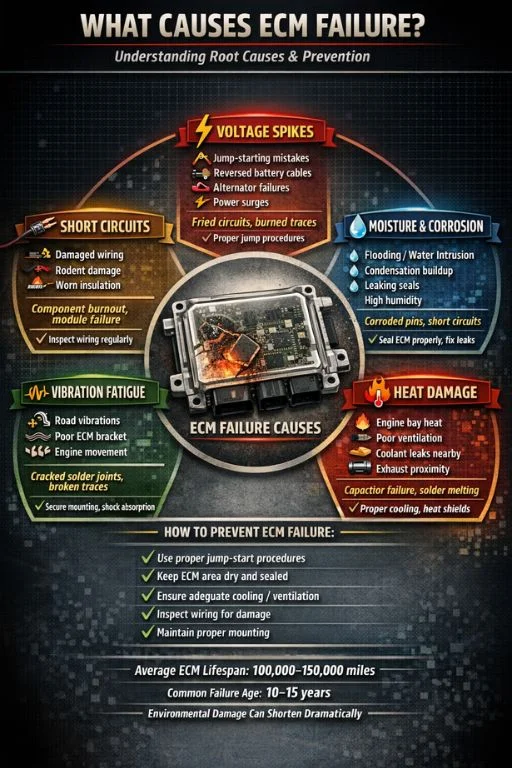
Understanding what leads to ECM failure helps with prevention. The most common causes include:
Voltage spikes: Wrong connections when starting a car might send sharp power surges through the control module. A backward battery fit sends shockwaves into delicate electronics without warning. Sudden jolts like these melt internal pathways just as fast as flames on paper.
Moisture and corrosion: When water gets inside – whether from floods, drips, or damp air – it can eat away at the tiny metal parts and joints on the ECM. Corrosion creeps in slowly, weakening how those pieces stick together.
Heat damage: Constant warmth from the engine area eats away at tiny parts inside electronics. Components like small energy holders slowly weaken when stuck near hot spots under the hood.
Vibration fatigue: Shaking on bumpy roads weaken solder points. Cracks form slowly, breaking contact now and then. Tiny splits grow until the circuit stutters without warning.
Short circuits: Faulty wiring somewhere in the car might push sudden spikes of power into the ECM. A glitch like that doesn’t always show up near where it started. Power jumps through paths you wouldn’t expect. That surge? It finds the weakest spot. The brain of the engine takes the hit even if the problem began miles away in a different circuit.
If your ECM failure has led to severe engine damage, Tagore Auto Parts offers quality remanufactured engines and replacement transmissions to get your vehicle back on the road.
How to Diagnose a Failing ECM?
In order to diagnose a failing ECM you need to follow these steps:
- OBD-II scan: Starting with an OBD-II scan means plugging in a high-quality tool to pull every DTC – both active and hidden. When odd error codes show up together without clear connection, that’s when attention is needed.
- Inspect wiring and connectors: Start by checking wires and connections. Spot any signs of rust, worn insulation, or melted spots along the ECM cable loom prior to moving on to test the unit. Damage here often points straight to the root cause.
- Check power and ground circuits: Start by testing the power supply – make sure the ECM gets steady voltage through a working circuit. A reliable ground matters just as much, so verify that connection too with your multimeter.
- Rule out sensor failures: Start by checking each questionable sensor – swap them one at a time or run quick checks. A glitchy reading might not mean the ECM is bad.
- ECM bench test or swap test: A working ECM from an identical model might show if the problem lies in the unit itself. Try swapping it first – this often points straight to a faulty module. When the replacement works, the original likely failed. Testing outside the truck helps rule out wiring issues.
Repair or Replace? ECM Options Compared
| Option | Estimated Cost | Pros | Cons |
| ECM Repair/Rebuild | $150 – $400 | Cost-effective; retains VIN programming | Not always possible; quality varies |
| Remanufactured ECM | $300 – $700 | Reliable; often pre-programmed | May still require dealer programming |
| New OEM ECM | $800 – $1,500+ | Highest quality; full warranty | Most expensive option |
Conclusion
When the brain of your car starts to fail, everything else seems off too – even if nothing major is wrong. Since it manages how fuel flows, when sparks happen, and what fumes get released, tiny glitches show up as big troubles on the road. Misfiring engines, sluggish starts, dropping mileage, or shutting down without warning – all might point back here. Spotting these clues fast helps avoid long waits and high bills later. Things like soaked wires, worn connections, excess heat, or power surges could be behind the scenes.
Work step by step, check each piece before blaming the core unit, so decisions about fixing or swapping make real sense.According to Society of Automotive Engineers (SAE) research, proper ECM diagnostics and early detection of electronic control system failures can prevent up to 60% of catastrophic engine failures, making regular system checks essential for long-term vehicle reliability and safety.
Frequently Asked Questions
Can I drive with a bad ECM?
Generally it is not advice to drive a car with a bad ECM. Even if it runs okay right now, skipping a check could backfire fast. When the engine control module struggles, things like sudden stalls or rough idling showing no guarantee.
Will a bad ECM always trigger the Check Engine Light?
No, it is not possible, a glitch in the system comes and goes without leaving traces. Yet when odd errors stack up – especially with rough idling or stalling that points toward something deeper. A pattern like that often means the brain of the engine is struggling.
How long does an ECM typically last?
A healthy engine computer might last up to 150,000 miles. Trouble might usually show up because of leaks, overheating, or power surges, not age. Moisture sneaks in, wires fry, voltage spikes mess things up; that’s when it quits.
Can a bad ECM damage other parts of my car?
A broken engine control module might mess up how fuel injectors work. When that part fails, sparks from ignition coils turn irregular. Transmission solenoids react oddly without proper input. Signals go wrong – parts wear down over time. Left too long, small issues grow worse.
Is ECM replacement a DIY job?
No, the ECM replacement is not a DIY job as this step usually needs tools found at dealerships or specialty shops. Most of the time, getting help from someone trained makes sense.