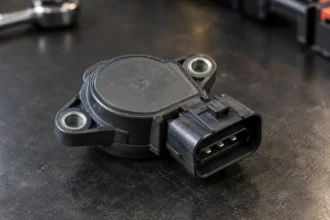
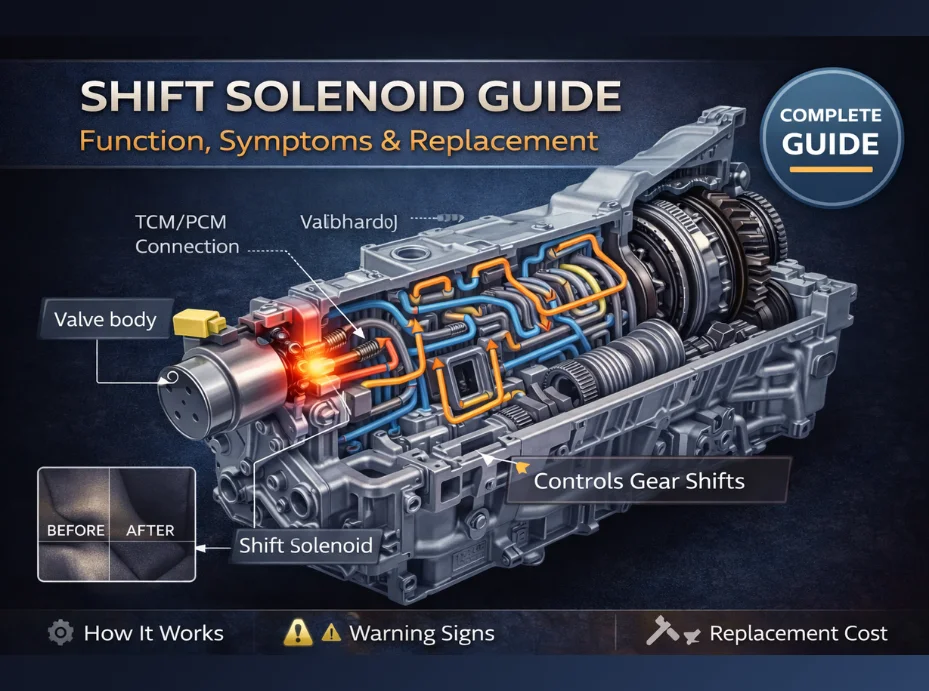
In the world of modern cars, seamless and quick gear shift can take place almost instantly until a transmission problem disrupts your commute. At the center of its heart lies a small yet vital electromechanical component that controls the flow of transmission fluid inside an automatic gearbox. The shift solenoid is controlled through the signals sent by the transmission control module (TCM) or powertrain control module (PCM), in order to control the Hydraulic pressure to engage the correct gears at the right time offering you better acceleration and drivability.
Once this component begins to malfunction the driver can experience the typical symptoms of the transmission which include slow shifting, gear slipping, limp mode, or even transmission itself. Understanding how the shift solenoid works, what warning signs to pay attention to, and what frequency the change of the transmission solenoid will make you avoid significant repairs and drive with ease.
What Is a Shift Solenoid and How Does It Work?
A transmission solenoid or gearbox solenoid or a shift solenoid is a kind of a valve which regulates the hydraulic pressure within an automatic transmission. It is located in the transmission valve body, and it responds to the inputs of the vehicle transmission control module (TCM) or powertrain control module (PCM). When engaged it opens or closes in order to permit the transmission fluid to pass so that the gears can be changed correctly.
Most vehicles are fitted with multipolar shift solenoids (typically 2-4), and cause specific gears to turn on, like 1-2, 2-3 or overdrive. Solenoid A can be used to control the transition between the first and the second gear as in an example of normal 4 speed automatic. The components that can be related to it are the shift interlock solenoid that does not allow the shifter to exit the Park until the brake pedal is released, and the VVT solenoid (variable valve timing solenoid) which also used to control the engine valve timing, but is not directly linked to the transmission shifts.
Key functions include:
- Accurate gear choice: Makes sure that power is delivered as efficiently as possible and fuel is used efficiently.
- Torque converter lockup: Switches to higher gears in a smooth transition over the highway.
- Adaptive shifting: Changes according to the driving conditions such as the load or speed.
Common Transmission Solenoid Symptoms to Watch For
Ignoring early warning signs may lead to complete transmission solenoid malfunctioning. Early detection of the symptoms of transmission solenoids will help you save money on repairs. Here’s what to look out for:
- Delayed or rude shifting: Gears jump or clunk into gear, particularly between 1st and 2nd.
- Unpredictable gear changes: Car shifts out of gear or accelerates without changing gear.
- Stuck in limp mode: Stops at one gear (usually 2nd or 3rd) and appears with a check engine light.
- Transmission overheating: Fluid pressure problems are associated with too much heat.
- Abnormal sounds: Whining or buzzing of the transmission pan during changing gears.
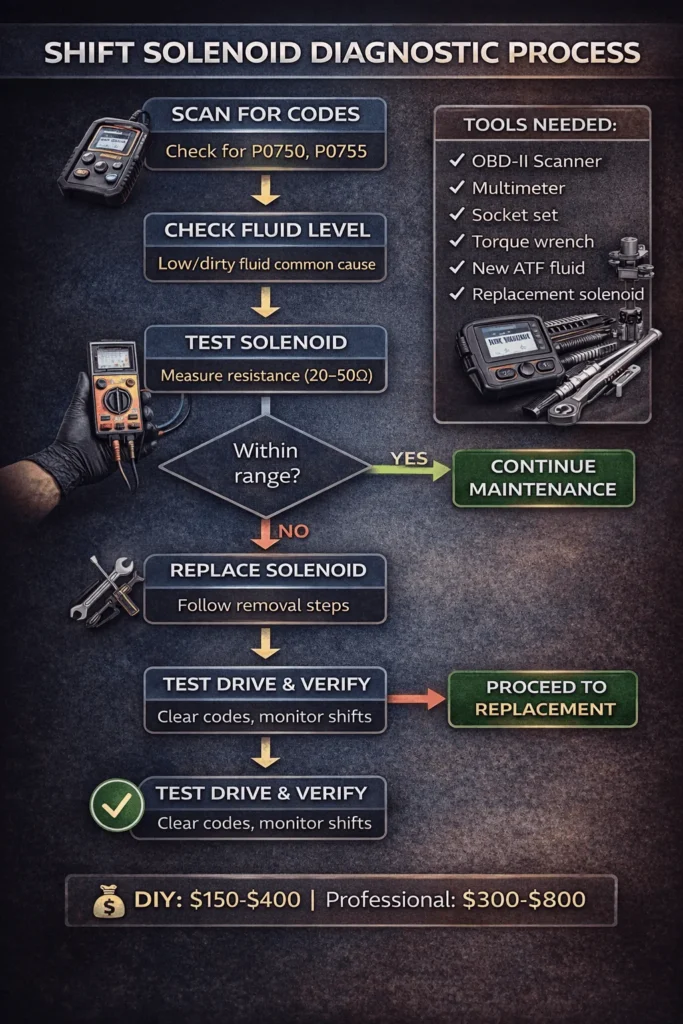
Such DTCs as P0750 (Shift Solenoid a Malfunction) or P0755 (Shift Solenoid B) usually verify the troubles with the help of an OBD-II scanner. Shift solenoid issues are often caused by low or contaminated transmission fluid and always check fluid levels before.
Shift Solenoid vs. Related Components: A Quick Comparison
Not all solenoids are created equal. Here’s a table comparing key types for clarity:
| Solenoid Type | Primary Function | Location | Common Failure Signs | Avg. Replacement Cost (USD) |
| Shift Solenoid | Controls gear shifts via fluid pressure | Transmission valve body | Harsh shifts, limp mode | $200–$600 (parts + labor) |
| Shift Interlock Solenoid | Locks shifter in Park without brake | Shifter assembly | Can’t shift out of Park | $150–$400 |
| VVT Solenoid | Adjusts valve timing for engine efficiency | Engine cylinder head | Rough idle, reduced power | $100–$300 |
| Gearbox Solenoid (General Term) | Broad term for transmission solenoids | Valve body | Slipping gears, fluid leaks | Varies by vehicle |
This breakdown highlights why misdiagnosing a shift solenoid issue as a VVT solenoid problem can lead to unnecessary engine work.
Diagnosing and Replacing a Faulty Shift Solenoid
The diagnosis begins by scanning the codes and providing a visual inspection. Provided, it can be confirmed, replacement of the transmission solenoid is an easy task, though it demands transmission skills.
Replacement Process in Steps
- Collect equipment and components: OEM or aftermarket quality shift solenoid kit, new ATF fluid, torque wrench.
- Remove the transmission pan: de-fluid and take the pan to value body.
- Find and verify solenoids: Measure resistance with a multimeter (usually 20-50 ohms); substitution of defective solenoids.
- Refill: Torque bolts to spec, fluid addition and clear codes.
- Test drive: Scan and watch DTCs. The installation of a replacement transmission solenoid will cost between 300 and 800 in various parts and labor depending on the vehicle (e.g. a Honda Civic) versus a Ford F-150). DIYers are able to save 200+ dollars, whereas professionals suggest it on complex transmissions.
Prevention tips:
- Change transmission fluid after every 30,000-60,000 miles.
- Do not drive aggressively stressing the valve body.
- Fit auxiliary transmission cooler in hot climates.
Conclusion
The unsung hero of the automatic transmission is the shift solenoid, which determines whether one is making a daily commute or a highway haul. Recognizing transmission solenoid symptoms, learning comparisons such as shift interlock solenoid or VVT solenoid, and proactively addressing the transmission solenoid replacement cost can help you have a long life of your gearbox and prevent the hassle of being by the side of the road. Maintenance is your security, and you should not wait till you see that check engine light.
For more information on keeping your vehicle in top condition, explore our car maintenance checklist and learn about other critical components like the ignition coil and camshaft position sensor. If you need quality replacement transmission components, visit Tagore Auto Parts for OEM and remanufactured transmissions. Ready to check your ride? The codes can be scanned nowadays or rely on a credible mechanic.
Frequently Asked Questions
Is it possible that a defective shift solenoid can damage my transmission?
Yes, it overheats with long use, clutches wear out and require full rebuilds of over 2,000 above.
How do you distinguish between a shift and a transmission solenoid?
They are usually interchangeable; “shift solenoid” is used to define the types of gear-shifting in the larger class of “transmission solenoid” category.
What is the duration of a shift solenoid?
100,000-150,000 miles with adequate maintenance, but few do not last that long because of nasty fluid.
Warranty on replacement of solenoid of shift?
Yes many times on powertrain warranties (5-10 years/100,000 miles); see your warranty.