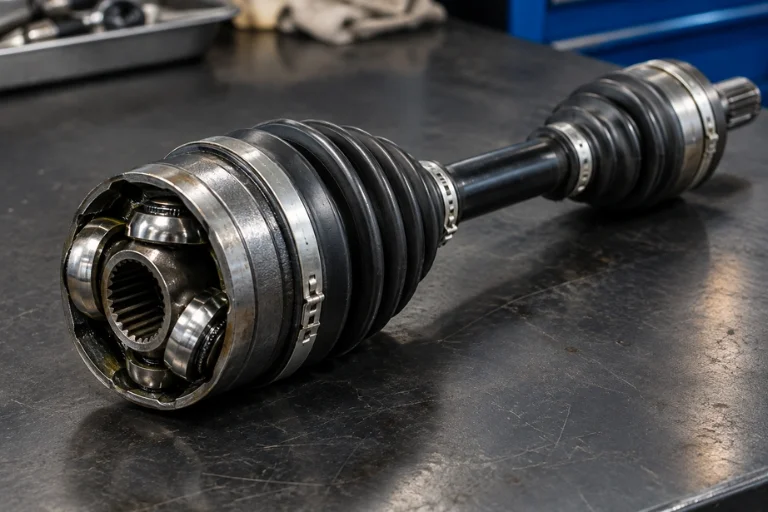
Is your car making a clicking noise or have you noticed a grease splattered near your wheels than there can probably a chance your CV axle needs a serious attention. The CV axle is one of the most important yet often overlooked sign that most of the car enthusiasts often miss. The CV Axle is one of the most crucial component of your car that transfers power from our transmission to your wheels while allowing smooth suspension and easy steering. In this blog we will cover everything you need to know about what does a CV joint do to What is the CV joint repair cost, so that you can make informed decision about your car’s maintenance.
What Is a CV Axle and What Does a CV Joint Do?
A CV axle (constant velocity axle) is a drive shaft featuring CV joints at both ends, one end connects to the transmission (inner joint) and the other to the wheel hub (outer joint). The design of the constant velocity joint allows the axle to transmit power at a constant speed, regardless of the angle created by suspension movement or steering. If you are wondering what does a CV joint do? The answer to this is it allows the axle to flex and bend while maintaining a constant speed allowing the wheels to move left or right and move up and down without power delivery.
The CV axle works in direct partnership with the transmission and engine to deliver smooth power to the wheels — meaning any failure in the CV system puts immediate stress on surrounding drivetrain components. For vehicles where CV axle failure has caused broader drivetrain damage, Tagore AutoParts stocks a full range of used engines for popular makes and models across the USA to support complete mechanical restorations.
Common Symptoms that your CV Joints Going Bad
Catching a failing CV joint early can mean the difference between a simple cv joint refurbishment and a full cv axle replacement. Watch for these warning signs:
- Clicking or popping noises when turning, especially at low speeds
- Grease splatter on the inside of the wheel or along the underside of the vehicle
- Visible cracks or tears in the rubber CV boot
- Vibration that increases with acceleration or speed
- While shifting gears or when shifting from reverse to drive you can hear a clunking sound
- Excessive play in the axle when the wheel is lifted and wiggled
In case if you find any of the symptoms occurring than there can be a possibility that your CV joints are going bad, it’s best to have a mechanic inspect the axle before it fails completely. For front-wheel-drive and all-wheel-drive vehicles where CV axle failure places additional stress on the transmission output shaft and differential, Tagore AutoParts carries dependable used transmissions for a wide range of makes and models at competitive prices nationwide.
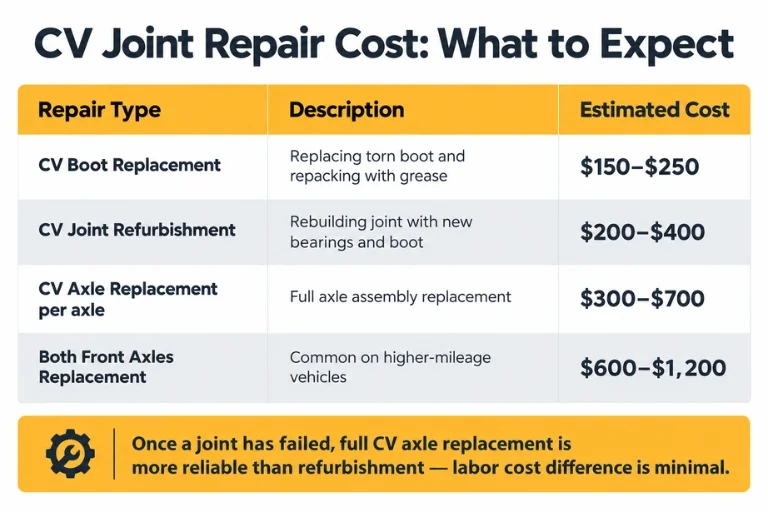
CV Joint Repair Cost: What to Expect
One of the most common questions drivers ask is about the price to fix cv joint issues. Costs vary depending on whether you’re repairing the boot, refurbishing the joint, or replacing the entire axle assembly.
| Repair Type | Description | Estimated Cost (Parts + Labor) |
| CV Boot Replacement | Replacing torn boot and repacking with CV joint grease | $150 – $250 |
| CV Joint Refurbishment | Rebuilding the joint with new bearings and boot | $200 – $400 |
| CV Axle Replacement (per axle) | Full axle assembly replacement | $300 – $700 |
| Both Front Axles Replacement | Common on higher-mileage vehicles | $600 – $1,200 |
CV Joint Refurbishment vs. Full Axle Replacement
Many drivers wonder whether it’s more cost-effective to refurbish a CV joint or replace the entire axle. Here’s how to decide:
- Choose refurbishment if: The boot has just torn, damage is minimal, and the joint itself is intact with no excessive play or noise.
- Choose full replacement if: The joint has been running dry for an extended period, there is visible pitting or metal-on-metal wear, or the axle shaft itself is bent or damaged.
- Consider cost: Refurbishment is often cheaper upfront but may not last as long as a new axle assembly, especially on older, high-mileage vehicles.
Most professional technicians recommend a full cv axle replacement rather than refurbishment once a joint has failed, since the labor cost difference is often minimal but the reliability of a new unit is significantly higher. For Honda Accord and front-wheel-drive sedan owners where CV axle replacement is one of the most common high-mileage repairs, Tagore AutoParts stocks used Honda Accord engines for drivers whose inspection has revealed engine wear alongside drivetrain component failure.
Preventive Maintenance Tips
- Make sure to inspect CV boots regularly for cracks, especially during the oil changes.
- Make sure to avoid driving through deep puddles or off-road conditions as this can damage boots.
- Replace torn boots immediately to prevent grease loss and contamination.
- During inspection have your mechanic check axle play.
- Notice if any you could hear any unwanted sound or vibration.
For Nissan Altima and front-wheel-drive car owners where CV axle wear is particularly common due to the transverse engine layout placing constant load on the inner joints, Tagore AutoParts also stocks used Nissan Altima engines for drivers whose comprehensive inspection has revealed mechanical wear beyond the axle system alone.
Conclusion
Your CV axle plays a crucial role in delivering a smooth and optimal performance. Ignoring the early warning symptoms can lead to unwanted tension and costly repairs. One of the most crucial and often overlooked component of your vehicle is the CV axle. This component ensures you to maintain smooth and optimal performance. So, if you are dealing with a CV boot repair or a complete CV axle replacement, taking a quick action can be helpful. If you are listening to a clicking sound, feel unusual vibration, grease around the axle — always make sure to take your car to a nearby trusted mechanic. Figuring out these problem can help you save from costly repairs and major faults.
For all your vehicle drivetrain needs — from CV axle components to complete used engines and transmissions — trust Tagore AutoParts, your reliable autoparts supplier serving customers nationwide.
Frequently Asked Question
How long does a CV axle last?
Most CV axles might last from up to 70,000 miles to 130,000 miles but with proper protective rubber boots that can remain intact.
Can I drive with a bad CV joint?
No, it is not considered to be safe to drive your vehicle with a bad CV joint as it can lead to complete failure that can lead to loss of power to the wheels or even separation of the axle.
Should I replace the CV axle or just the boot?
Generally, it is recommended to exchange the entire CV axle if your vehicle is making a clicking noise or has been exposed to dirt.
Do both CV axles need to be replaced at the same time?
Unless both shows some sign of failure or damage it is not necessary to replace it at the same time.