Table of Contents
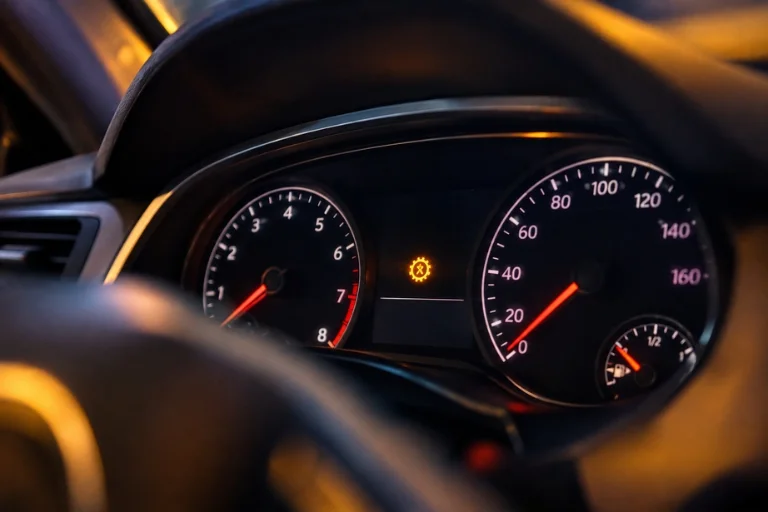
Are you frustrated seeing your EPC light illuminating on your dashboard? Or are you irritated seeing your vehicle suddenly lose power, idle roughly, or become difficult to accelerate? Well, this might seem like a simple warning light, but the EPC system is connected to several important electronic components that help control throttle response and engine performance. There are several factors responsible for triggering the warning light. In this guide we’ll explain what the EPC light means, the common causes behind it, and the symptoms you need to watch for before diagnosing this problem.
What Does the EPC Light Mean?
EPC stands for Electronic Power Control, the system that manages your car’s “drive-by-wire” throttle. Instead of a physical cable connecting your gas pedal to the engine, a sensor reads pedal position and sends that signal electronically to the Engine Control Unit (ECU). The ECU then commands a small electric motor inside the throttle body to open or close, controlling airflow into the engine.
When the EPC light Volkswagen or Audi models is displayed, it means the ECU has detected a discrepancy somewhere in this electronic chain between what the driver is requesting and what the throttle system is actually doing. To protect the engine and transmission, the car automatically triggers “limp mode,” a safety mode that limits power until the issue is diagnosed.
When repeated limp mode events go unresolved and the underlying EPC fault causes sustained engine stress, repair bills on Volkswagen and Audi platforms can escalate rapidly. For VW and Audi owners whose engine has sustained damage from prolonged limp mode or related misfires, Tagore AutoParts stocks a wide range of used engines for popular makes and models across the USA as a cost-effective alternative to a full engine rebuild.
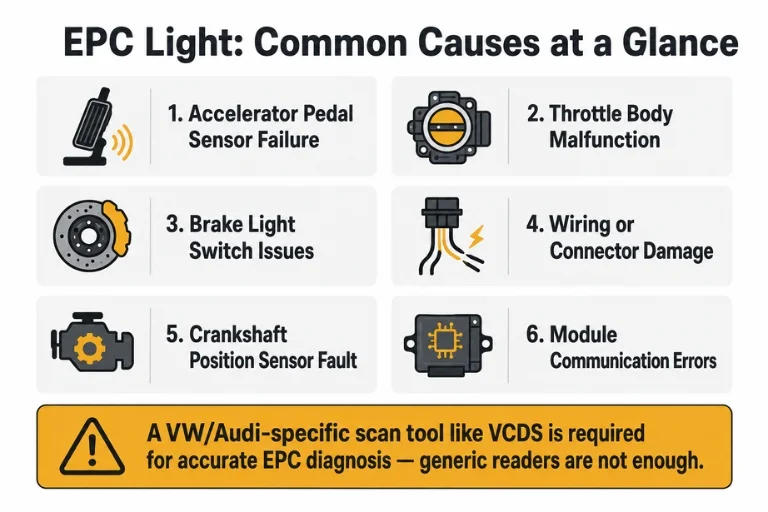
Common Causes of the EPC Light
The EPC warning can be triggered by several different failures within the same electronic network:
- Accelerator pedal sensor failure – sends inaccurate signals to the ECU
- Throttle body malfunction – internal wear, carbon build-up, or motor failure
- Brake light switch issues – a surprisingly common trigger, since the ECU cross-checks brake and throttle signals
- Wiring or connector damage – corrosion or loose connections interrupt communication
- Crankshaft position sensor faults – disrupts engine timing data
- Module communication errors – lost communication between the ECU, throttle body, or ABS module
Which VW and Audi Models Are Most Affected?
The EPC light is not limited to one model. It’s tied to drive-by-wire technology used broadly across turbocharged, direct-injection (TSI/TFSI) engines from the mid-2000s onward, since these engines depend heavily on precise electronic throttle control.
| Brand | Commonly Affected Models |
| Volkswagen | Jetta, Passat, GTI, Golf, Tiguan, Atlas |
| Audi | A3, S3, RS3, A4, S4 (B7/B8), A6, A7, Q5, SQ5, Q7, TT |
Hot climates can accelerate wear on wiring harnesses and electronic connectors, which is why EPC faults tend to show up more frequently as vehicles age in warmer regions. For Audi and VW owners whose DSG or automatic transmission has also been stressed by repeated limp mode events — which restrict shift points and place additional load on the gearbox — Tagore AutoParts carries dependable used transmissions for a wide range of European and domestic platforms at competitive prices nationwide.
Symptoms to Watch For
Beyond the dashboard light itself, an EPC fault usually comes with noticeable drivability issues:
- Reduced power (limp mode) – the car may not rev past 2,500–3,000 RPM
- Rough or unstable idle – shaking, stuttering, or erratic RPM
- Additional warning lights – Check Engine and ESC/ASR lights often appear together with EPC
- Stalling – in more severe cases, the engine may stall or struggle to restart
How Is the EPC Light Properly Diagnosed?
A generic code reader often isn’t enough to pinpoint the real cause of an EPC light VW or Audi fault — a fault code points to a symptom, not necessarily the root problem. A proper diagnosis typically includes:
- Full system scan – using VCDS or an Audi/VW-specific scan tool to pull exact fault codes (e.g., P1545, P0221) and identify which module stored them
- Live data monitoring – checking real-time signals from the accelerator pedal and throttle body sensors to see if they respond smoothly and accurately
- Wiring and connector inspection – checking the harness for corrosion, damage, or loose connections
- Component testing – directly testing the throttle body motor or brake light switch output
Skipping straight to parts replacement without this process often leads to repeat repairs and wasted money. For Audi A5 and RS3 owners whose EPC diagnosis has confirmed engine damage that makes replacement more economical than repair, Tagore AutoParts stocks used Audi RS3 engines to support complete engine restorations at a fraction of the dealership cost.
What Does a Typical EPC Repair Involve?
Once the root cause is confirmed, the repair usually follows these steps:
- Replace the faulty component – most often the throttle body, a sensor, or the brake light switch
- Clean the intake – carbon build-up around the throttle plate is addressed during throttle body replacement
- Perform throttle body adaptation – the ECU must “relearn” the new throttle’s fully closed and fully open positions using a scan tool; skipping this step often causes the EPC light to return
- Clear fault codes and test drive – confirming the issue is resolved and the light doesn’t reappear under normal driving conditions
For Audi S4 and A4 owners whose throttle body replacement jobs have also revealed broader engine wear on the high-mileage 2.0T or 3.0T platform, Tagore AutoParts stocks used Audi S4 engines as a reliable and cost-effective engine swap solution.
Final Thoughts
An EPC light Volkswagen or Audi owners encounter is your car’s way of flagging a real problem in the electronic throttle system — not something to ignore. Left unaddressed, it can lead to more expensive damage down the road. If your EPC light comes on, have it scanned and diagnosed by a specialist familiar with VW and Audi electronics rather than relying on generic code readers. A proper diagnosis and repair, including throttle body adaptation where needed, is the only reliable way to restore full performance and keep the warning light off for good.
For all your VW and Audi parts needs — from throttle system components to complete used engines and transmissions — trust Tagore AutoParts, your reliable autoparts supplier serving customers nationwide.
Frequently Asked Questions
Can I drive with an EPC light on?
No, it is not recommended to drive a car with an Electronic Power Control (EPC) light on, as it might lead to severe driving risk, engine damage, and sudden stalling.
Can low oil cause EPC?
Yes, low oil or low oil pressure can allow the EPC light to illuminate in vehicles like Volkswagen and Audi.
Is an EPC warning serious?
Yes, an EPC warning light is often considered serious and indicates that your car’s throttle system has found fault in the throttle system, engine sensors, or related electronics.
How will a car act if it’s low on oil?
Low oil levels strip the engine of its lubrication. This causes metal parts to rub together with high friction, which illuminates the yellow light.