Table of Contents
There is a specific sound that makes every driver think what has gone wrong. A high-pitched squeal from under the hood, usually right when you’re pulling out of the driveway. Nine times out of ten, that noise is coming from the drive belt system, and more specifically, from a tensioner that’s on its last legs. Learning how to change car belt yourself isn’t just a way to save a couple hundred bucks — it’s genuinely useful knowledge, the kind that means you’re not standing on the side of the road wondering what just happened.
Why the Tensioner Does More Work Than People Realize
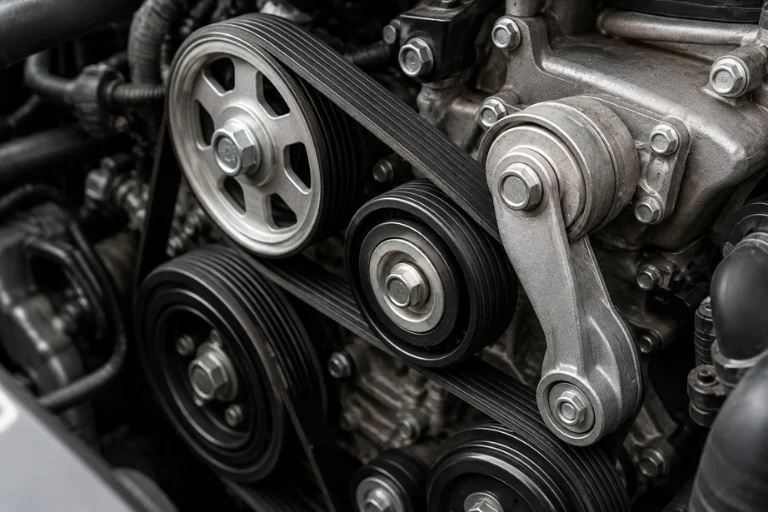
Most cars built in the last couple decades use one long serpentine belt to run a handful of components off a single loop — the alternator, the power steering pump, usually the water pump, and the AC compressor too. That belt only works because something is constantly pulling it tight. That’s the tensioner pulley’s whole job. It’s a spring-loaded pulley that keeps pressure on the belt no matter how much the engine shakes or heats up while you’re driving.
When a tensioner starts to go, you don’t always get a dramatic failure right away. Sometimes it’s just a little play in the pulley, or a faint wobble you can feel if you touch it while the engine’s idling. Left alone long enough, though, a bad tensioner will let the belt slip, squeal, or in the worst case, come off the pulleys entirely — and losing that belt means losing your power steering and your charging system in one shot.
A failed serpentine belt that takes out the water pump can lead to rapid overheating and serious internal engine damage in a very short time. For vehicles where belt-related overheating has already caused head gasket failure or deeper engine damage, Tagore AutoParts stocks a full range of used engines for popular makes and models across the USA.
Signs Your Belt (or Tensioner) Is on the Way Out
A few things to watch for:
- Squealing on cold starts, or when you hit the gas
- Cracking, fraying, or a shiny “glazed” look on the belt itself
- A pulley that rattles or wobbles when you look under the hood
- Battery or power steering warning lights
- The AC or power steering suddenly feeling weak
- Wear marks on the smaller pulleys the belt runs over
One of these on its own might not mean much. Two or three together, and it’s worth popping the hood for a closer look.
Belt, Pulley, Tensioner — What’s Actually the Difference?
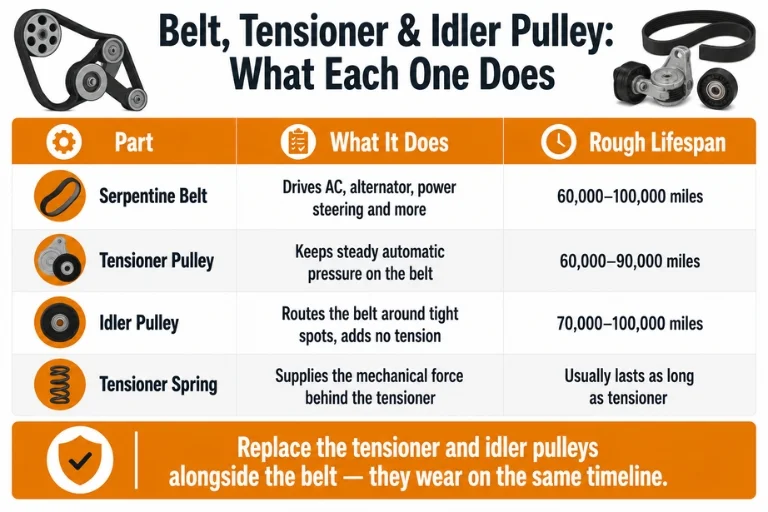
People throw around “serpentine belt” and “drive belt” like they’re different things, but they’re really the same part — one continuous belt snaking around every accessory pulley in the engine bay. Where things get confusing is the hardware that keeps it tight, since that setup varies a fair bit by make and model.
| Part | What it does | Rough lifespan |
| Serpentine belt | Drives the AC, alternator, power steering, etc. | 60,000–100,000 miles |
| Tensioner pulley | Keeps steady pressure on the belt automatically | 60,000–90,000 miles |
| Idler pulley | Routes the belt around tight spots (no tension added) | 70,000–100,000 miles |
| Tensioner spring | Supplies the mechanical force behind the tensioner | Usually lasts as long as the tensioner does |
Because all of these wear out on roughly the same timeline, a lot of mechanics will just replace the tensioner and idlers along with the belt rather than waiting for each one to fail on its own schedule. It’s a bit more upfront cost, but it saves you from doing the job twice. For trucks and SUVs where belt and tensioner jobs frequently coincide with transmission fluid service intervals, Tagore AutoParts carries dependable used transmissions for a wide range of makes and models to support complete drivetrain maintenance at competitive prices.
Steps to Change a Car Belt
This is a job plenty of people handle in a driveway on a Saturday. Roughly, here’s how it goes:
- Find the belt routing diagram — it’s usually a sticker somewhere under the hood, or in the owner’s manual if the sticker’s worn off.
- Release tension using a breaker bar or a dedicated tensioner tool, turning it the direction the diagram shows.
- Once the tension’s off, slide the old belt free of the pulleys.
- While it’s off, spin each pulley by hand and feel for roughness or looseness — that’s your chance to catch a failing idler before it strands you later.
- Route the new belt exactly as shown in the diagram (this step trips people up more than any other).
- Let the tensioner ease back into place slowly so the belt seats naturally.
- Start the engine and listen. It should be quiet.
If you’re working on something like a 2006 Honda Civic, expect to pull a splash shield or an engine mount brace out of the way to get at the tensioner pulley — access varies enough between models that it’s worth glancing at a model-specific guide before you start pulling things apart. For Honda Civic owners whose belt inspection has also revealed broader engine wear beyond the accessory drive system, Tagore AutoParts stocks used Honda Civic engines as a reliable and cost-effective replacement solution.
Should You DIY It or Call a Shop?
Plenty of people do it themselves without facing any issue. Consider calling a shop when:
- Your engine bay is cramped and there’s barely room to work
- The tensioner is bolted into the same assembly as other parts
- You don’t have a torque wrench for putting bolts back to spec
- The idea of working around a running engine makes you nervous
Shops typically charge somewhere between $150 and $400 for this, depending on the car and whether the pulleys and idlers get swapped at the same time.
Picking a Decent Replacement Tensioner
Not every tensioner on the market is built the same. It’s tempting to grab the cheapest one in stock, but the springs in budget aftermarket parts are often weaker than OEM spec, and that shows up fast as premature belt wear or the same squeal coming right back.
Worth checking for:
- Sealed bearings (they hold up better over time)
- Spring tension that actually matches OEM specs
- Some kind of corrosion resistance on the housing
- Confirming fit by VIN or part number, not just “should fit”
For Chevy Silverado and full-size truck owners where serpentine belt and tensioner replacement is a regular high-mileage maintenance item, Tagore AutoParts also stocks used Chevy Truck Silverado 3500 engines for drivers whose belt inspection has revealed deeper engine wear worth addressing at the same time.
Conclusion
A squealing belt can be annoying sometimes, but it is also one of the more forgiving problems a car can throw at you — catch it early and it’s a cheap managed fix. Wait too long and you are looking at a stranded car and a much bigger bill. Whether you end up doing the job yourself or handing it to a shop, it’s worth checking the belt, the tensioner and the idler pulleys before that squeal turns into something worse.
For all your vehicle parts needs — from belt system components to complete used engines and transmissions — trust Tagore AutoParts, your reliable autoparts supplier serving customers nationwide.
Frequently Asked Questions
How often should I change my car belt?
Generally it is recommended to change the car belt between every 60,000 to 100,000 miles.
Can you replace a car belt yourself?
Yes, along with proper guidance and knowledge, you can replace your car belt on your own.
How much does it cost to change belts on a car?
Generally, the cost to change a car belt might range around $100 to $2,000+, depending entirely on whether you are replacing an exterior drive belt or an internal engine timing belt.
How do I know if my belt needs replacing?
If you are hearing a squealing sound and can see visible cracks and are experiencing system failure like hard steering or an overheating engine, then you must know your belt needs replacing.