
Table of Contents
Imagine cruising through the highway and suddenly a car in front of you gets stop. Before any further do your car immediately applies brakes and slows down helping to minimize or prevent any mishap from occurring. However, the AEB in your car is stand in there as one of the most advanced feature combined with active safety technology designed to help drivers to avoid the severity of collisions.
The AEB uses a blend of camera, radar and in some cases LIDAR sensors to continuously monitor the road ahead without causing further inconvenience. Unlike tradition brake system, The AEB can intervene on its own by slowing down the vehicle or bringing it to complete stop without letting the driver do his job.
Whether you’re searching for quality used engines for sale or trying to understand the safety tech built into your vehicle, knowing how AEB works is essential for every driver on American roads. As one of the most trusted autoparts suppliers across the USA, Tagore AutoParts is here to break it all down for you.
Knowing What is AEB and How Does It Work?
Taking a look at what Automatic Emergency Braking is and how does it work, first let us understand that Automatic Emergency Braking is an advanced Safety technology that helps prevent or minimize collisions. This advanced safety feature is also known as the Autonomous Emergency Braking, uses the blend of cameras, radar and LIDAR sensors to detect and scan the road ahead making it save for other vehicles and obstructions occurring. If the system senses if there is any potential without the driver noticing it first, it automatically slows down the vehicle and applies automatic brakes to bring the car to halt.
Unlike the traditional brake assist systems, which only activate braking when the driver presses the brake pedal, whereas the AEB takes action in the absence of driver emerging as one of the most crucial safety feature in the advanced automobile world.
Types of AEB Systems
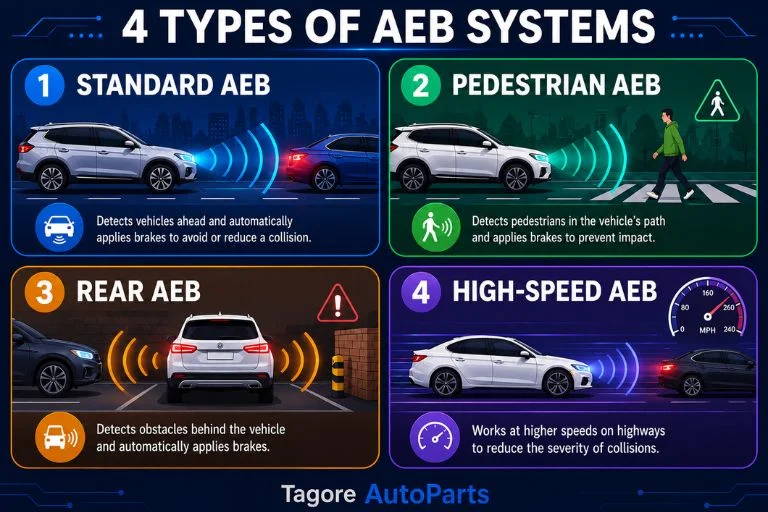
Not all AEB systems are the same. Here’s a breakdown of the main variants available on modern vehicles:
| AEB Type | What It Does | Speed Range |
| Standard AEB | Detects vehicles ahead and auto-brakes to prevent/reduce collision | City (<55 mph) or Highway (>55 mph) |
| AEB with Pedestrian Detection | Detects pedestrians and cyclists in the vehicle’s path | Up to 45 mph (NHTSA standard) |
| Rear AEB | Prevents collisions while reversing | Low speed / parking |
| High-Speed AEB | Full braking capability on highways | Up to 90 mph (impact reduction) |
Understanding which type is fitted to your vehicle matters, especially if you’re replacing a damaged sensor assembly or ECU after a collision. As a go-to autoparts dealer serving customers across the USA, Tagore AutoParts stocks the components that keep these safety systems running.
Why Automatic Emergency Braking Matters: The Data Behind the Technology
The Insurance Institute for Highway Safety (IIHS) reports that cars with AEB/FCW have half the number of rear-end crashes. New NHTSA regulations that will become fully effective Sept. 2029 include all of the following:
- Smoothing vehicle stops to protect against collisions at speeds up to 65 mph
- Ability to reduce impacts up to 90 mph
- Day and night pedestrian detection up to 45 mph
The projected outcome? More than 24,000 injuries prevented and more than 360 lives saved each year in the U.S. alone.
When a collision does happen despite AEB systems, it often means significant engine or transmission damage. That’s where having access to a reliable used engine for sale or a quality used transmission for sale can save you thousands in repair costs. Browse our full inventory at Tagore AutoParts Shop.
What Makes a Good AEB System?
The ideal Automatic Emergency Braking system is one that drivers don’t even realize is working until they have to. A strong automatic emergency braking system should be:
- Correctly classified without false activation (phantom braking)
- Able to respond to both city and highway speeds
- Can see pedestrians and cyclists as well as vehicles
- Works in poor light and bad weather
- Enhanced by brake assist for increased stopping power
Even the most advanced Automatic Emergency Braking will not always work. Dirt, glare, heavy rain or snow can impair camera and sensor functions. Drivers should use AEB to ensure safety as a precautionary measure instead of relying on it to replace careful driving.
A damaged ECU or faulty wiring can also disable your Automatic Emergency Braking system without warning. If your AEB warning light is on, it may be time to inspect your ECU or wiring harness — both available through Tagore AutoParts.
For a deeper technical understanding of your engine’s role in collision recovery, check out our blog on Signs of a Blown Motor and learn how to spot damage early.
Automatic Emergency Braking by Brand: Common Names to Know
Automakers market Automatic Emergency Braking under many different names. Here are some of the most recognizable:
| Manufacturer | AEB System Name |
| Toyota / Lexus | Pre-Collision System (TSS-P / LSS+) |
| Honda / Acura | Collision Mitigation Braking System (Honda Sensing) |
| Subaru | Pre-Collision Braking — Eyesight |
| Ford / Lincoln | Pre-Collision Assist with AEB (Co-Pilot360) |
| Hyundai / Kia | Forward Collision Avoidance Assist |
| Volvo | City Safety |
| Volkswagen | Front Assist with Pedestrian Monitoring |
| Mercedes-Benz | Active Braking Assist |
Due to a voluntary industry commitment, nearly all new vehicles sold after September 2022 include AEB as standard equipment across all trim levels — not just premium packages.
Interested in safety tech across different systems? Our blog on Electronic Stabilization Program (ESP) is a great companion read — another critical active safety system explained in plain English.
How Does Brake Assist Work with Automatic Emergency Braking?
Brake assist increases brake pressure when the driver applies strong braking force. It operates in conjunction with AEB: when automatic braking is activated, brake assist applies the brakes to the greatest extent. This combination dramatically cuts stopping distances compared to either system working alone.
If you drive a vehicle like the 2015 Jeep Patriot or a Chevy Silverado 3500, understanding the braking chain — from the Automatic Emergency Braking module to the brake system — can help you prioritize maintenance that protects both your car and your safety.
For issues related to ECM failures that can affect braking systems, read our detailed guide on Symptoms of a Bad ECM.
Conclusion
The Automatic Emergency Braking has changed the way how modern vehicle enthusiasts look at safety where every second counts. Whether it’s detecting a vehicle that suddenly stops ahead, or identifying the pedestrians crossing the road, it reduces the chances of collision and crash. Automatic Emergency Braking has become a key solution to safer roads globally as more vehicles come along with the technology as standard equipment and safety regulations evolve.If you’re looking for your next vehicle part or recovering from a collision that overwhelmed your AEB system, Tagore AutoParts is your go-to trusted autoparts supplier and autoparts dealer across the USA. From used engines for sale to used transmissions for sale, we’ve got you covered nationwide.
Frequently Asked Question’s
Are AEB and ABS the same?
The ABS allows the driver to stop over less distance in adverse braking situations whereas the AEB is an automatic detection and braking system that can help drivers avoid collisions.
Is it possible to avoid every accident with AEB?
No, it is not possible to avoid every accident with AEB as it can decrease the severity and likelihood of collisions, but it won’t completely prevent collisions.
Does AEB detect a collision at high speeds?
Depending on the system. There are some autonomous emergency braking systems that only work at city speed (under 55 mph). Under new NHTSA recommendations, the impact can be cut at up to 90 mph with high-speed Automatic Emergency Braking systems.
What is brake assist and how is it related?
When the driver applies strong brake pressure, brake assist increases the brake pressure. It operates in conjunction with AEB: if automatic braking is activated, brake assist applies the brakes to the greatest extent.
When will all new vehicles be required to have AEB?
By September 2029, all new passenger vehicles must comply with the new NHTSA rule that sets out a comprehensive performance standard for AEB.