Table of Contents
Whether you’re a new driver learning the basics or a seasoned road-tripper who spends hours on the highway, cruise control is a feature that can completely transform your driving experience. The purpose of cruise control is to help make long drives smoother, more comfortable and less tiring. But many drivers are still not fully aware of how it works, when they should use it, and how the new technology has progressed far beyond just speed control. In this guide we will explore everything you need to know from the basics of cruise control to the ways adaptive cruise control is making modern roads more convenient, efficient and safe.
What Is Cruise Control
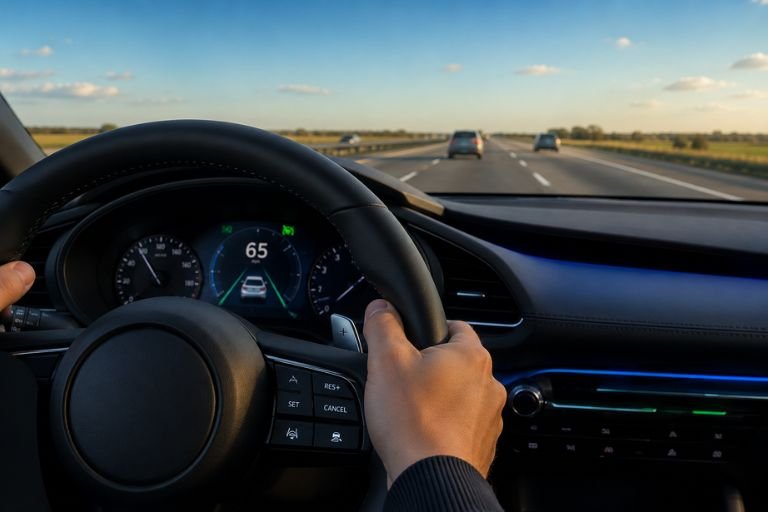
Cruise control is one of the most crucial features on your car that enables it to maintain constant speed without the need to hold on to the accelerator pedal. It takes over on the highways so that you can rest your foot. All controlled by the buttons on or near the steering console, making it easier for the drivers to pre-program, adjust, cancel and resume a set speed. As this feature is activated, the car keeps the set speed until you press the brake button, clutch button or cancel button.
Whereas some new cars might have a standard cruise control system that keeps a steady speed, or a more sophisticated system called Adaptive Cruise Control (ACC) that uses radar, sensors or cameras to automatically adjust the vehicle speed on traffic conditions and maintain a safe following distance.
Understanding cruise control connects naturally to understanding your vehicle’s engine and transmission. Just as knowing whether your car uses an automatic vs manual transmission affects how you engage and disengage the system, your drivetrain configuration determines how cruise control interacts with your vehicle’s power delivery. For a comprehensive look at how cruise control fits within your vehicle’s broader systems, the NHTSA’s official driver assistance technology guide provides federally-standardized safety information and recommended usage guidelines for all cruise control types.
How to Use Cruise Control?
Learning how to use cruise control is easy and most vehicles follow these steps:
- Increase speed to desired speed (usually greater than 25-30 mph).
- Hold the “SET” button on the steering wheel or stalk and that speed will be locked in.
- Foot off the gas — system takes over. Increase or decrease speed in small increments using “+” / “–” buttons.
- Use brake or clutch to immediately disengage the system.
- After a short period of slowdown, press “RESUME” to resume at the previous setting speed.
- A dedicated “CANCEL” button is also found in most modern vehicles to cancel cruise control without erasing the memory of the cruise control.
Using cruise control correctly requires your vehicle to be in good working order. A well-maintained engine and properly functioning throttle response are prerequisites for reliable cruise control operation. Following a thorough car maintenance checklist ensures your vehicle systems — including throttle, brakes, and sensors — respond correctly when cruise control engages and disengages.
Does Cruise Control Save Gas?
One of the most commonly asked questions drivers have is does cruise control save gas? The answer is absolutely Yes, with the caveat of the right conditions. By reducing the number of times you have to accelerate and decelerate, fuel efficiency will be improved by maintaining a steady speed. In normal driving conditions, such as on the flat on open road, using cruise control can increase fuel efficiency by 7-14% over manual operation. On hilly or winding roads, the system can sometimes over-accelerate in order to keep up with desired speed, potentially decreasing efficiency.
| Driving Condition | Cruise Control Fuel Impact |
| Flat highway | Improves fuel economy (7–14%) |
| Moderate hills | Neutral to slight improvement |
| Steep or winding roads | May reduce efficiency |
| Stop-and-go traffic | Not recommended |
The fuel-saving benefits of cruise control are closely tied to your engine’s efficiency profile. Understanding how many cylinders your car has helps explain why larger V8 engines benefit differently from cruise control compared to 4-cylinder engines — smaller engines must work harder to maintain set speeds on hills, reducing the fuel economy advantage in those conditions.
What Is Adaptive Cruise Control?
The traditional cruise control uses a set speed, while adaptive cruise control (ACC) goes the extra mile. But, what is adaptive cruise control? Adaptive cruise control relies on a combination of radar sensors positioned at the front of the car, cameras or lidar (laser sensors) and sometimes a combination of all three to see the distance and speed of the car in front of them. When a vehicle ahead of you slows down, the driver’s car will automatically adjust its speed to maintain a safe distance. The system recovers to your set speed once traffic has cleared. As soon as the traffic is cleared the system accelerates back to its current speed.
Adaptive cruise control has a number of features, such as:
- This is an automatic speed control device that adjusts speed in accordance with traffic volume.
- Many systems incorporate collision warning.
- Stop and go (in advanced variants — makes a full stop and resumes)
- Lane-keep systems in combination with lane centering assistance
The radar and sensor technology powering adaptive cruise control is closely related to the broader electronic safety ecosystem in modern vehicles. The Electronic Stability Control (ESC) system similarly uses sensors to monitor vehicle behavior and make real-time adjustments — both technologies represent the evolution of passive driving aids into active safety systems that work continuously in the background.
Dynamic Cruise Control: The Next Evolution
Dynamic cruise control is a further refinement that adjusts not only to the car in front but also to the road conditions, curves and speed limits (as detected by the GPS or recognising signs) along with weather data in the most sophisticated versions. This is sometimes mistaken for predictive ACC, as it detects up-coming topography and adjusts speed in advance of a hill or bend. Dynamic cruise control has evolved in a few high-dollar car brands, such as BMW, Mercedes-Benz and Tesla, toward near-autonomous highway technology, with it now offered in combination with lane keeping assist in a full driver assistant suite.
Dynamic cruise control systems in vehicles like BMW and Mercedes represent the pinnacle of technology-driven performance optimization. This parallels how modern car tuning uses ECU software to optimize engine parameters — dynamic cruise control essentially applies similar software-driven optimization to vehicle speed management, reading road conditions and adjusting outputs accordingly.
Adaptive vs. Standard Cruise Control: A Quick Comparison
| Feature | Standard Cruise Control | Adaptive Cruise Control |
| Holds set speed | Yes | Yes |
| Adjusts for traffic ahead | No | Yes |
| Radar/sensor technology | No | Yes |
| Stop-and-go capability | No | (Advanced versions) |
| Fuel efficiency benefit | On flat roads | Broader conditions |
| Availability | Most modern vehicles | Mid-range to premium vehicles |
Safety Considerations
Both cruise control and adaptive cruise control can be of great assistance, but they must be used responsibly:
- Do not use cruise control in heavy traffic, rain or on slippery road surfaces.
- Always be ready to react, adaptive cruise control is a driver assist feature, not an autonomous driving system.
- Keep in mind the time required to brake even when ACC is engaged.
- Please refer to your vehicle’s manual for calibration and limitations of the sensor.
Safe cruise control usage is part of broader responsible driving awareness. The rules of the road guide explains how traffic laws govern driver assistance features — including when cruise control must be disengaged, speed limit compliance requirements, and how adaptive systems interact with school zones and construction zone speed restrictions. Understanding these legal frameworks ensures your cruise control use remains both safe and lawful.
Conclusion
Cruise control has become one of the most sophisticated yet more crucial driving assistance technology in today’s motoring world. These technologies are changing the way modern motorists drive, whether they are looking to keep their speed steady on the highway or adjust to the speed of other cars around them with more adaptive and cruise control systems. Cruise control is all featured to help drivers navigate long distance with greater ease, comfort and efficiency by controlling vehicle speed. When used properly, cruise control can make driving longer distances smoother, less tiring and more efficient. Hence, adaptive cruise control is one of the fastest emerging key attributes that has made driving much safer and easier.
Frequently Asked Question’s
Is adaptive cruise control a way to prevent crashes?
Yes, adaptive cruise control (ACC) enables the driver and the passengers to stay safe by preventing lots of crashes, by automatically maintaining a safe distance.
Should you get an adaptive cruise control?
ACC provides additional safety and comfort for drivers who drive on the highway often or drive long distances daily. It is now a standard feature on many new, mid-range cars and is becoming more common.
Does using cruise control affect tyre wear?
No, cruise control does not even alter the throttle input / affect tyre wear in any significant way. The three main factors that have a big influence on tyre wear are braking, cornering and tyre pressure.
What are the disadvantages of cruise control in a car?
There are several disadvantages of cruise control in a car and this might include slower emergency braking reaction times, an extreme risk of drowsy driving and severe loss of traction control.
Is it safe to use adaptive cruise control in a traffic jam?
However, if your vehicle is equipped with a stop and go ACC system, you may not need to use the brake. These sophisticated editions cannot just bring the car to a halt, but they can also restart it back into traffic at low speeds. As a general rule, standard ACC will disengage at a certain predetermined speed.