Table of Contents
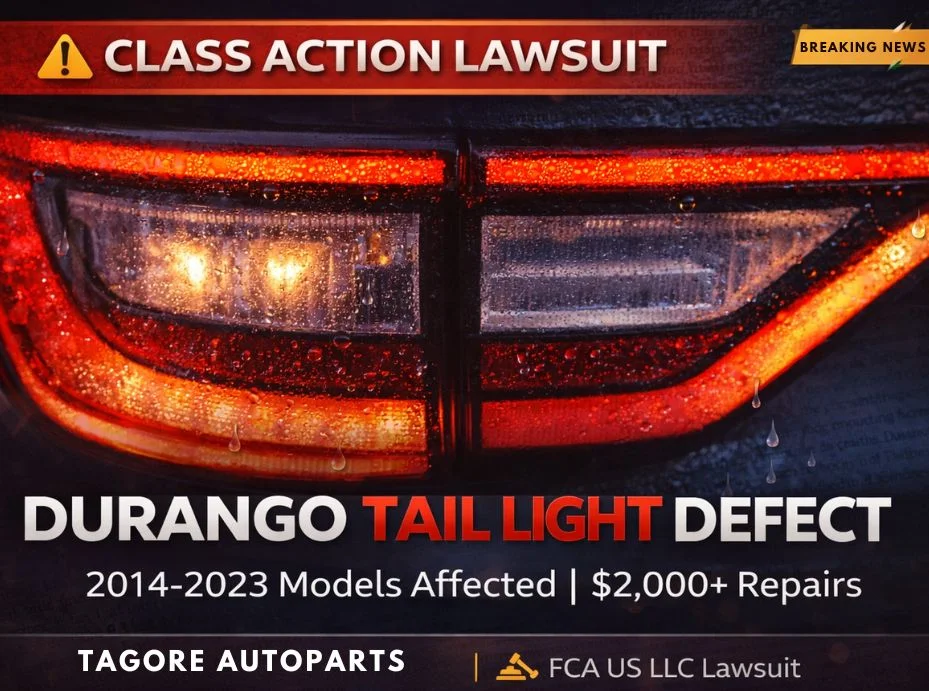
Many Dodge Durango owners have been left frustrated after discovering the fact that water can leak into SUV’s signature LED racetrack tail light. A class-action case Cranstoun, et al., V. FCA US LLC, claims this isn’t just a normal wear and tear, but a design problem. FCA US LLC is suing the manufacturer. The Durango racetrack tail light suit claims that there is an underlying flaw in sealing that lets moisture seep in the taillight assembly, which causes corrosion and electrical malfunctions as well as posing severe safety risks.
Repair bills exceeding $2,000 regularly and a jury trial set for January 25, 2027, in Delaware, victims should know what is going on, why, and what they should do about it immediately. This article is the in-depth analysis of the Dodge Durango tail light lawsuit since the mechanics of the fault up to the legal settlements in court that are underway so you are able to save your car and your wallet.
Affected Vehicles and the Scope of the Problem
Not all Durango model years or trim configurations are necessarily equal in their risk profile, but the lawsuit casts a wide net. The following table summarizes the key scope details as alleged in the complaint:
| Category | Details | Owner Impact |
| Affected Years | 2014–2023 Dodge Durango | Up to 10 model year cohorts |
| Defective Component | LED “racetrack” taillight assembly | Both left and right assemblies at risk |
| Root Cause (Alleged) | Inadequate sealing around taillight housing | Water entry in rain, car washes, snow |
| Failure Symptoms | Dimming, flickering, or total LED failure | Also affects license plate & backup camera lights |
| Repair Cost Range | Often $1,500 – $2,000+ per assembly | Replacement parts can also fail again |
| Legal Venue | U.S. District Court, Delaware | Jury trial scheduled January 25, 2027 |
The Safety Hazard: More Than an Inconvenience
It is quite evident that this is not just a beauty issue when it comes to the Dodge Durango tail light lawsuit. Taillights are safety systems that are required by the federal government. In case they fail, the consequences may be severe:
- Poor Rear Visibility: Traffic behind a Durango whose tail lights have broken may not get the required warning during braking or during changing lanes, which may result in rear collisions, especially when it is night or unfavorable weather.
- License Plate Light Failure: Non-functioning license plate lights constitute an instant traffic violation in all states of the U.S. and can result into law enforcement action and fines.
- Rearview Camera Interference: Water can tap into the taillight housing and interfere with wiring related to it, resulting in the factory backup camera not functioning, which is depriving a major safety aid when reversing.
- Short-Circuit and Fire Risk: Water that is built up in an energized electrical assembly presents the risk of short-circuit. Extremely, short circuiting of electrical parts in vehicles has been associated with fire on the vehicle. The Durango racetrack tail light plaintiffs argue that these cumulative risks are a real danger to the public safety, which the manufacturer should have known about and acted to prevent and not allow owners to find out about the issue on their own, at a personal cost.
What the Lawsuit Is Seeking
The plaintiffs in the Dodge Durango tail light lawsuit are pursuing several forms of relief through the courts. Primarily, they are seeking a mandatory recall of all affected 2014–2023 Durango models equipped with the racetrack LED taillight. Beyond a recall, the suit demands that FCA provide a genuine, permanent, and cost-free repair solution—not simply a replacement of the same defective assembly with an identically designed part.
Critically, the lawsuit also seeks full financial reimbursement for owners who have already paid out of pocket to address the taillight failures, including repair costs, diagnostic fees, and any related expenses. If the court certifies the class and plaintiffs prevail, potentially hundreds of thousands of Durango owners could be eligible for compensation. The case moving to a jury trial in January 2027 signals that neither side has reached a settlement, meaning the legal battle is very much active.
What Durango Owners Should Do Right Now
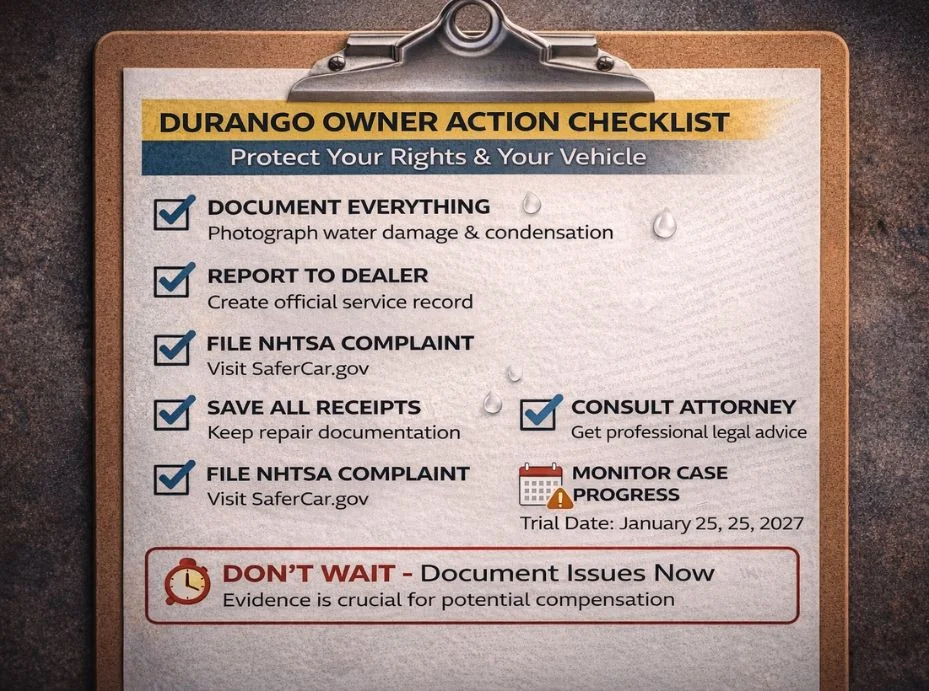
Regardless of whether you have gotten any symptoms yet, active measures can guard your interests in the context of the lawsuit about tail lights Durango racetrack:
Document everything: Take a picture of all the water, condensation or corrosion you see inside your taillight housing. Stamp images where feasible. Should the need to make a claim prove viable, visual evidence is useful.
If you are not willing to pay the costs of repairs, make an official record of the fault with your authorized dealership in Dodge. This creates a written record in the warranty and service system of FCA.
Use NHTSA Complaint: Submit a Vehicle Safety Complaint at safercar.gov (National Highway Traffic Safety Administration portal). The complaints received in NHTSA assist the regulators in following the trend of defects and may be used to initiate a mandatory recall.
Keep all Receipts: You should hold on to all invoices, receipts and work-orders in case you have already paid to get the taillight repaired or to get the diagnostics done. Such documents will be required in case the lawsuit will lead to a reimbursement program.
You could also speak to a Consumer Rights Attorney: This may be an attorney who deals with cases of automotive defect or lemon law and can advise you to become part of the class action or to leave the action and file individual claims or to just follow the proceedings.
Follow-up Case: As the trial will take place in January 2027, there may be major developments such as possible settlement talks in 2025 and 2026. Be updated with legal news and the case docket.
FCA’s Position and the Industry Context
At the point of writing, FCA US LLC (since operating under the Stellantis umbrella) has been challenging the claims of the lawsuit and had not recalled the cars concerning the taillight sealing in the racetrack. In the course of class-action litigation, automakers often defend themselves by saying that the so-called defects are not inherent, that ordinary wear and exposure to the environment contribute, or that warranty coverage provided by the seller is sufficient to respond to the claims made by owners.
The legal team of plaintiffs involved in the Durango racetrack tail light lawsuit, however, counters that the number of complaints that involves different model years and even those found on comparatively new vehicles are indicative of a systemic design or manufacturing flaw and not the individual cases. Other cases of similar litigations in the automobile industry have led to huge settlements. The cases of F-150 panoramic sunroof, different transmission, and many tailgate/seal failures have all led to billions of dollars in consumer reimbursements in the last decade, a clear-cut precedent by the courts that these kinds of suits are taken seriously.
Conclusion
The Durango racetrack tail light legal case went much more than a cosmetic frustration, that rose serious questions on the safety, protection of consumers and liability of manufacturers. The Cranstoun, et al., v. claimed made against the FCA US LLC is that the sealing error of Dodge Durango will allow moisture to enter the signature LED race track taillight, corrode and cause electrical failures and expensive repairs, which may lead to costly repairs that can exceed upto $2000 USD on each assembly.
As the case proceeds in the U.S. District Court for the District of Delaware and a jury trial will commence in January 25, 2027, the case result may dictate the reimbursement, a recall or a lasting solution to the problem affecting the owners.
No matter the outcome of the litigation, the suit is an excellent message to the automotive industry that widespread safety-related flaws will be subjected to legal scrutiny. The Durango owners, record keeping and maintaining records of repairs is still one of the things that they need to do in order to secure their car and their finances. If you’re facing electrical issues or need to replace defective components, consider using OEM-quality replacement parts to ensure proper fit and function.
Frequently Asked Question
What model years of Dodge Durango vehicles are subject to the racetrack tail light lawsuit?
The Durango racetrack tail light lawsuit includes the 2014-2023 model years of the Dodge Durango fitted with the continuous LED taillight of the racetrack. And, in case your car is within the years mentioned, you could become one of the members of the class. Test with a consumer attorney to determine your eligibility.
I must I have paid to have the repairs made to be included in the class action?
Not necessarily. The Dodge Durango tail light legal case can cover owners of the vehicle that have not yet paid to have the problem fixed and also those who have paid to get the problem fixed. Owners who have incurred out-of-pocket costs in repairing their vehicles might be in a good position to claim reimbursements, however.
What should I do in case the taillight was already changed in my Durango and had a failure?
Repeat failures are, in fact, one of the most pertinent claims in the Durango racetrack tail light litigation- replacement parts are themselves faulty and that they have the same design defect. Failure of the document repeats with dated photographs and retains all the invoices of the repairs since this type of failure is directly connected with the claims in the lawsuit.
What will be the date to settle the lawsuit?
Its jury trial is set to start on January 25, 2027. Nevertheless, the cases of the class-actions are often resolved out of court before trial is reached after discovery has been completed and all parties have evaluated their risk. There is a possibility although no certainty that a settlement might be announced prior to that date.
Is the cost of the class action participation?
Class-action suits are usually pursued on contingency basis where the members of the class do not pay any legal fees unless the case is won or settled. When you get the class action notice in the mail, do not rush and check carefully and seek the services of an attorney before the deadline to opt-in or opt-out.