Table of Contents
Few maintenance jobs cause as much confusion or as much sticker shock as timing belt replacement. If you are preparing for a future timing belt replacement or you’d like to better understand a timing belt replacement quote from your mechanic, it’s important to know the actual timing belt replacement cost to avoid overpaying and, more importantly, avoid damage to your engine. This article will explain car belt component replacement costs, symptoms and what to compare when it comes to car belts.
Why Timing Belt Replacement Matters
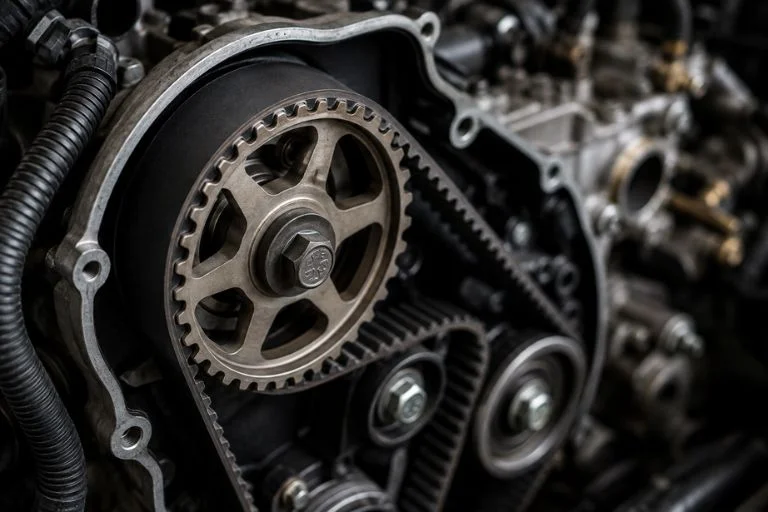
Your timing belt synchronizes the rotation of the crankshaft and camshaft, so that valves open and close at the proper time and place in relation to the pistons. When it snaps, particularly on an interference engine, the pistons are able to strike the valves, which can lead to the need for a complete rebuild or replacement of the entire engine. That’s why manufacturers are prescribing their replacement schedules and why it’s better business sense than car maintenance trivia to be aware of the replacement cost of the components before the event.
When a timing belt snaps on an interference engine and causes valve and piston damage beyond economical repair, engine replacement is often the most cost-effective path forward. Tagore AutoParts stocks a full range of used engines for popular makes and models across the USA — giving drivers a reliable alternative to a costly engine rebuild after timing belt failure.
Timing Belt Replacement Cost: A Realistic Breakdown
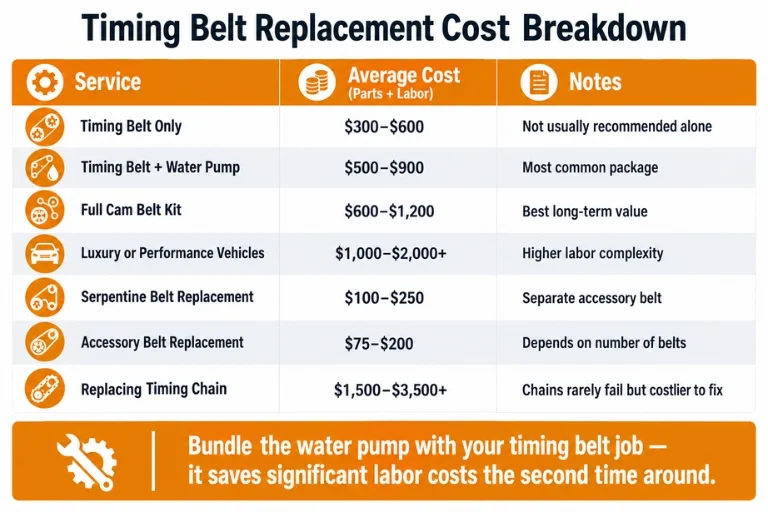
The cost of a timing belt replacement ranges from $500 to $1,000 for local SUV and $1,200 and $2,500 for luxury car models. While the belt is typically a $30 to $100 cost, most of the cost is for labor as mechanics are likely to take a number of engine components out of the way to reach the belt. In addition, other components like the tensioner, idler pulleys and water pump may be inspected or replaced during the replacement. In doing so, it will reduce the chances of further breakdowns and extra labor expenses in the future.
Many vehicles can suffer severe engine damage if the timing belt fails, so it is important to adhere to the manufacturer’s timing belt replacement schedule.
| Service | Average Cost (Parts + Labor) | Notes |
| Timing belt only | $300 – $600 | Not usually recommended alone |
| Timing belt + water pump | $500 – $900 | Most common package |
| Full cam belt kits (belt, tensioner, idlers, water pump) | $600 – $1,200 | Best long-term value |
| Luxury/performance vehicles | $1,000 – $2,000+ | Higher labor complexity |
| Serpentine belt replacement cost | $100 – $250 | Separate accessory belt |
| Accessory belt replacement cost | $75 – $200 | Depends on number of belts |
| Replacing timing chain cost | $1,500 – $3,500+ | Chains rarely fail but are costlier to fix |
These figures are general estimates — always get a written quote from a trusted mechanic for your specific make and model.
Timing Belt vs. Serpentine Belt vs. Timing Chain
These can be easy to confuse, but here’s a little clarification:
- Timing belt (cam belt): Internal, it synchronizes the crankshaft and the camshaft. It can result in serious engine damage.
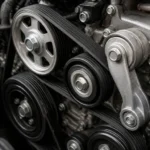
- Accessory belt/serpentine belt: External, powers the alternator, power steering pump and air conditioning compressor. The cost of replacing a serpentine belt is not as high and the consequences of failure are not as severe.
- Timing chain: A metal chain alternative to the rubber belt, will typically last the life of the engine but replacement costs are two to three times that of a belt job due to the time required to remove the timing chain.
For vehicles where a timing chain replacement job has revealed broader transmission wear at the same time — particularly in older high-mileage engines — Tagore AutoParts carries reliable used transmissions to support complete drivetrain restorations at competitive prices nationwide.
Common Cam Belt Symptoms to Watch For
Cam belt symptoms can become obvious and prevent an unexpected roadside breakdown or a blown engine. Watch for:
- A ticking or slapping sound from the timing cover of the engine.
- Misfires or rough idling for no apparent reason.
- When inspected, there should be no visible cracks, fraying or glazing of the belt.
- Oil leakage around the timing cover.
- Failure of the engine to start or of the crank to rotate whilst the camshaft does not turn.
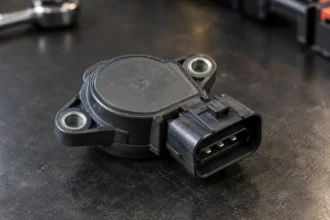
- Engine codes come from either the camshaft position sensor or the crankshaft position sensor.
- The check engine light is triggered by codes from the camshaft position sensor or the crankshaft position sensor.
Don’t wait — if you see any of these symptoms, make an appointment for inspection today. For Toyota and Honda vehicle owners where cam belt failure on interference engines is a well-documented risk, Tagore AutoParts stocks used Toyota Camry engines and other popular models for drivers whose timing belt failure has already caused internal engine damage.
What’s Included in Cam Belt Kits
One of the smartest methods to keep track of your timing belt replacement bill is to purchase complete cam belt kits instead of individual pieces. Most kits will contain:
- Any components of the timing belt system.
- Tensioner and idler pulleys.
- Water pump (most modern kits will have this).
- A new drive belt or crank seal sometimes is necessary.
When buying a kit, you know that all the parts that get worn will be replaced at once, lessening the likelihood of going back to the shop and the costs associated with it.
How Often Should You Replace Your Timing Belt?
The recommended mileage for replacing the belt varies by manufacturer, but is typically 60,000 to 100,000 miles. As with anything else, it is advisable to consult your owner’s manual because driving conditions, the weather and the engine design all impact the lifespan of your belt. Waiting too long is the biggest error that drivers make when attempting to save money on timing belt replacement cost — a broken timing belt will almost certainly cost much more than a replacement.
For Ford Escape and compact SUV owners where timing belt service is a commonly deferred maintenance item, Tagore AutoParts stocks used Ford Escape engines for drivers whose delayed belt replacement has resulted in engine damage requiring full replacement.
Tips to Manage Timing Belt Replacement Cost
- Obtain two or three quotes from a licensed mechanic before choosing a deal.
- Question the shop if they use OEM or high quality aftermarket cam belt kits.
- Bundle the water pump replacement so that you don’t end up paying for labor twice.
- Keep service records to be certain of the time when your belt was last replaced.
- Follow manufacturer service bulletins which could alter the intervals.
Conclusion
Knowing how much a timing belt replacement may cost is not only to do some budgeting — it’s to prevent unnecessary and costly damage to your engine. Once cam belt symptoms are noticed, opt for a quality cam belt kit, and follow your manufacturer’s recommended replacement intervals and your engine will run smoothly for years to come, and repair costs will remain predictable. If in any doubt, see a trusted mechanic and obtain an itemized, detailed quote prior to any work being done — it is the best way to drive with confidence and not get caught out by any unwanted expenses later.
For all your vehicle parts needs — from belt system components to complete used engines and transmissions — trust Tagore AutoParts, your reliable autoparts supplier serving customers nationwide.
Frequently Asked Questions
What is the cost of replacing camshaft timing belt?
The cost of replacing the timing belt or cambelt is usually $400 to $1,200, including parts and labor. The physical belt is relatively cheap ($30 to $100) but it needs a lot of engine disassembly, so a lot of labor takes up most of the price.
Is it possible to let a timing belt last for 20 years?
If a timing belt was supposed to last for 20 years, no, it could not be safe.
Do cam belts cost a lot to replace?
Yes, it is usually costly to replace a cam belt (timing belt) and the price range is from $300 to $1,500.
Which is more cost-effective — repair or replacement of a timing belt?
Replacing a timing belt is far more cost effective as it can range nearly up to $500–$1,400.