Do you know what must be working behind the Front wheel of your car that turns it smoothly while soaking up bumps at the same time? Well, the mighty part is none other than the ball joint. It is easy to overlook until something goes wrong — and when a ball joint starts to fail your car will call out to you. The steering might feel loose, the front-end clunks over bumps and in the worst cases, a broken ball joint can let you loose full control over your steering while driving. Well, this guide will break down how the ball joint works, what are the common signs of it failing out and why choosing the right replacement matters.
So, whether you are a DIY mechanic or a car enthusiast it is very important for you to understand how ball joints keep your car pointed in the right direction.
What Does a Ball Joint Do?
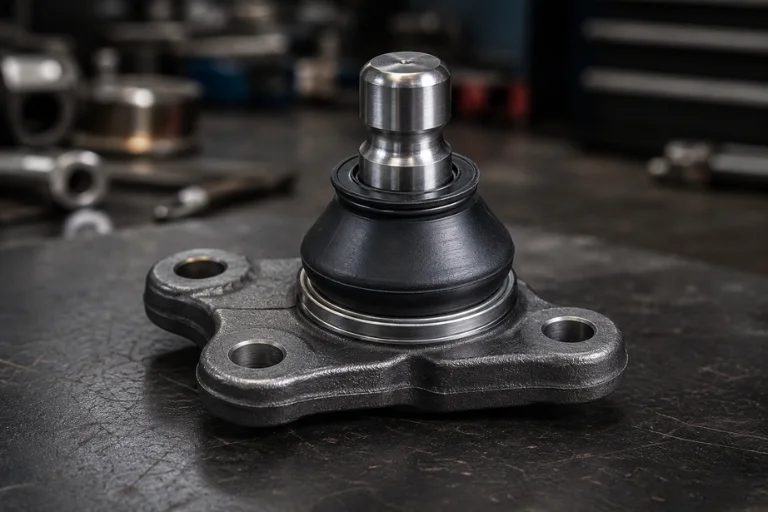
A ball joint is one of the major parts in your vehicle suspension system that connects your car’s steering knuckles to its control arms. Just like a hip joint in the human body a ball sits inside a socket, allowing movement in multiple directions at once. Letting your front wheels move in an up and down motion over uneven pavement while still turning left or right when you steer. The suspension system can’t work without a functioning ball joint, as every ball joint works to:
- Allows your vehicle’s wheel turn from left to right while maintaining alignment and suspension.
- To keep your ride smooth the ball joints absorb the road shock so that it doesn’t transfer it directly to the steering wheels.
- It keeps the tire in consistent contact with the road for better grip and control.
- Supports proper wheel alignment to stay geometrically straight, while looseness can often lead to wheel position often shifting.
Ball joints work as part of a larger suspension and steering system — and when one component is compromised, the stress shifts to surrounding parts including the engine mounts and drivetrain. For vehicles where suspension damage has contributed to broader mechanical wear, Tagore AutoParts stocks a full range of used engines for popular makes and models across the USA.
Anatomy of a Ball Joint
Every ball joint shares a few core components, no matter the make or model of vehicle:
- Housing – the outer metal casing that holds everything together
- Ball stud – the rounded stud that swings and rotates inside the housing
- Internal bearings – reduce friction and wear between the stud and housing
- Grease – lubricates the joint and helps block out moisture and debris
- Rubber boot – seals the opening to keep contaminants out and grease in
- Cover plate or closure – seals the assembly; many modern designs use a pressed-in cover plate for added durability
Most factory-installed units are sealed for life, which means once the rubber boot tears, water and grit get in fast — and wear accelerates from there. That’s one reason many aftermarket ball joints are built with a greaseable design, so contaminants can be flushed out and the joint’s service life extended.
Upper and Lower Ball Joints: What’s the Difference?
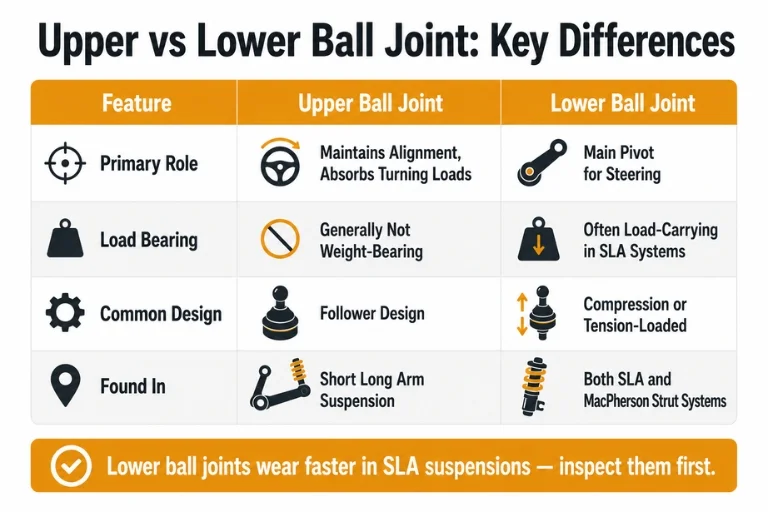
Every front suspension typically relies on two ball joints per wheel — an upper and a lower — and each one has a distinct job.
| Feature | Upper Ball Joint | Lower Ball Joint |
| Primary role | Maintains alignment, absorbs turning (radial) loads | Acts as the main pivot for steering |
| Common design | Follower design | Compression-loaded, tension-loaded, or follower, depending on suspension type |
| Load-bearing? | Generally, not weight-bearing | Often load-carrying in SLA suspension systems |
| Found in | Short/long arm (SLA) suspension | Both SLA and MacPherson strut systems |
In a short long arm (SLA) suspension, the lower ball joint frequently carries the weight of the vehicle, which means it tends to wear out faster than its upper counterpart. In a MacPherson strut suspension, the lower ball joint doesn’t support vehicle weight, but it still absorbs significant stress during cornering and braking. Understanding which type of ball joint your vehicle uses can help you and your mechanic diagnose problems more accurately. For trucks and SUVs with SLA suspension systems where lower ball joint wear is accelerated by heavy loads, Tagore AutoParts also carries reliable used transmissions for drivers addressing multiple worn components at the same time.
Signs of a Worn or Broken Ball Joint
Ball joints wear gradually, so catching the early warning signs can save you from a much bigger repair — or a dangerous roadside failure. Watch for:
- A clunking or knocking noise from the front end over bumps
- Steering wheel that pulls to one side
- Uneven or accelerated tire wear
- Looseness or “play” in the steering
- Front-end shimmy or vibration, especially at higher speeds
- Squeaking noises when turning
If left unaddressed, a worn ball joint can eventually become a broken ball joint — and that’s a serious safety issue. A broken ball joint can allow the wheel to separate from the suspension entirely, resulting in a sudden and total loss of steering control. Any of these symptoms warrant a prompt inspection by a certified technician. For vehicles where prolonged suspension wear has also affected engine mounts and caused internal engine damage, Tagore AutoParts stocks used Jeep Wrangler engines and other 4×4 and SUV engines popular among drivers who regularly tackle demanding terrain.
Why the Right Replacement Ball Joint Matters
Not all replacement parts are created equal. When it’s time to replace a ball joint, quality matters just as much as fit. Premium ball joints, like those from MOOG, are engineered with features designed to:
- Increase strength and durability under load
- Extend service life compared to standard OE-style parts
- Simplify installation for technicians
- Resist contamination through improved sealing and boot design
Choosing a well-engineered ball joint isn’t just about longevity — it’s about restoring the same precise, confident steering feel your vehicle had when it was new. For a trusted independent reference on ball joint inspection standards and replacement best practices, MOOG’s official ball joint resource and installation guide is one of the most detailed and reliable sources available for both DIY mechanics and professional technicians. For drivers whose suspension inspection has also revealed drivetrain wear, Tagore AutoParts stocks used Chevy Tahoe engines and other full-size SUV engines to support comprehensive vehicle restorations at competitive prices nationwide.
Conclusion
The ball joint may be small, but it plays an outsized role in how your car handles, rides, and stays safe on the road. From absorbing everyday bumps to keeping your tires planted through every turn, upper and lower ball joints work together as one of the unsung heroes of your front suspension. Pay attention to the warning signs, don’t ignore unusual noises or steering play, and when replacement time comes, invest in a quality part built to last. If you suspect a worn or broken ball joint, don’t wait — schedule an inspection with a certified technician to keep your vehicle safe and your steering precise.
For all your vehicle parts needs — from suspension components to complete used engines and transmissions — trust Tagore AutoParts, your reliable autoparts supplier serving customers nationwide.
Frequently Asked Questions
How many ball joints does a car have?
Most vehicles with an independent front suspension have four ball joints total — an upper and lower ball joint on each front wheel. Some MacPherson strut vehicles only use one lower ball joint per side.
How long does a ball joint last?
It varies by vehicle, driving conditions, and joint type, but many ball joints last anywhere from 70,000 to 100,000 miles. Load-carrying joints in SLA suspensions often wear faster than follower-type joints.
Can I drive with a bad ball joint?
It’s not recommended. A worn ball joint can quickly progress into a broken ball joint, which risks sudden steering failure. Have it inspected as soon as you notice symptoms.
How much does it cost to replace a ball joint?
Costs vary widely depending on the vehicle, the type of ball joint, and labor rates in your area. A certified technician can give you an accurate estimate after inspection.
Is it safe to replace just one ball joint?
While it’s mechanically possible, most technicians recommend replacing ball joints in pairs (both sides) to maintain even wear, balanced handling, and consistent alignment.