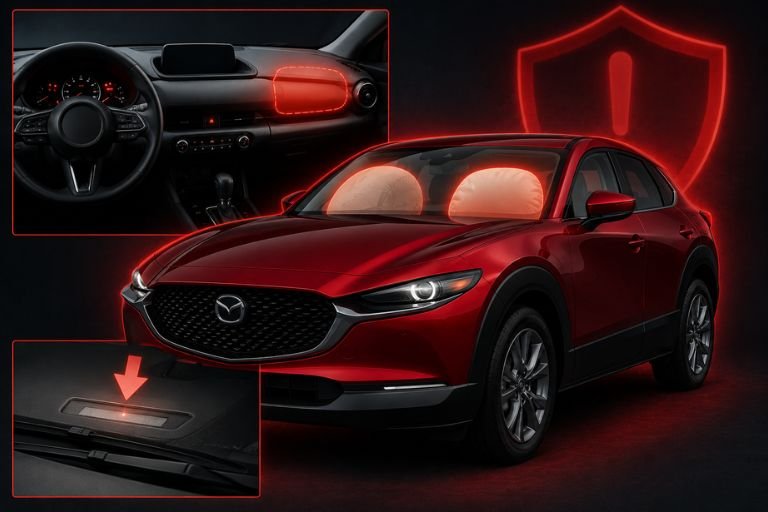
SAFETY ALERT: If you own a Mazda CX-30 or Mazda3, this recall directly affects your safety and the safety of your passengers. Read this guide completely and check your VIN today.
Table of Contents
Automakers and customers both prioritize vehicle safety and reliability. When a defect emerges that could affect occupant protection, responding swiftly becomes absolutely critical. The Mazda CX-30 Mazda3 airbag recall has brought Mazda’s commitment to road safety and proactive defect management to the forefront.
In this guide you’ll learn:
- The exact nature of the airbag defect
- Which vehicles and VINs are affected
- The serious risks involved
- Precise steps to protect yourself and your passengers
- What Mazda is doing to resolve the issue
Understanding the Mazda CX-30 Mazda3 Airbag Recall
What Is This Recall About?
The Mazda CX-30 Mazda3 airbag recall centers on a critical defect in the passenger-side front airbag inflator. This is classified as a Takata-type inflator defect—a term now synonymous with one of the largest and most dangerous automotive safety crises in history.
The Technical Defect Explained
The airbag inflator uses a chemical propellant to rapidly inflate the airbag during a collision. Under normal conditions, this propellant burns in a controlled manner, generating gas that fills the airbag within milliseconds.
The failure mechanism works like this:
The propellant compound degrades over time when exposed to:
- High humidity environments
- Temperature cycling (hot and cold extremes)
- Long-term aging beyond design parameters
When degraded propellant ignites during a crash, it burns unevenly and generates excessive pressure inside the metal inflator canister. If that pressure exceeds the canister’s structural limits, the housing can rupture violently.
The result: Metal fragments launch outward at extremely high velocity—comparable to shrapnel from an explosive device—directly toward the front passenger.
Why This Is Classified as a High-Risk Safety Emergency
This is not a comfort issue, a performance complaint, or a minor inconvenience. The Mazda airbag recall involves a defect that has caused:
- Severe lacerations requiring emergency surgery
- Eye and facial injuries
- Deaths in documented global cases
The National Highway Traffic Safety Administration (NHTSA) has received owner complaints and issued recommendations requiring immediate action from Mazda owners.
RECALL AT A GLANCE: KEY DETAILS
| Detail | Information |
| Recall Type | Safety Recall — Airbag Inflator Defect |
| Models Affected | Mazda CX-30 and Mazda3 |
| Component | Passenger-side frontal airbag inflator |
| Defect Type | Takata-type propellant degradation |
| Risk Level | HIGH — Potential for metal fragmentation on deployment |
| Remedy | Free replacement of airbag inflator |
| Owner Cost | No charge to vehicle owner |
| Where to Repair | Authorized Mazda dealers nationwide |
| NHTSA Campaign | Filed under Mazda Recalls database |
| Urgency | Immediate — Do not delay |
Which Vehicles Are Affected?
Not All Mazda CX-30 and Mazda3 Vehicles Are Recalled
It is important to understand that this recall does not cover every Mazda CX-30 and Mazda3 ever produced. Mazda has identified specific VIN ranges associated with particular model years and manufacturing batches where the defective inflator was installed.
Affected Model Overview
Mazda3 (Sedan and Hatchback):
- Specific 2024-2025 model year production batches
- Both sedan and hatchback body styles affected
- Front passenger airbag inflator only
Mazda CX-30 (Crossover SUV):
- Specific 2024-2025 model year production batches
- Front passenger airbag inflator defect
Important: Even if you have not received an official recall notification letter, your vehicle may still be included in the Mazda airbag recall campaign. Notification delays occur due to address changes, registration updates, and mailing system backlogs.
How to Check Your VIN Immediately
5 Ways to Verify Your Vehicle’s Recall Status
Method 1: NHTSA Official Recall Tool (Fastest)
- Go to NHTSA
- Click “Check for Recalls”
- Enter your 17-character VIN
- View all open recalls including Mazda airbag recall
- Print or save results for your records
Method 2: Mazda’s Official Recall Website
- Visit mazdausa.com
- Navigate to “Owner” section
- Select “Recall Information”
- Enter complete 17-digit VIN
- Follow instructions provided
Method 3: Contact Your Authorized Mazda Dealer
- Locate your nearest Mazda dealer
- Provide your VIN number over phone
- Dealer checks recall database directly
- Schedule repair if applicable
Method 4: Mazda Customer Service Recall Hotline
- Call Mazda’s dedicated recall number
- Provide your VIN and contact information
- Receive personalized guidance
- Schedule service appointment
Method 5: Vehicle Registration and Owner Manual
- Locate VIN on dashboard (driver side, visible through windshield)
- Cross-reference with NHTSA database
- Check owner manual for Mazda contact information
Where to Find Your VIN
Your 17-digit VIN is located:
- Dashboard: Driver’s side, lower corner of windshield
- Driver’s door jamb: Label on door frame
- Insurance card: Listed as vehicle identifier
- Vehicle title and registration: Official document
Critical reminder: Check your VIN status immediately—even if you haven’t received an official notification letter, your vehicle may still be affected.
The Science Behind the Inflator Failure
Understanding Why Airbag Inflators Fail
To fully appreciate the seriousness of this recall, it helps to understand airbag inflator chemistry and why degradation is so dangerous.
Normal Airbag Operation
When a collision triggers the airbag sensor, an electrical signal ignites the propellant inside the inflator. This controlled chemical reaction generates nitrogen gas that fills the airbag in approximately 30 milliseconds—faster than a human can blink.
The propellant compound: Most modern airbag inflators use ammonium nitrate-based propellants. These compounds are highly effective under controlled conditions but are chemically sensitive to environmental factors.
The Degradation Process
Stage 1: Initial Exposure The inflator canister, while sealed, is not perfectly isolated from environmental humidity. Microscopic moisture infiltration begins over years of vehicle operation, particularly in high-humidity climates.
Stage 2: Chemical Breakdown Repeated temperature cycling—hot summers, cold winters, daily temperature swings—causes the ammonium nitrate propellant to cycle through phase changes. Each cycle introduces microscopic crystalline structure changes in the propellant.
Stage 3: Uncontrolled Burn When the degraded propellant ignites in a collision, instead of a smooth, controlled burn, it detonates. This creates pressure spikes 10-20 times beyond normal design parameters within milliseconds.
Stage 4: Canister Rupture The metal inflator housing, designed for controlled burn pressures, cannot contain the explosive pressure spike. The canister fractures violently, launching metal fragments at occupants.
Why heat and humidity accelerate the problem: Vehicles in high-temperature, high-humidity environments (Southern United States, Southeast Asia, tropical climates) show dramatically accelerated propellant degradation. This is why the Takata recall historically affected more vehicles in certain geographic regions.
Recall Context and Broader Vehicle Safety
Understanding How Recalls Fit Into Vehicle Safety
Vehicle recalls are a critical part of automotive safety management. Understanding this recall connects to broader vehicle knowledge that all Mazda owners should have. Just as knowing about the FCA US Ram trucks recall helped Ram owners protect themselves, this Mazda recall requires equally immediate action from affected owners.
The Takata airbag crisis affected dozens of manufacturers—Honda, Toyota, BMW, Ford, and many others faced similar inflator defects. Understanding how and why these recalls occur helps vehicle owners stay vigilant across all manufacturers.
The broader recall pattern shows:
- Defects can emerge years after purchase
- Factory quality processes are not infallible
- Manufacturer response time varies significantly
- Owner response directly impacts personal safety
Mazda’s Response to the Recall
What Mazda Is Doing to Address This Issue
Mazda has responded to this recall in full compliance with NHTSA regulations and federal safety standards. The company’s recall response includes several key components designed to protect owners and minimize disruption.
Official Mazda Response Actions
Owner Notification Program:
- Direct mail letters sent to all registered owners of affected VINs
- Digital notification via email where owner contact information is available
- Updates through the NHTSA recall tracking system
- Dealer notification with technical service bulletins
Parts Supply Management:
- Expedited replacement inflator manufacturing
- Dealer inventory pre-stocking for common models
- Priority allocation for highest-risk vehicles
- Parts tracking system for owner visibility
Dealer Service Preparation:
- Certified technician training on replacement procedure
- Specialty tools and equipment provisioning
- Estimated service time: 1-2 hours per vehicle
- No dealer appointment charges
Customer Support Infrastructure:
- Dedicated recall hotline staffed with trained agents
- Loaner vehicle availability at participating dealers
- Expedited service scheduling for affected owners
- Documentation provided upon repair completion
The Repair Process
The remedy for the Mazda CX-30 Mazda3 airbag recall is straightforward and completely free to owners:
- Appointment scheduling: Contact authorized Mazda dealer
- Vehicle check-in: Dealer verifies VIN against recall list
- Inflator removal: Defective passenger airbag inflator removed
- Replacement installation: New, redesigned inflator installed
- System verification: Complete airbag system tested
- Documentation: Repair record provided to owner
- Vehicle return: Typically completed same day (1-2 hours)
The replacement inflators use redesigned propellant formulations and improved moisture-resistant sealed canisters, completely eliminating the degradation pathway that causes the defect.
Safety Implications for Your Specific Mazda
Vehicle Safety Systems Work Together
The airbag recall directly affects one component of your vehicle’s overall safety system. Understanding how all safety systems interact helps you appreciate why this repair cannot wait.
Airbag System Integration
Modern vehicles like the Mazda3 and CX-30 use integrated safety systems where multiple components work together:
Crash sensor network: Accelerometers and impact sensors detect collision forces and trigger airbag deployment signals within milliseconds.
Electronic control module: Processes sensor data and decides which airbags to deploy based on crash severity and direction.
Airbag inflators (the defective component): Execute the deployment decision by rapidly generating gas to fill airbag cushions.
Airbag cushions: Physical fabric bags that inflate to protect occupants from impact with steering wheel, dashboard, and door panels.
When the inflator fails: The entire safety system’s effectiveness is compromised. Instead of the airbag protecting you, the exploding inflator canister itself becomes the danger.
Connection to Electronic Safety Systems
Understanding your vehicle’s broader electronic safety architecture helps contextualize this recall. The Electronic Stability Control (ESC) system, like airbags, relies on properly functioning electronic sensors and components. When any safety system component fails, the entire protection network weakens—making prompt recall repairs essential for complete vehicle safety.
What Affected Owners Must Do Right Now
Your Complete Action Plan
If your Mazda CX-30 or Mazda3 is included in this recall, follow this precise action plan without delay:
IMMEDIATE ACTIONS (Today):
Step 1: Check VIN Status
- Visit nhtsa.gov/recalls
- Enter your complete 17-digit VIN
- Screenshot or print results
- Time required: 5 minutes
Step 2: Implement Safety Precaution
- Do not allow passengers in the front passenger seat until the recall repair is completed
- Place a reminder note on the dashboard if needed
- Inform all regular passengers of this restriction
Step 3: Contact Mazda Dealer
- Call your nearest authorized Mazda dealer
- Confirm parts availability for your specific model
- Schedule your recall appointment
- Ask about loaner vehicle if service will take longer than expected
WITHIN THE NEXT 7 DAYS:
Step 4: Complete the Recall Repair
- Attend your scheduled service appointment
- Bring VIN documentation and government ID
- Allow 1-2 hours for the complete repair
- Ensure you receive written documentation of completed repair
Step 5: Preserve Documentation
- File the repair completion paperwork with your vehicle documents
- Note the repair date and dealer information
- This documentation increases resale value and verifies recall compliance
ONGOING:
Step 6: Monitor Future Recall Notices
- Register your vehicle with NHTSA for recall notifications
- Maintain current address with vehicle registration
- Check nhtsa.gov annually for any new campaigns
Recall Impact on Vehicle Ownership and Value
How Recalls Affect Your Mazda’s Value and Insurance
Many owners worry about how a safety recall affects their vehicle’s value, insurance, and future ownership decisions. Understanding these implications helps you make informed decisions.
Impact on Resale Value
Before repair completion:
- Unrepaired recall vehicles may face reduced resale value
- Informed buyers may negotiate lower prices
- Some dealers won’t accept trade-ins with open recalls
- Private party buyers may avoid unrepaired vehicles
After repair completion (with documentation):
- Full market value typically restored
- Documentation proves recall was properly addressed
- Demonstrates responsible ownership history
- May actually differentiate your vehicle positively
Insurance Considerations
A completed recall repair should not negatively impact your insurance premiums. However, some considerations apply:
- If an accident occurred due to the defective airbag inflator prior to repair, liability questions could arise
- Maintaining current recall compliance demonstrates responsible vehicle ownership
- Contact your insurance provider with any specific questions about coverage
Long-Term Ownership Planning
For owners planning long-term vehicle ownership, the recall repair is an investment in continued safe operation. The car maintenance checklist provides a comprehensive framework for tracking all service records including recall repairs, ensuring your Mazda remains in peak condition throughout ownership.
Comparing This Recall to Industry Pattern
How the Mazda Recall Fits the Broader Industry Picture
The Mazda CX-30 Mazda3 airbag recall is part of a decade-long industry reckoning with Takata inflator technology. Understanding the broader context helps owners appreciate why manufacturer responses and regulatory oversight have intensified.
Industry-Wide Recall Patterns
The Takata airbag crisis began emerging publicly around 2013-2014, eventually expanding to affect over 100 million vehicles across dozens of manufacturers worldwide. Key lessons emerged:
Manufacturer accountability: Federal regulations now require faster defect identification and more aggressive owner notification.
Parts supply prioritization: Manufacturers must demonstrate adequate replacement part supply to NHTSA before recall announcements.
Geographic risk stratification: Vehicles in high-humidity regions receive priority recalls due to accelerated propellant degradation risk.
NHTSA enforcement: Manufacturers face substantial fines for delayed recalls or inadequate owner notification programs.
Similar recalls across other brands underscore that no manufacturer is immune to component-level defects. The Nissan recalls covering various safety systems demonstrate how industry-wide defect patterns can affect multiple manufacturers simultaneously—making proactive VIN checking essential for all vehicle owners regardless of brand.
Mazda3 vs CX-30 — Understanding Your Specific Vehicle
Key Differences Between Affected Models
Both the Mazda3 and CX-30 are affected by this recall, but they serve different driver needs. Understanding the distinctions helps owners of each model know exactly what to expect.
Mazda3 Profile
Body styles affected:
- Mazda3 Sedan (4-door)
- Mazda3 Hatchback (5-door)
Vehicle characteristics:
- Lower, sportier stance
- Front-wheel drive standard
- More fuel-efficient
- Sportier handling dynamics
- Sedan: Dedicated trunk space
- Hatchback: Versatile cargo area
Recall component location:
- Passenger-side dashboard airbag module
- Standard replacement procedure
- 1-2 hour repair window
Mazda CX-30 Profile
Body style affected:
- CX-30 Crossover SUV (5-door)
Vehicle characteristics:
- Higher ride height than Mazda3
- Available all-wheel drive
- More interior space
- Slightly more cargo room
- Better visibility from higher seating position
Recall component location:
- Passenger-side dashboard airbag module
- Same defect type as Mazda3
- Similar 1-2 hour repair procedure
Should You Buy a Mazda3 or CX-30?
For buyers weighing these two models beyond the recall, the choice comes down to priorities. The CX-30 offers better ground clearance, standard AWD availability, and more cargo space. The Mazda3 delivers sharper handling, better fuel economy, and a more driver-focused experience. The recall affects both equally—once repaired, neither presents elevated safety risk.
Vehicle Safety Maintenance After Recall Repair
Maintaining Complete Vehicle Safety Post-Repair
Once your Mazda airbag recall repair is completed, ensuring your vehicle remains in excellent overall condition becomes the priority. A safe vehicle requires all systems functioning properly, not just the airbag inflator.
Post-Repair Safety Checklist
Airbag system verification: After the recall repair, your dealer should confirm:
- Airbag warning light functions normally
- SRS (Supplemental Restraint System) shows no fault codes
- Passenger airbag indicator (if equipped) operates correctly
- All safety systems cleared for normal operation
Broader vehicle safety review: Use the recall appointment as an opportunity to have your dealer check other vehicle systems. Addressing multiple items in one visit saves time and ensures complete vehicle safety.
Understanding your vehicle’s overall mechanical condition supports better safety awareness. Knowing signs of a blown motor helps you identify developing problems before they become dangerous situations—the same proactive awareness that makes recall compliance so important.
Parts Quality for Post-Recall Repairs
If your Mazda requires any additional parts or components beyond the recall repair, quality sourcing matters for long-term reliability. Tagore Auto Parts provides quality automotive components including remanufactured engines and transmissions for various vehicle makes and models, ensuring your vehicle restoration or repair uses reliable parts.
Conclusion
The Mazda CX-30 Mazda3 airbag recall is among the most serious safety issues any Mazda owner will encounter. A defective airbag inflator is not a minor mechanical inconvenience—it transforms a critical safety system into a potential weapon capable of causing severe injury or death.
The path forward for affected owners is clear and completely cost-free:
- Check your VIN today at nhtsa.gov or mazdausa.com
- Restrict front passenger use until repair is complete
- Schedule your dealer appointment as soon as parts are available
- Complete the repair and preserve documentation
- Continue monitoring for any future recall campaigns
Mazda’s response to this recall—free repairs, proactive owner notification, dedicated support hotline, and loaner vehicle availability—demonstrates that when you take action, Mazda meets you with full support.
Your safety and the safety of every passenger who rides with you depends on completing this recall repair promptly. Visit nhtsa.gov or contact your authorized Mazda dealer today.
Frequently Asked Question’s
Does my Mazda CX-30 or Mazda3 definitely have to be recalled for the airbags?
No, not all Mazda or CX-30 vehicles are recalled for airbags, but a significant recall that came in 2025 can affects certain models from 2024-2025 models due to a sensor malfunction that can deactivate airbags.
Which year to avoid Mazda CX-30?
It is better to prefer years between 2022-2024, as these models are non turbo models for lower chances of oil consumption or mechanical issues.
How long does it take to replace an airbag inflator?
Generally, 1-2 hours are required to change or replace an airbag inflator depending on the cause of damage or the issues caused.
Should I buy a Mazda 3 or CX-30?
If you are willing a better ground clearance, standard all-wheel drive and better space than you can opt for Mazda CX-30 whereas if you willing for perfect shape, sportier handling and better fuel efficiency than the aesthetic Mazda3 is all for you.
How do I know if my Mazda has a recall?
If you want to know the status of Mazda than you can enter the VIN to see the status of any pending recalls for your vehicle.