Table of Contents
There are number of emission-control devices incorporated in modern vehicles in order to minimize number of harmful gases emitted in the environment and EGR valve is one of the most significant. When the engine is running, it may also produce nitrogen oxides (NOx) at high combustion temperatures and this may be one of the causes of air pollution. EGR system assists to mitigate these emissions by diverting a minimal amount of exhaust gases back to the engine intake manifold. This will reduce the combustion temperatures as well as limit the formation of harmful pollutants.
The EGR valve also regulates the quantity of exhaust gas recirculated, thus ensuring that the engine performs well and does not exceed its limit in polluting the air. The accumulation or wear of carbon with time may however result in faults in the valve that reduces efficiency or causes visible engine problems. The knowledge about the functioning of the valve and the knowledge of the first signs of malfunction may allow drivers to keep their vehicles in order and avoid expensive mistakes. This blog will discuss the concept of the valve, its purpose, its significance in regulating engine performance and emissions and the symptoms that are common when it fails.
What Does an EGR Valve Do?
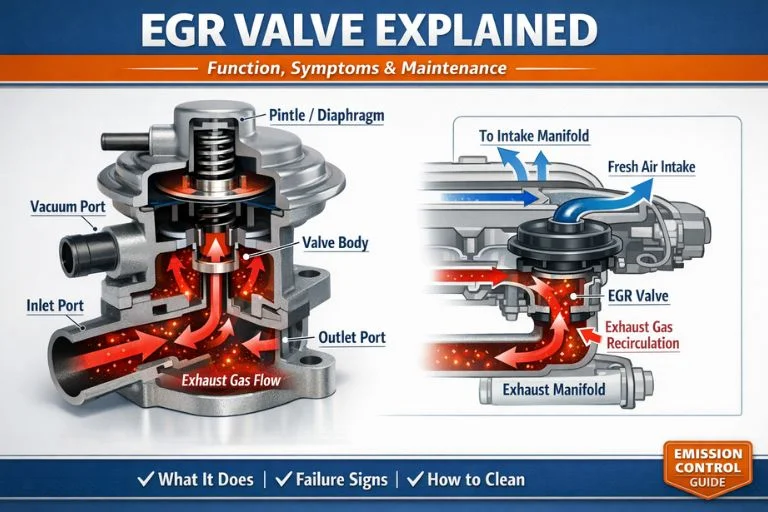
Exhaust Gas Recirculation (EGR) valve is significant in regulating engine emissions as well as enhancing efficiency. This is primarily intended to direct a little bit of exhaust gases into the intake of the engine rather than expelling them into the exhaust system. Recirculation of these gases by the EGR valve in the engine reduces the temperature of combustion in the engine cylinders, which in turn helps to reduce the creation of harmful nitrogen oxides (NOx) emissions.
The process does not only aid in vehicles to comply with the environmental regulations but also enhances the engine performance in some of the conditions. To ensure proper engine functioning, the valve normally opens with the moderate loads and closes in the idle or full acceleration mode.
Understanding EGR Valve Operation in Context
The EGR valve works as part of a complex emission control system that includes other critical components. Similar to how the catalytic converter processes harmful exhaust gases, or how the camshaft position sensor and ignition coil work together for proper engine timing, the valve must function correctly to maintain optimal engine performance. A malfunctioning valve can affect other systems, potentially causing issues that might be mistaken for problems with the alternator or fuel delivery system. If severe carbon buildup damages the engine over time, you may eventually need remanufactured engines to restore proper performance.
Common Defective EGR Valve Symptoms
Carbon is the most prevalent cause of EGR valve failure that may lead to the sticking of the valve to remain open, closed, or stuck permanently. In case this occurs, a number of visible symptoms can be presented:
- Rough Engine Idle: When the EGR valve stays open, it admits excess exhaust gas into the engine, which interferes with the air-fuel mixture and results in harsh idling, vibration, or stalling.
- Decreased Engine Performance: The engine will stall, sputter or accelerate slowly, with a wrong air-fuel ratio and low efficiency.
- Fuel/ Exhaust Smell: There is likelihood of excess fuel that does not burn and thus produces a noticeable fuel/ exhaust smell around the car or in the cabin.
- Over emissions: A malfunctioning EGR valve may enhance emissions of nitrogen oxide (NOx) leading to a failure in an emissions test by such vehicle.
- Engine Knock at Low RPM: When the valve continues to remain closed, then the engine combustion temperatures are elevated and therefore knock or ping at lower engine speeds.
- Check Engine Light: The EGR system detects problems in the engine control module and activates the check engine light giving a code of diagnostic trouble.
How to Check the EGR Valve?
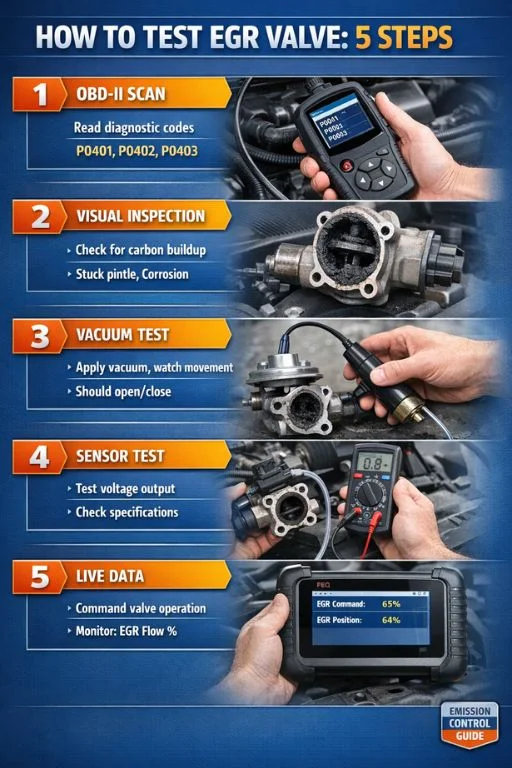
A faulty EGR valve is usually diagnosed by use of scan tools analysis, inspection, and component testing. Here’s a step-by-step approach:
Step 1: To extracting any fault code that might have been stored, an OBD-II scanner is connected. EGR defines that the system is the root cause of the problem.
Step 2: Unscrew EGR valve, examine it and see whether there is heavy carbon deposition, corrosion and damages. The valve or pintle diaphragm is said to be clogged or stuck and needs to be cleaned or replaced.
Step 3: Push button of hand vacuum pump to bring vacuum into the EGR valve. The proper functioning valve should open and when the vacuum is released the valve is supposed to be closed. No movement that would hint on mechanical failure.
Step 4: Observe the reference of the voltage and the output signal of the DPFE sensor with a multimeter. Out of range reading means that the sensor is not working and may be imitating EGR valve symptoms although the valve may be in perfect condition.
Step 5: These scan tools are more advanced and are able to transmit the EGR valve open and closed commands. Measure live data change in EGR flow rate so that it is operating well.
How to Clean the EGR System?
If carbon buildup is causing the EGR valve to stick, cleaning is often a cost-effective alternative to full replacement. Here’s how to approach EGR system cleaning:
- EGR cleaner spray (available at automotive stores), safety gloves, eye protection, and basic hand tools.
- Disconnect and remove the EGR valve from the engine according to your vehicle’s service manual.
- Spray EGR cleaner generously into the valve passages and allow it to soak for 15–30 minutes (or overnight for heavy deposits).
- Use a soft brush or pipe cleaner to gently dislodge loosened carbon deposits from the valve body and passages.
- Wipe clean and inspect. If the valve pintle still does not move freely after cleaning, replacement is recommended.
- Also clean the EGR passages leading into the intake manifold, as buildup there can restrict flow even after the valve is serviced.
Conclusion
EGR valve is a small machine that has got a huge influence on the work of the engine and its fuel consumption, as well as environmental standards. It could be rough idling, engine knock, a lingering odor of fuel or just a lit Check Engine Light, whatever the symptom of the defective EGR valve, it is important to identify the symptoms of the malfunctioning EGR valve before the symptoms develop into a more severe and costly engine malfunction.
The routine care of the vehicle, such as checking the EGR system and the EGR sensor on a regular basis will greatly prolong the life of the valve and avoid the possibility of a carbon-related failure. When cleaning still causes symptoms, then replacement EGR valve is much cheaper than the engine repair that may come as a result of an extremely poorly maintained EGR system.
The above diagnostic steps help identify the problem, although an approach to obtaining your EGR system restored to proper operation is to enlist the services of a reliable automotive expert. According to Consumer Reports’ automotive maintenance recommendations, regular emission system maintenance, including EGR valve inspection, is essential for long-term vehicle reliability and environmental compliance.
Frequently Asked Question’s
What does an EGR valve do?
It reintroduces some of the exhaust gases into the combustion chambers to cool them down and minimize the NOx formation.
Which are the most prevalent symptoms of defective EGR valves?
Rough idle, engine knock, power loss, fuel odor, heavy emission and check engine light.
What is a DPFE sensor?
Differential Pressure Feedback EGR (DPFE) sensor is a sensor used to measure the flow of EGR using the difference in pressure, to aid the ECM in controlling the EGR valve operation.
How do I check the EGR valve?
Observe carbon accumulation and check valve movement with a vacuum pump or commanding it through a scan tool, read DTCs visually, and detect carbon accumulation with an OBD-II scanner.
How do I clean the EGR system?
Take out the valve and spray EGR-special cleaner to dissolve the carbon. In the case of extreme accumulation, it might be required to leave overnight and then re-install.