Table of Contents
Modern vehicles have become one of the most iconic statement of the modern engineering packed with advanced technologies. Featured to make driving safer, comfortable and responsive the Active Cornering Enhancement (ACE) stands out as one of the most impactful suspension technologies available today.
Whether you’re navigating tight mountain switchbacks or cruising along a motorway on ramp, ACE works silently in the background to keep your vehicle stable and composed. This guide breaks down everything you need to know about active cornering enhancement how it works, why it matters and what to do when something goes wrong.
What Is Active Cornering Enhancement?
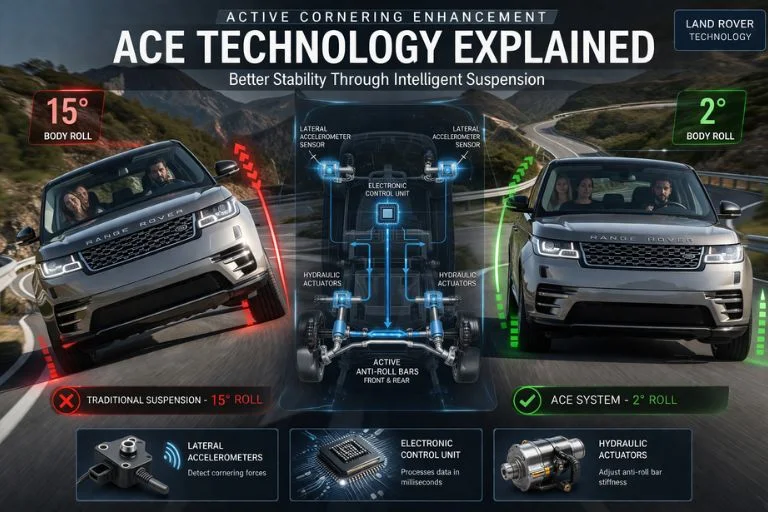
Active Cornering Enhancement (ACE) is a high-tech automobile system designed to greatly reduce body roll and improve the stability of a car in the process of cornering. Body roll happens when the vehicle tilts to one side while turning, this may make the handling less accurate and leaving the driver less confident, especially at higher speeds or when executing sudden maneuver. ACE resolves this problem with an advanced sensor system, a control unit, and hydraulically operated anti-roll bars that are constantly responding to driving issues like steering input and lateral acceleration.
The system also changes the stiffness of the anti-roll bars within milliseconds in response to forces that can make the vehicle lean, so that the vehicle remains flat and in control around corners. This real-time adjustment does not only help in enabling and handling road grip, but helps control undesirable body movements. ACE is very helpful in SUVs, which inherently have a higher center of gravity as it is useful feature to provide smoother, safer and more controlled driving experience.
How Active Cornering Enhancement Works
At its core, active cornering enhancement relies on three key components working together seamlessly:
| Component | Function |
| Lateral Accelerometers / Sensors | Detect the degree and speed of body roll in real time. |
| Electronic Control Unit (ECU) | Processes sensor data and calculates the required corrective response. |
| Hydraulic or Electronic Actuators | Physically adjust the anti-roll bars to stiffen or soften suspension. |
When the system detects lateral force building during a corner, the ECU sends an immediate signal to the actuators. Within milliseconds, the anti-roll bars are stiffened on the outside of the turn, redistributing load and keeping the body level. As the vehicle exits the corner, the system relaxes the suspension back to its standard setting. This continuous loop of sensing, processing, and acting is what gives active cornering enhancement its distinct advantage over conventional passive systems.
Understanding the Suspension System Integration
Active cornering enhancement works as part of your vehicle’s broader suspension system, which also includes critical components like struts and shocks that absorb road impacts, and control arms that maintain wheel alignment. Similar to how the electronic stabilization program (ESC) prevents skidding through individual wheel braking, ACE enhances stability through active suspension control. The system relies on sensors comparable to those used in the ECM to monitor vehicle dynamics in real-time.
Active Cornering Enhancement vs. Traditional Suspension Systems
To understand the value of Active Cornering Enhancement, it helps to compare it with conventional suspension setups.
| Feature | Traditional Passive Suspension | Active Cornering Enhancement (ACE) |
| Body roll control | Limited; relies on springs and anti-roll bars | Actively reduces lean via sensors and actuators |
| Handling feel in corners | More noticeable sway and tilt | Flatter, more planted cornering |
| Passenger comfort in curves | More lateral movement felt | Smoother, less wobbly ride |
| Adaptability to driving conditions | Fixed tuning; no real-time adjustment | Continuously adjusts to cornering forces |
| Suitability for high CG vehicles | Prone to body roll in SUVs/crossovers | Much better control of lean and stability |
Key Benefits of Active Cornering Enhancement
ACE is beneficial to drivers and passengers in a number of ways:
- Reduced Body Roll: The most immediate advantage – corners are flatter and more stable, enhancing confidence in the driver.
- Improved Ride Comfort: As opposed to anti-roll bars that are permanently stiff, ACE firms only when necessary, retaining ride on straight roads.
- Enhanced Safety: Improved stability in sharp or emergency maneuvers has decreased the likelihood of rollovers, especially in higher SUVs and 4x4s.
- Better Off-Road Articulation: Since ACE is also capable of softening the suspension where necessary, it enables the wheel to move more in response to the rough surface – an essential feature in off-road cars.
- Extended Component Life: By dynamically distributing suspension loads, ACE reduces unnecessary stress on tires, bushings, and related components.
Understanding the ACE Warning Light
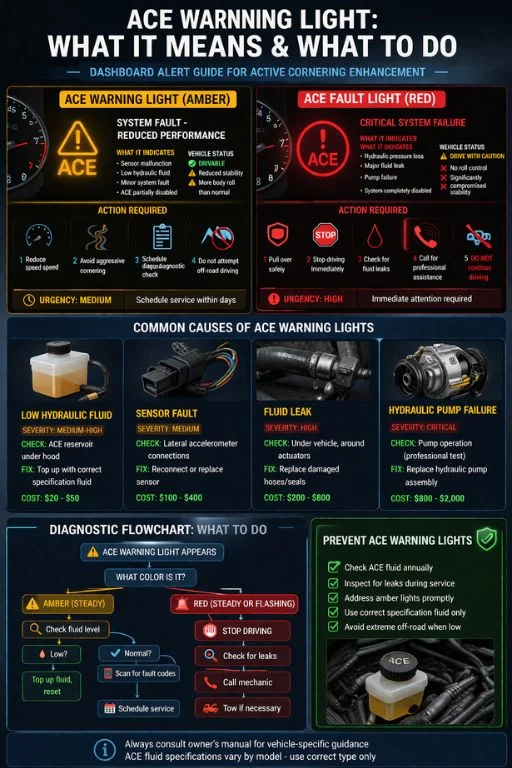
One of the most common issue that driver’s faces is the illumination of the ACE warning light on the dashboard. Understanding what it this warning light means can help you to avoid extra stress:
- Amber (Constant) Light: Indicates a system fault that reduces ACE performance. The vehicle remains drivable, but you should reduce speed, avoid aggressive cornering, and schedule a diagnostic check promptly.
- Red (Flashing or Constant) Light: Signals a serious fault — potentially a fluid leak or critical pressure loss. You should pull over safely and seek professional assistance immediately, as continued driving could damage vehicle components.
Common triggers for the ACE warning light include:
- Low hydraulic fluid levels in the ACE reservoir
- A faulty or disconnected wheel speed or lateral sensor
- Hydraulic pump failure
- Electrical system faults
How Active Cornering Enhancement Works: Technical Details
Active Cornering Enhancement is based on a close feedback control that involves sensors and a control unit as well as hydraulic or electronic actuators. The system works in the following way:
- Sensing Cornering Forces: When the vehicle starts to turn, two accelerators sense the lateral acceleration. These sensors provide the Active Cornering Enhancement computer with the information about the speed of the cornering and the degree of body lean.
- Real-time Data Processing: The electronic control unit (ECU) determines the extent of body roll and determines the amount of force required to offset it. The ECU is able to adjust the responses in relation to the speed of the road, steering angle and driving dynamics.
- Applying Corrective Torque: ACE employs pressurized fluid direct to hydraulic actuators (or electronic actuators in modern versions) to exert torque on torsion bars and other suspension parts. This acts in counteraction to the body lean, in effect, flattening the vehicle in passing.
- Adaptive Response Thresholds: Lateral acceleration up to the level of the body roll of approximately 0.4 g is practically removed in many ACE implementations. After that point, the system can permit a limited quantity of lean to provide the driver with a response that he/she is closing in on the cornering limit.
Conclusion
Active cornering enhancement is a major advancement in the technology of the automotive suspension that provides an attractive package of ride comfort, handling accuracy, and security. Whether you are off-road and testing your 4×4 in rough conditions or you are a family driver and want to take a leisure and calm ride in your motorway, ACE is working round the clock to make your ride a smooth journey. Knowledge of how the system works, and the knowledge of what to do in the eventuality of warning lights, will enable you to take better care of your car and drive with a higher level of confidence.
If your vehicle requires extensive repairs beyond the suspension system, Tagore Auto Parts offers quality remanufactured engines and replacement transmissions to restore your vehicle to optimal condition. With the current development of automotive technology, active cornering enhancement is just going to be more advanced, intelligent, and more accessible across the market.
According to Consumer Reports’ automotive technology research, advanced suspension systems like ACE reduce rollover risk by up to 50% in SUVs and significantly improve passenger comfort and vehicle control, making them one of the most valuable safety technologies in modern vehicles.
Frequently Asked Questions
-
What are the common vehicles that have active cornering enhancement?
The high-end SUVs and luxury cars, like Land Rover models, Discovery, Defender and Range Rover comprises of ACE or similar active roll control systems.
-
Is it possible to be driving with the ACE warning light on?
Yes, it is possible to still continue driving with the ACE warning light on particularly when it is amber or yellow in color.
-
What is the frequency of ACE fluid monitoring?
Checking ACE fluid levels is recommended during the regular service, which is usually every 12 months, or indicated in your owner manual.
-
Is active cornering improvement equivalent to electronic stability control?
No. Whereas the two contribute to the stability of vehicles, ESC is mainly involved in braking of individual wheels, but active cornering enhancement is specifically aimed at the suspension to control body roll.