Table of Contents
When shopping in an auto dealership or scrolling through a company webpage, you have must have probably come across the term MSRP. But what is MSRP and why does it matter to you as a car buyer? Whether this is your first car purchase or your tenth, knowing what MSRP is can be the key to saving money by buying a car at an actual fair price rather than paying more than you need to. In this guide, we will dive into all the information you should know about vehicle MSRP how it is determined, the difference between it and other price terms, and how it can be used as a bargaining instrument.
What Is MSRP?
Wondering what MSRP is? The MSRP is the abbreviation used for Manufacturer’s Suggested Retail Price. It is also known as the sticker price or list price and ensures that the prices are kept similar in various stores and locations, especially cars, electronics and household products. It is not however a set rule and sellers may sell it above or below this price.
In cars, MSRP is displayed on the car window sticker as an opening price. It is useful in retail and online shopping to ensure consistency in pricing and prevent significant price disparities among sellers. MSRP can help buyers negotiate their prices and most customers attempt to pay below the price, yet in some instances, a popular or in-demand product can fetch a higher price.
The manufacturer and not the dealer sets the MSRP; this implies that a 2025 GMC Sierra will have the same MSRP in California and New York but the final price you end up paying may differ significantly across the dealerships.
What Is MSRP for Cars? Key Pricing Terms Explained
To fully understand what is a MSRP for an automobile, it helps to see how it compares to related pricing terms you’ll encounter during the buying process.
| Pricing Term | What It Means | Who Sets It |
| MSRP | Manufacturer’s recommended retail price for the base vehicle | Automaker |
| Base Price | MSRP of the vehicle with no optional add-ons or packages | Automaker |
| Invoice Price | What the dealer actually paid the manufacturer for the car | Automaker / Dealer |
| Sale Price / Transaction Price | The final agreed amount you pay at the dealership | Negotiated |
| Destination Fee | Shipping cost from factory to dealership, added to MSRP | Automaker |
Understanding these distinctions is essential because dealers can price a car above or below the MSRP depending on demand, inventory levels, and negotiation. The MSRP is your reference point — not a fixed rule.
How Is the MSRP Determined?
Automakers do not establish an MSRP out of the blue. The figure is the outcome of a close examination of a number of factors:
- Manufacturing and materials costs: The raw materials, labour, assembly and engineering costs are all fed into the base figure.
- Market research and competitor pricing: Manufacturers research what other cars are selling at and their positioning in the market.
- Previous dealer mark-up history: The average mark-ups that dealerships make would guide the automaker to come up with a figure that is commercially feasible.
- Trim level and options: MSRP only applies to the base level of a car. Every upgrade package, technology bundle or performance tier has its own unique MSRP.
- Demand forecasting: Limited-edition or high-demand models might be priced higher as a result of the supposed competition among the purchasers.
Can You Negotiate Below the MSRP?
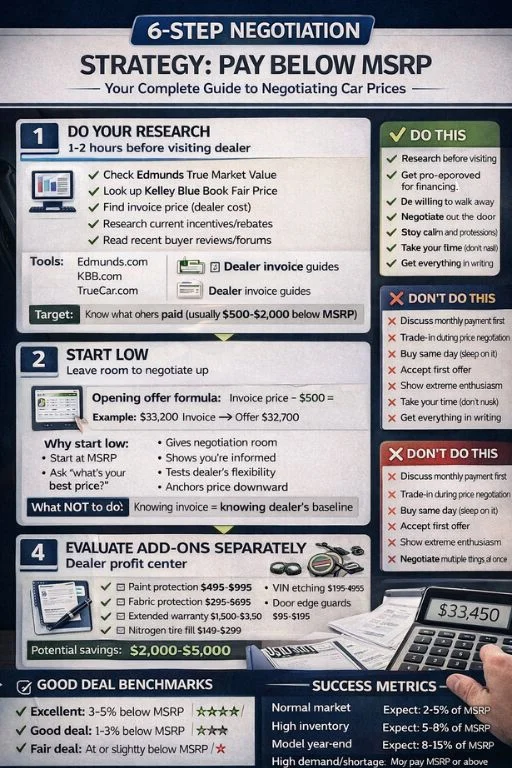
Yes, in most cases, you ought to endeavour to negotiate. The MSRP (sticker price) is not the end price but the starting price. The dealers generally pay less than the MSRP, therefore, they are able to reduce the price and still make a profit. This is an easy method of managing it:
- Conduct some research initially: Visit sites such as Edmunds or Kelley Blue Book to find out what others are actually paying to purchase the car. It usually is lower than the MSRP.
- Open with a low price: Do not open at the sticker price. Begin small to leave room in case you have to raise your offer.
- Request the price of the dealer: You can request the dealer to tell you the price he or she paid (invoice price). And they may not necessarily tell you, but it helps them to.
- Consider any additional expenses independently: Items such as accessories or extended warranty are tacked on to the price. Choose whether you really need them or not by not accepting everything at once.
- Compare various dealers: Request several dealers to give their prices. They will also compete, and there are higher chances that you will be offered a better deal.
- Leasing? It does count: The price of a car does make a difference on your monthly payment, even when leasing. A decrease in price also results in reduced payments.
Understanding the Complete Vehicle Pricing Landscape
When researching MSRP and vehicle pricing, it’s helpful to understand the broader automotive market context. Similar to how different Honda models like the HRV vs CRV have varying MSRPs based on size and features, or how AWD vs 4WD systems affect vehicle pricing and capabilities, understanding these comparisons helps you make informed purchasing decisions.
For major component replacements beyond regular maintenance, quality aftermarket suppliers like Tagore Auto Parts provide reliable remanufactured engines and transmissions at prices significantly below new MSRP, helping you maintain your vehicle’s value cost-effectively.
Where to Find a Vehicle’s MSRP
To locate the MSRP of any new automobile is easy and free:
- On the manufacturer site the Build and Price tool is used to view base MSRP and the impact of options on it.
- The Monroney sticker on the window of the car in the dealership.
- Third-party sites are also available with real-world transaction price data.
- The dealership listing page on its own site, which usually shows MSRP with any dealer added packages.
Conclusion
Knowing what MSRP is one of the most practical skills that you can bring to a car dealership. It provides you with what the manufacturer believes to be a decent retail cost of the vehicle and it also provides you with a clear reference point in which to build your negotiation around.
Whether you are asking what is the MSRP for cars to prepare you to buy your first automobile or polishing up before hiring your next vehicle, the most important thing to understand is that the MSRP is where the discussion begins, not where it has to end.
Research on the MSRP and the average transaction prices online, know the difference between the invoice and MSRP, and never think twice about walking out and shopping around before going to any dealership. An informed customer is always the best.
Frequently Asked Question’s
Is MSRP the same as the final price I pay?
No, MSRP is the not the same as the final price. This depends on negotiation, dealer fees, taxes, add-on packages and current market demand.
What does MSRP stand for in simple terms?
MSRP stands for Manufacturer Suggested Retail Price. It’s the price the carmaker recommends that dealers charge consumers for a specific vehicle model and trim level.
Why do different trim levels of the same car have different MSRPs?
Each trim level represents a different configuration — higher trims include more features, better materials, and advanced technology, all of which raise the manufacturing cost and thus the MSRP. The base MSRP covers the entry-level configuration only.
Can dealers legally charge above MSRP?
Yes. MSRP is a suggestion, not a legal cap. During high-demand periods, dealers may add mark-ups above MSRP. Shopping around and timing your purchase strategically can help you avoid paying above sticker.
Does MSRP include taxes and fees?
No. MSRP typically reflects the vehicle price before taxes, registration fees, destination charges, and dealer documentation fees. Always ask for the full “out-the-door” price to understand your total cost.