Table of Contents
The Safety of the vehicle extends far beyond airbags and anti-lock brakes. One of the most critical yet often overlooked components of automotive safety lies in the condition of your tires. Approx. 25% of the vehicles on American roads runs with a worn out engine, this were understanding how to accurately measure tread depth comes in. A tire tread gauge has become one of the most important tool which is essential for every car owner, this tool helps the owner get the exact measurements that can distinguish between safe travel and the disaster.
The tread depth of tires is one of the factors that directly affect how your vehicle brakes, accelerates, and maintain controls in different weather conditions. Although most motorists depend on visual checks or coin checks, a specialized tire depth gauge can be precise and dependable to enable them make informed decisions on the maintenance and replacement of tires. In this blog we will dive into everything you need to know about tire depth- what it is, why it matters, how to measure it and when it’s time to replace you tires to ensure you drive safe and smooth.
Understanding Tire Tread Depth and Its Critical Importance
The tire tread depth can be defined as the vertical measurement between the tallest point of the tread rubber with the lowest point of the deepest grooves of the tire. New tires typically have 8/32 -12/32 of an inch tread depths, which give their tires the highest possible traction and water displacement competencies. The treading on your tires have a number of essential purposes. The tread block spaces are effective in conduction of water and water is not able to hydroplane because of the channels. Small slits that are made in the tread blocks increase grip in wet and icy areas.
These features are ineffective when tires wear out, which reduces the safety of vehicles to a significant extent. The depth of tires to 4/32 of an inch reduces the tire performance considerably, especially during wet weather. Tires measure 2/32 of an inch which is the legal minimum in most states and it is necessary to replace them immediately. At this critical stage, the distance of stopping is highly increased and there is high risk of hydro-planning.
How to Measure Tire Tread Depth: Methods Compared
Penny Test Method
The penny test is one of the quickest and free methods of determining whether or not your tires were safe to use. You can easily tell tread depth by looking at it when you insert a penny with its face down into the groove of the tread. When all of Lincoln can see his head it is too late, the tread has worn below 2/32 of an inch, the legal minimum in many states, and a sure indicator that the tire is going to fail very soon.
By applying this test repeatedly, in different grooves as well as positions one can also be assured that wear is also taking place or there is a danger of wear being extremely low in certain places.
Quarter Test Approach
The quarter test is an early warning mechanism that enables you to plan on replacing the tires before the situation is unsafe. This will require a quarter placed in the tread groove with the head of Washington facing down. When you think you can see the top of the head of Washington, the depth of the treads has dropped to less than 4/32 of an inch, meanings less traction-in wet weather. Although the tire can still be in use, this outcome is an indicator that they should be replaced in the nearest future. It is important to check various points on each tire to have a more precise evaluation.
Application of Professional Tire depth gauge
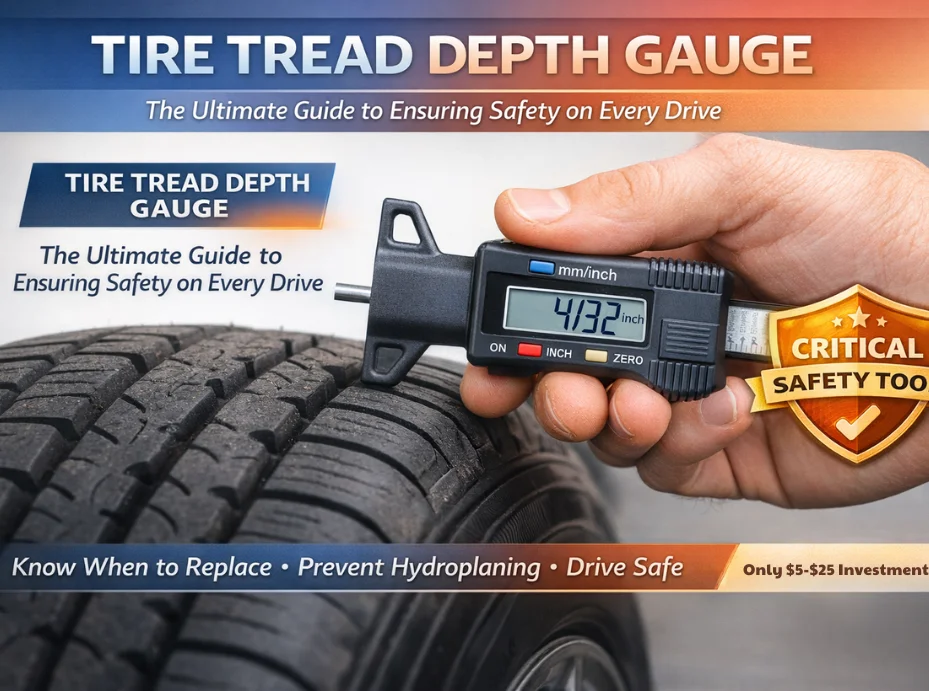
The best and the most reliable method of measuring the tire wear is using a tire tread depth gauge. A gauge offers precise numerical values unlike a coin test, and will enable you to track tread depth change over time and identify areas of uneven wear. Having measured a number of points in each tire, you are able to detect problems of misalignment, inappropriate inflation or suspension problems early on. Such precision does not only ensure safety, but it also can increase tire life, and avoid expensive repairs due to untimely or irregular wear of tires.
Tire Tread Depth Measurement Methods: Accuracy, Cost & Best Use Cases
| Method | Accuracy | Cost | Skill Level | Best For |
| Penny Test | Basic | Free | Beginner | Quick safety checks |
| Quarter Test | Basic | Free | Beginner | Determining replacement timing |
| Tire Tread Depth Gauge | High Precision | $5-$25 | Easy | Accurate monitoring and documentation |
| Tread Wear Indicators | Visual Only | Free | Beginner | Emergency checks |
Benefits of Regular Tread Depth Monitoring
Safety advantages:
- Reduced risk of hydroplaning in wet conditions
- Improved braking performance and shorter stopping distances
- Enhanced vehicle control during emergency maneuvers
- Better traction on snow and ice
Financial benefits:
- Extended tire life through proper rotation scheduling
- Early detection of mechanical issues preventing costly repairs
- Optimal tire replacement timing maximizing value
- Potential insurance benefits from documented maintenance
Performance improvements:
- Maintained fuel efficiency through proper tire contact
- Consistent handling characteristics
- Reduced road noise from evenly worn tires
- Better weight distribution across all four tires
Identifying Uneven Wear Patterns
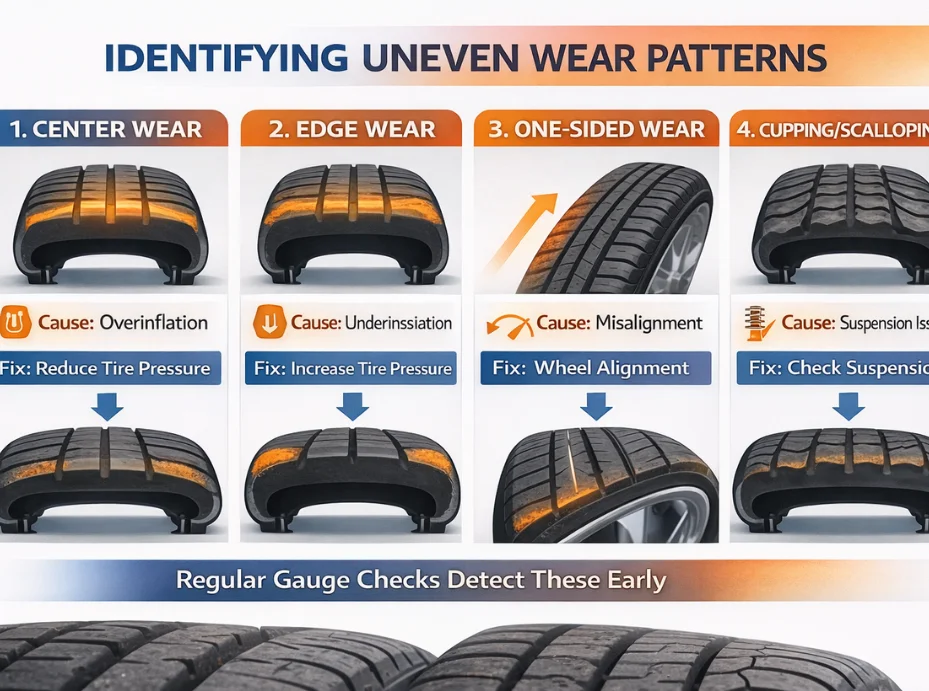
Regular measurements with your tire depth gauge can reveal important maintenance needs:
- Center wear: Indicates overinflation requiring pressure adjustment
- Edge wear: Suggests underinflation or aggressive cornering
- One-sided wear: Points to alignment problems needing professional attention
- Cupping or scalloping: Indicates suspension issues or tire imbalance
When to Replace Your Tires?
Most automotive experts recommend tire replacement when tread depth reaches 4/32 of an inch, particularly if you frequently drive in wet conditions. This threshold provides adequate safety margin before reaching the legal minimum of 2/32 inch. Always replace tires in pairs on the same axle to maintain balanced handling. Match the size, type, speed rating, and load index of your existing tires when purchasing replacements. For comprehensive tire safety information, refer to our detailed tire speed rating chart to ensure you select the correct replacement tires for your vehicle.
Conclusion
Investing in a quality tire tread depth gauge represents a small expense that yields significant returns in safety, performance, and cost savings. This simple tool empowers you to make informed decisions about tire maintenance, rotation schedules, and replacement timing. By measuring tread depth regularly and addressing wear patterns promptly, you protect yourself, your passengers, and other road users while maximizing your tire investment. Don’t wait for a close call to prioritize tire safety—make tread depth monitoring part of your regular vehicle maintenance routine today.
Frequently Asked Questions
What is the desired frequency of checking my tire tread depth?
Make sure the tread depth of your tire is checked monthly with a tire tread depth gauge, and always when the weather is changing seasonally or before some long trips. The frequency assists in the detection of wear patterns at an early stage and guarantees maximum safety.
Is it possible to check all my tires using other means?
Although consistency is preferable; a combination of methods is efficient. Monitor the tire depth with a tire depth gauge regularly every month and the penny test done informally during the periods between formal inspections.
What is the difference between a digital and a mechanical tread fathometer?
Digital gauges have easier reading and are sometimes memory enabled whereas mechanical gauges are cheaper and do not need a battery. When appropriately utilized, both of them are correct in their measurements.
Are not all tires worn at the same rate?
Nope, in front-wheel drive cars, front tires normally wear at higher rates because of steering and power transmission. It should be rotated regularly (after every 5,000-7,000 miles) to provide even distribution on all tires.
Can tread wear indicators be depended upon in the absence of a gauge?
Indicators of tread wear indicate when the tires are at 2/32 inch which is the legal minimum. Nevertheless, the safety professionals suggest a replacement at 4/32 inch that must be measured by using a tire tread depth gauge.