Table of Contents
What Is Fuel System Cleaning?
Fuel system cleaning is a preventive maintenance procedure that removes carbon deposits, varnish, and other contaminants from your vehicle’s fuel delivery system. Over time, gasoline leaves behind residue in the fuel injectors, fuel lines, fuel pump, throttle body, and intake valves — all of which can choke your engine’s performance and fuel efficiency.
This guide is for car owners, DIY mechanics, and anyone who wants to extend engine life, improve gas mileage, and avoid costly repairs down the road. Whether you drive a daily commuter or a high-mileage truck, understanding fuel system cleaning is essential to keeping your vehicle running at its best.
Why Fuel System Cleaning Matters
Modern gasoline, even with fuel detergent additives required by the EPA, leaves behind traces of varnish and carbon with every combustion cycle. According to the U.S. Department of Energy, a clogged or dirty fuel injector can reduce engine efficiency by up to 15%, meaning you’re paying more at the pump for less power.
A clean fuel system ensures:
- Optimal fuel atomization — fuel injectors spray a precise mist for efficient combustion
- Stable idle and smooth acceleration — no misfires or hesitation
- Lower harmful emissions — fewer unburned fuel particles escape into the exhaust
- Extended engine life — less carbon buildup means less wear on pistons and cylinder walls
- Better MPG — a clean system burns fuel completely rather than wastefully
Think of your fuel system like the bloodstream of your engine. Just as clogged arteries restrict blood flow, clogged fuel injectors and dirty fuel lines restrict the flow of gasoline — and your engine suffers the consequences.
Signs Your Fuel System Needs Cleaning

Most drivers ignore their fuel system until something goes obviously wrong. Watch out for these warning signs:
1. Rough or Unstable Idle If your engine shudders or struggles to maintain a steady RPM at a stoplight, dirty injectors may be delivering inconsistent fuel amounts.
2. Hard Starting A dirty fuel system can make it difficult for the engine to build adequate fuel pressure, leading to slow cranking or repeated start attempts.
3. Decreased Fuel Economy Tracking your MPG over time? A sudden or gradual drop in fuel economy is one of the earliest signs of injector deposits or a clogged fuel filter.
4. Poor Acceleration or Hesitation Step on the gas and feel a lag? Clogged injectors can’t deliver the fuel surge your engine demands under acceleration.
5. Engine Misfires Misfires happen when a cylinder doesn’t receive the right fuel-air mixture. This can trigger a check engine light (code P0300 series) and cause the vehicle to run roughly.
6. Black Smoke or Rich Exhaust Smell Excess fuel from a stuck-open or leaking injector can cause black smoke from the exhaust and a noticeable gasoline odor.
7. Failed Emissions Test Dirty injectors contribute to high hydrocarbon and carbon monoxide readings, causing your vehicle to fail state emissions inspections.
What Does a Fuel System Cleaning Include?
A complete fuel system cleaning service at a professional shop typically covers multiple components:
Fuel Injector Cleaning
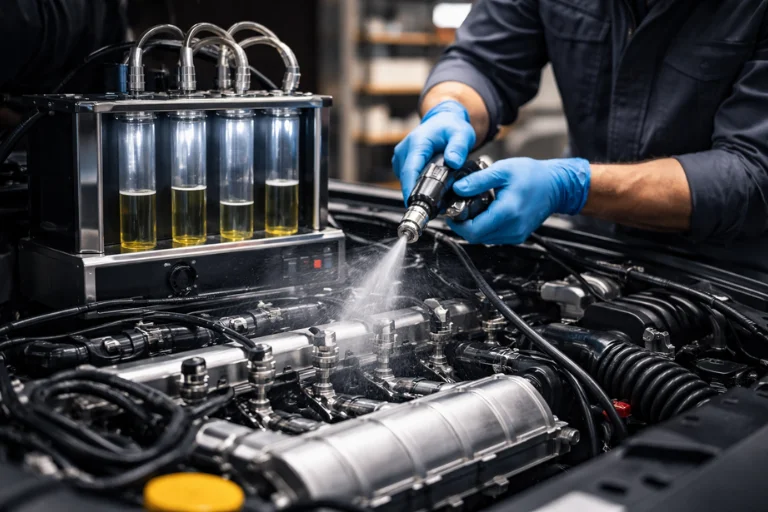
The most critical step. Technicians use a pressurized cleaning solution — often run directly through the fuel rail — to dissolve varnish and carbon deposits inside and around the injector nozzles. Some shops perform ultrasonic injector cleaning off the vehicle for a deeper clean.
Fuel Filter Replacement
A clogged fuel filter starves the engine of fuel and can damage the fuel pump. Most manufacturers recommend replacing the fuel filter every 20,000–40,000 miles, and it’s usually done in conjunction with a fuel system cleaning.
Throttle Body Cleaning
The throttle body controls airflow into the engine. Carbon buildup on the throttle plate causes rough idling and poor throttle response. Technicians spray a dedicated throttle body cleaner to dissolve deposits.
Intake Manifold and Valve Cleaning
On direct-injection (GDI) engines, fuel injectors spray directly into the cylinder — bypassing the intake valves entirely. This means no fuel detergent washes the valves, and carbon deposits accumulate rapidly. Walnut blasting or chemical valve cleaning is often required for GDI engines every 40,000–60,000 miles.
Fuel Pressure Testing
A technician tests fuel pump output pressure to ensure the pump is delivering adequate flow (typically 40–65 PSI depending on the vehicle).
Fuel System Cleaning: DIY vs. Professional Service
| Factor | DIY Fuel System Cleaner | Professional Service |
| Cost | $10–$30 per bottle | $80–$200+ |
| Effectiveness | Mild — good for maintenance | Deep clean for clogged injectors |
| Time Required | 5 minutes (add to tank) | 1–2 hours |
| Tools Needed | None | Specialized equipment |
| Best For | Preventive maintenance | Performance restoration |
| Frequency | Every 3,000–5,000 miles | Every 30,000–60,000 miles |
DIY Fuel Additives like Chevron Techron, Sea Foam, and Lucas Fuel Treatment work best as a preventive measure — keeping your system clean between professional services. Pour them into a full or half-full tank and drive normally.
Professional cleaning is necessary when your vehicle shows actual symptoms: misfires, rough idling, or failed emissions tests. Shops use pressurized cleaning machines with concentrated solvents that are far more powerful than any bottle additive.
Pro Tip: If you’re replacing a major engine component like a used engine or transmission, always follow it up with a full fuel system cleaning. Old engines may have years of deposits that will flow back into your new or replacement part.
How Often Should You Clean Your Fuel System?
There’s no universal interval, but here are commonly recommended guidelines:
- Fuel system additive (DIY): Every 3,000–5,000 miles or every oil change
- Professional fuel injector cleaning: Every 30,000 miles
- Throttle body cleaning: Every 30,000–45,000 miles
- Intake valve cleaning (GDI engines): Every 40,000–60,000 miles
- Fuel filter replacement: Every 20,000–40,000 miles (check your owner’s manual)
High-mileage vehicles (100,000+ miles), those that primarily make short trips, or cars that sit unused for extended periods benefit from more frequent cleaning.
Fuel System Cleaning Cost Breakdown
Here’s what you can expect to pay in the United States in 2025:
| Service | Average Cost |
| DIY fuel additive | $10–$30 |
| Fuel filter replacement | $50–$175 (parts + labor) |
| Throttle body cleaning | $80–$150 |
| Professional injector cleaning (on-car) | $80–$200 |
| Professional injector cleaning (off-car/ultrasonic) | $150–$350 |
| Complete fuel system service (all-in-one) | $150–$400 |
| Intake valve / walnut blasting (GDI) | $400–$800 |
Always get a written estimate before authorizing any fuel system work, and ask whether the technician recommends an injector flow test before and after cleaning to verify improvement.
Best Fuel System Cleaners on the Market
If you’re going the DIY route, these are the most consistently recommended fuel system cleaning additives:
1. Chevron Techron Concentrate Plus Widely considered the industry benchmark. Techron’s PEA (Polyether Amine) formula is highly effective at dissolving varnish and carbon. Use one bottle per 3,000 miles.
2. Sea Foam SF-16 Motor Treatment A versatile product that cleans fuel injectors, stabilizes fuel, and can also be added to oil and crankcase. Excellent for vehicles that sit unused.
3. Lucas Fuel Treatment A popular choice for high-mileage engines. It conditions fuel system components and reduces wear, with a thicker formula that coats injector tips.
4. BG 44K Fuel System Cleaner The professional-grade choice. BG 44K is what many dealerships use in their in-tank cleaning process. Available online and through service shops.
5. Royal Purple Max-Clean A 3-in-1 formula that cleans injectors, carburetors, and intake valves while also improving combustion efficiency.
Related Reading from Tagore AutoParts
If your fuel system cleaning reveals deeper engine problems — like excessive oil consumption, misfires that don’t resolve, or compression issues — you may need more than just a cleaning service.
- Browse Quality Used Engines → — Find affordable used engines for your make and model if your engine is beyond simple maintenance.
- Explore Used Transmissions → — Fuel delivery problems sometimes mask transmission-related performance issues; explore used transmission options if your drivetrain needs attention.
Conclusion
Fuel system cleaning is one of the most overlooked — and most impactful — forms of routine vehicle maintenance. Whether you’re adding a bottle of Techron to your tank every few months or scheduling a full professional cleaning every 30,000 miles, keeping your fuel system free of deposits pays dividends in performance, fuel economy, and engine longevity.
If your cleaning service uncovers more serious engine problems, Tagore AutoParts has you covered. We offer a wide selection of quality used engines and transmissions to keep your vehicle on the road without breaking the bank.
Frequently Asked Questions
Is fuel system cleaning really necessary?
Yes. Over time, every gasoline engine accumulates carbon and varnish deposits in the injectors and intake system. Regular cleaning prevents performance loss, maintains fuel economy, and helps avoid expensive component failures. According to the Car Care Council, neglected fuel systems are one of the top causes of unnecessary engine wear.
Can fuel system cleaning damage my engine?
No, when done correctly with manufacturer-approved products. Professional services use OEM-compatible solvents, and reputable DIY additives are safe for all gasoline engines, fuel injectors, oxygen sensors, and catalytic converters.
How long does a professional fuel system cleaning take?
A standard in-car fuel system cleaning typically takes 1–2 hours. Ultrasonic injector cleaning (where injectors are removed from the vehicle) can take 2–4 hours depending on the number of cylinders.
Will fuel system cleaning improve my MPG?
It depends on how dirty the system is. Vehicles with significant injector deposits can see a 5–15% improvement in fuel economy after a thorough cleaning, according to findings cited by the U.S. Department of Energy vehicle efficiency research. Vehicles already in good condition may see little noticeable change.
Can I do fuel system cleaning with a full tank of gas?
For DIY additives, adding to a half-full tank (8–10 gallons) is often recommended so the concentration is stronger. For professional cleaning services, fuel level doesn’t matter — the machine bypasses the tank entirely.
What’s the difference between a fuel injector cleaner and a fuel system cleaner?
A fuel injector cleaner targets only the injectors. A fuel system cleaner is broader — it addresses the entire system including fuel lines, throttle body, and intake valves. Most quality additives like Techron and BG 44K perform both functions.