Table of Contents
When it comes to vehicle suspension system most of the drivers think about shock, struts or springs. But have you ever wondered what makes the wheels of your car connect to the chassis? Well, there is where the control arm comes in, as this is the another most critical component that keeps your wheels stay connected to the chassis and allows proper suspension movement.
If the control arm or its bushings wear out, it can affect your vehicle’s stability, steering, and overall driving comfort. In this guide, we will discuss what a control arm is, how it works, the common symptoms of a failing control arm, and what you can do to fix the problem.
What Is a Control Arm?
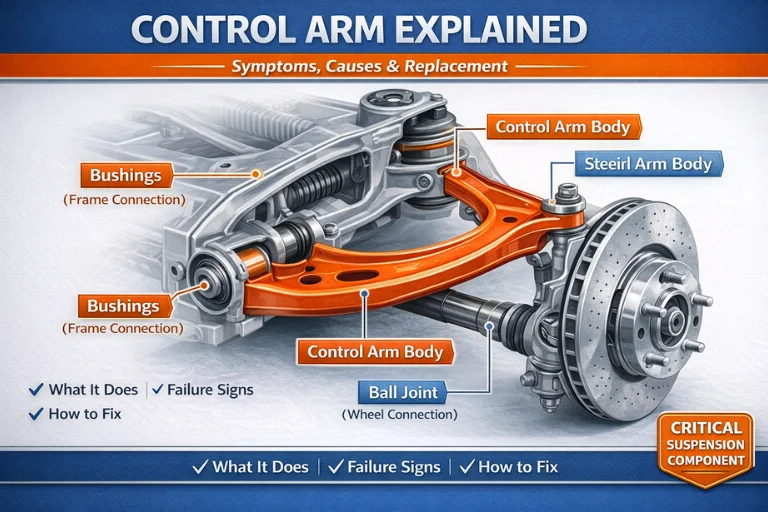
Control arms as the name implies control the motion of the wheels and suspension without blocking the flexibility required to allow smooth and stable driving. It is one of the important aspects of a vehicle suspension system is a control arm which is used to link the chassis or frame to the steering knuckle or wheel hub. It serves as a hinged joint which enables the wheel to go up and down with the suspension and maintain it in appropriate position with the car. This action assists the tires to have consistent contact with the road enhancing stability, steering and comfort of the ride.
Control arms typically have bushings, which will connect them to the frame, and ball joints, which will connect them to the steering knuckle that will ensure that wheels can move freely. They are usually of hardened materials like forged steel, stamp steel, or aluminum to be able to endure all-time stress and road shocks. Certain control arms often have a triangular shapes and are A or L shaped whereas others can be in a straight bar or tube shape. They usually have round bushings, ball joints, or both, that permit movement under control and therefore absorb vibrations.
What to Watch for in a Bad Control System?
The trick to keeping the costs down is to recognize the alarming symptoms at an early stage. The most frequent bad lower control arm symptoms are the following:
- Clunking or Knocking Noises: Clunking sounds during driving on the rough roads bumps, potholes, or speed bumps is among the most common characteristic of failing bad control arm. Worn-out joints enable parts of metal materials to move against one another instead of colliding evenly.
- Vague or Loose Steering: When your steering steers are imprecise or lagging, then you could have steering input being absorbed before the tires respond. You might find that the car is drifting even as you hold the steering wheel in a straight position.
- Irregular Tire Wear: Normal tires wear in a circular manner over the tread length. The failure of the lower control arm may result in the imbalanced force exerted on the outer rim of the tire, which leads to accelerated and unbalanced wear marks.
- Unpredictable/ Random Control Employing: Rough rear control arms tend to make the rear axle lean laterally or fore-aft, giving an impression of being loose or wandering that is particularly evident when changing direction or switching lanes on the highway.
Control Arm Symptoms at a Glance
| Symptom | Likely Cause | Urgency Level |
| Clunking over bumps | Worn bushings or ball joints | High |
| Loose/vague steering | Worn control arm bushings | High |
| Uneven tire wear | Misaligned or worn lower control arm | Medium |
| Erratic handling | Worn rear or front control arm joints | High |
| Vehicle pulling to one side | Damaged control arm or alignment issue | Medium–High |
How to Fix a Bad Control Arm?
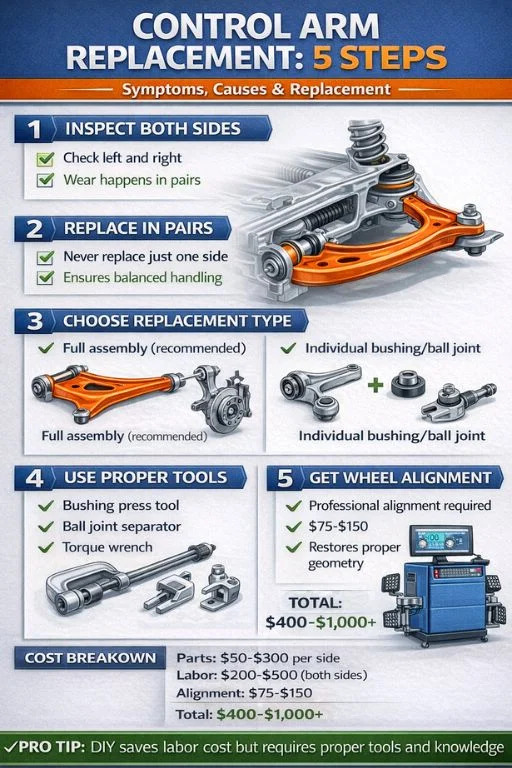
After determining the bad control arm symptoms, the repair procedure normally proceeds in the following way:
- Investigate both sides: You should always check left and right control arm at the same time. When one is worn, the other one is probably very near.
- Replace in pairs: To avoid uneven handling, left/right control arm pairs should be replaced in pairs, and not as individual parts.
- Choose between partial or full replacement: There are some control arms that can be replaced with a press tool individually and some bushing or ball joint. Others can be replaced as a whole unit to achieve increased reliability.
- Get an alignment later: A professional wheel-alignment needs to be performed after any replacement of a control arm has taken place to ensure correct geometries are reinstated.
- Use the right tool: There is a special bushing press tool that is used in pressing out old bushings and installing new ones, which can be found in most auto parts stores.
Conclusion
Control arm is not the most visible part in your car suspension system even so it is a crucial aspect of the stability, steering accuracy, and the general comfort when driving. It gives the suspension a smooth movement by attaching the wheels to the chassis of the vehicle, which ensures that the tires are well put in line with the road. Within a relatively short period of time when the control arm, its bushings, or ball joints start to wear out, such symptoms as clunking sounds, sloppy steering, unevenly worn tires, or an unsteady feel on the road may manifest themselves.
It is imperative to identify these warning signs before it causes additional harm to your suspension system and save you a lot of money in costly repairs. High and regular checks, maintenance, and replacing the worn-out parts of your vehicle can go a long way in enhancing the handling and safety of your vehicle. For comprehensive vehicle maintenance guidance, visit our car maintenance checklist to keep all systems running smoothly.
If you need quality replacement suspension components or OEM parts, Tagore Auto Parts offers reliable solutions for all your automotive needs. Regardless of whether you choose to install the control arm by yourself or to get a professional mechanic to fix it, responding to the problem will assist you to experience a smoother ride, longer tire life and more confidence whenever you are on the road. According to Consumer Reports’ automotive maintenance guidelines, regular suspension inspection is one of the most overlooked yet critical aspects of vehicle safety and longevity.
Frequently Asked Question’s
What is the average life of control arms?
Most control arms have a life span of 90,000-100,000 miles, but depending on the road conditions and the driving styles, it may be much less.
Will a bad control arm allow me to be able to drive?
It can possibly be short routes in case of an emergency but it is highly discouraged. A control arm is worn so that it may lose control on the vehicle abruptly.
How much does a control arm replacement cost?
Parts typically range from $50–$300 per arm depending on the vehicle, with labor adding $100–$300. Complete assemblies cost more but reduce installation time.
Are bad lower control arm symptoms different from upper arm symptoms?
Lower control arm failure more commonly causes clunking and tire wear issues, while upper arm wear tends to produce more steering vagueness and instability.