Key Takeaways
- A V4 (Inline-4) engine has 4 cylinders and is lighter, more fuel-efficient, and less expensive to maintain.
- A V6 engine has 6 cylinders and delivers more horsepower, torque, and towing capacity.
- The right choice depends on your driving needs, vehicle type, and budget.
- Tagore Auto Parts stocks quality tested used V4 engine and V6 engines shipped across the USA.
Table of Contents
What Is a V4 Engine?
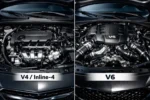
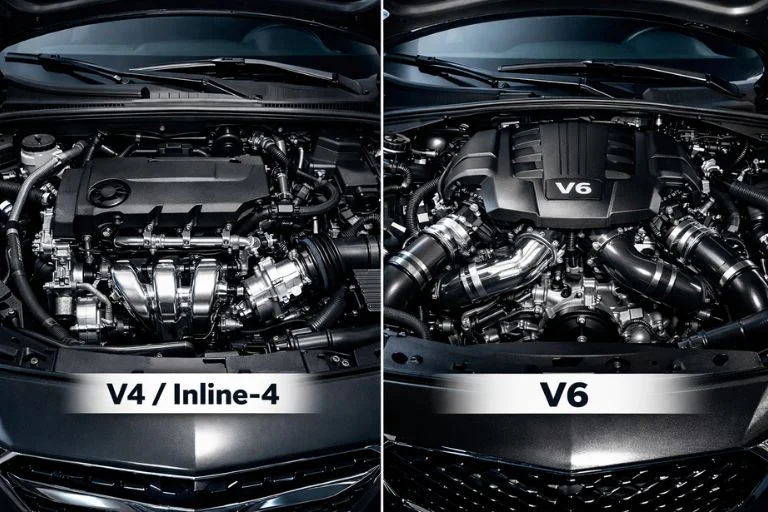
A V4 engine — more accurately called an Inline-4 or Straight-4 (I4) engine in most passenger vehicles — is a four-cylinder internal combustion engine where all four cylinders are arranged in a single row. It is the most common engine configuration in modern cars worldwide, found in small sedans, compact SUVs, hatchbacks, and economy vehicles.
This article is for car owners, fleet managers, and DIY mechanics who are deciding between a four-cylinder and six-cylinder engine — whether for a new purchase, an engine replacement, or a rebuild project.
True “V4” configurations (cylinders in a V-shape) are rare and mostly found in specific motorcycles and older European vehicles. In everyday automotive conversation, “V4” and “4-cylinder” are used interchangeably to refer to any four-cylinder engine.
Common V4 / Inline-4 engine vehicles:
- Toyota Camry (2.5L I4)
- Honda Civic (1.5L Turbocharged I4)
- Ford Focus (2.0L I4)
- Mazda3 (2.5L SkyActiv-G I4)
- Subaru Impreza (2.0L Boxer-4)
The typical displacement range for a four-cylinder engine is 1.4L to 2.5L, with turbocharged variants capable of producing outputs previously reserved for larger engines.
What Is a V6 Engine?
A V6 engine is a six-cylinder internal combustion engine where the cylinders are arranged in a V-configuration — typically at a 60° or 90° angle. This layout allows a larger engine to fit into a relatively compact space, making it popular in mid-size sedans, trucks, SUVs, and performance vehicles.
V6 engines generally displace between 2.5L and 4.0L and are prized for their balance of power and refinement. They are smoother than four-cylinder engines due to the additional cylinders firing more frequently per engine rotation.
Common V6 engine vehicles:
- Toyota Camry V6 (3.5L V6 — 301 hp)
- Ford F-150 (3.5L EcoBoost V6 — 400 hp)
- Honda Accord (3.5L V6)
- Chevrolet Equinox (older 3.6L V6)
- Nissan Murano (3.5L V6)
- Dodge Charger (3.6L Pentastar V6 — 292 hp)
V4 Engine vs V6 Engine : Key Differences at a Glance
| Feature | V4 (Inline-4) Engine | V6 Engine |
| Cylinders | 4 | 6 |
| Typical Displacement | 1.4L – 2.5L | 2.5L – 4.0L |
| Average Horsepower | 100 – 200 hp | 200 – 400 hp |
| Average Torque | 120 – 200 lb-ft | 200 – 350 lb-ft |
| Fuel Economy (City/Hwy) | 25–35 MPG / 30–42 MPG | 18–24 MPG / 24–32 MPG |
| Towing Capacity | Up to 1,500 lbs | Up to 5,000+ lbs |
| Engine Weight | Lighter (~250–350 lbs) | Heavier (~350–500 lbs) |
| Maintenance Cost | Lower | Higher |
| Common Use | Sedans, compact SUVs | Trucks, mid-size SUVs, performance |
Power & Performance
When it comes to raw power, the V6 engine wins — but the gap has narrowed significantly thanks to turbocharging technology.
A naturally aspirated four-cylinder engine typically produces between 100 and 180 horsepower. However, modern turbocharged four-cylinder engines — such as the Ford EcoBoost 2.3L — can produce up to 310 horsepower, rivaling many V6 outputs. According to data published by the U.S. Department of Energy, average engine displacement in U.S. passenger vehicles has trended downward as turbocharged 4-cylinder engines replace larger V6 units without sacrificing performance.
A standard V6 engine produces between 200 and 400 horsepower depending on displacement, tune, and forced induction. The Ford F-150’s 3.5L EcoBoost V6 generates 400 hp and 500 lb-ft of torque — figures that match or exceed many V8 trucks from just 15 years ago.
Winner for Performance: V6 (naturally aspirated), but Turbocharged V4 is competitive.
Fuel Economy
Fuel efficiency is one of the most significant advantages of a four-cylinder engine. Fewer cylinders mean less fuel consumed during each combustion cycle, resulting in meaningfully better MPG ratings.
According to fueleconomy.gov, a 2024 Toyota Camry with a 2.5L four-cylinder engine achieves 28 city / 39 highway MPG, while the same car equipped with a 3.5L V6 achieves just 22 city / 33 highway MPG. That difference of roughly 6 MPG can translate to $600–$1,000 in annual fuel savings depending on your driving habits and local gas prices.
That said, some modern V6 engines with cylinder deactivation technology — which shuts down 2–3 cylinders under light load — have closed this gap considerably.
Winner for Fuel Economy: V4 / Inline-4 Engine, clearly.
Reliability & Maintenance Cost
Four-cylinder engines are generally simpler, lighter, and less expensive to maintain than V6 engines. With fewer cylinders, there are fewer spark plugs, less engine oil required, and simpler valve train architecture.
- A typical four-cylinder engine tune-up (spark plugs, air filter, oil change) costs $150–$300
- A V6 tune-up for the same service can run $250–$500 due to the additional components
Both engine types are highly reliable when properly maintained. Honda’s 1.5L and 2.0L four-cylinder engines, Toyota’s 2AR-FE 2.5L, and Mazda’s SkyActiv-G series are widely praised for their longevity — frequently exceeding 200,000 miles with regular oil changes.
V6 engines like Toyota’s 2GR-FE 3.5L and Honda’s J-series are equally legendary for reliability. However, if a V6 engine does require major repairs — such as head gasket replacement or timing chain service — labor costs are significantly higher due to engine complexity.
Winner for Reliability & Cost: V4 for lower maintenance cost; both are reliable if maintained.
Towing & Hauling Capacity
If you need to tow a trailer, boat, or camper, the V6 engine is the clear winner.
Most four-cylinder vehicles are rated for towing 500 to 1,500 lbs — suitable for small utility trailers or jet skis. In contrast, a V6-powered truck or SUV can tow anywhere from 3,500 to 8,500 lbs depending on the vehicle configuration and hitch package. The Ford F-150 with the 3.5L EcoBoost V6 is rated to tow up to 13,200 lbs when properly equipped.
If you regularly tow heavy loads, a V6-equipped vehicle provides the torque and thermal capacity to do so safely and without excessive strain on the drivetrain.
Winner for Towing: V6 Engine, decisively.
Which Engine Is Best for Your Vehicle?
Choose a V4 / Inline-4 Engine if you:
- Drive primarily in the city or on the highway without heavy cargo
- Want to maximize fuel economy and reduce operating costs
- Own a compact sedan, small SUV, or commuter vehicle
- Are replacing a blown engine in an economy car
- Are on a tighter budget for both purchase and long-term maintenance
Choose a V6 Engine if you:
- Need towing or hauling capability
- Want a smoother, more refined driving experience
- Drive a mid-size or full-size SUV, truck, or performance sedan
- Frequently drive on highways at sustained high speeds
- Are replacing an engine in a vehicle originally equipped with a V6
Pro Tip: When replacing an engine, always match the same engine family and displacement as your original. Swapping from a V6 to a V4 requires significant modifications to the engine bay, wiring harness, and transmission — typically making it cost-prohibitive.
Cost of Used V4 vs V6 Engines
Engine replacement is one of the most significant repairs a vehicle can need. Purchasing a quality used engine is one of the most cost-effective alternatives to buying a brand new crate engine or replacing the entire vehicle.
Average Used Engine Pricing (USA market):
| Engine Type | Used Engine Price Range | New Crate Engine Price Range |
| Used V4 / Inline-4 | $500 – $1,800 | $1,800 – $4,000 |
| Used V6 | $800 – $2,500 | $2,500 – $6,500 |
At Tagore Auto Parts, we supply quality-tested used V4 and V6 engines sourced from low-mileage vehicles. Every engine is inspected before shipping and we ship across all 50 U.S. states with fast turnaround times.
Whether you need a used Toyota 2.5L four-cylinder, a Honda 3.5L V6, a Ford 2.3L EcoBoost, or a Dodge Pentastar V6, we likely have it in inventory.
Find Used Transmissions for Your Vehicle
Conclusion
When comparing a V4 engine vs V6 engine, there is no single correct answer — the best choice depends entirely on what you need from your vehicle.
A V4 (Inline-4) engine is the smart pick for everyday commuters who want reliability, fuel efficiency, and lower long-term costs. A V6 engine is the right choice for drivers who need towing power, highway performance, and a smoother drive.
If you’re dealing with a blown engine and need a replacement, buying a quality used engine is the most cost-effective path — and that’s where Tagore Auto Parts comes in. We specialize in low-mileage, tested used V4 and V6 engines shipped fast across the entire United States.
Don’t let a dead engine sideline your vehicle. Get back on the road with a reliable used engine from Tagore Auto Parts.
Frequently Asked Question
Is a V4 engine better than a V6?
Neither is universally better — it depends on your needs. A V4 (four-cylinder) engine is better for fuel economy and lower maintenance costs, making it ideal for commuter vehicles. A V6 is better for power, towing, and performance. If fuel savings matter most, choose a V4; if you need more power or tow frequently, a V6 is the right choice.
Can I replace a V6 engine with a V4 in my car?
Technically possible, but practically very complex and expensive. Swapping a V6 for a V4 requires modifying the engine mounts, wiring harness, transmission, and sometimes the engine bay itself. In almost all cases, it’s far more practical and cost-effective to replace a V6 with an identical or compatible V6 engine from a reputable used engine supplier like Tagore Auto Parts.
How many miles can a V4 engine last?
A well-maintained four-cylinder engine can last 150,000 to 250,000 miles or more. Engines from Toyota, Honda, and Mazda are particularly known for longevity. Regular oil changes every 5,000–7,500 miles and using the manufacturer-recommended oil grade are the biggest factors in engine lifespan.
How many miles can a V6 engine last?
V6 engines are equally capable of lasting 150,000 to 250,000+ miles with proper maintenance. Engines like the Toyota 3.5L V6 (2GR-FE) and Honda 3.5L J-series V6 are famous for their durability and are frequently found running reliably well past 200,000 miles.
Does a V6 engine always use more gas than a V4?
Generally yes — a V6 uses more fuel than a comparable four-cylinder under normal conditions. However, modern V6 engines with cylinder deactivation technology, direct injection, and variable valve timing have significantly improved fuel efficiency. Some V6 engines now achieve fuel economy within 3–4 MPG of equivalent four-cylinder vehicles.
Where can I buy a used V4 or V6 engine in the USA?
Tagore Auto Parts supplies quality used V4 and V6 engines to customers across all 50 U.S. states. Our inventory includes engines from all major manufacturers — Toyota, Honda, Ford, Chevrolet, Dodge, Nissan, Subaru, and more.
What is the average cost to replace a V6 engine?
The total cost to replace a V6 engine includes the engine itself plus labor. A used V6 engine typically costs $800–$2,500 depending on the make and mileage. Labor for engine replacement ranges from $1,000–$2,000 at most independent shops. The total all-in cost is typically $1,800–$4,500 — significantly less than purchasing a replacement vehicle.