Table of Contents
Whether you are an owner of Lexus or Toyota, there was a time when you saw the VSC light appear on your dashboard and you wondered what it is. Although it may not sound like a big or rather insignificant warning, it is actually connected to your car Vehicle Stability Control (VSC) which is a vital safety measure that will assist you in being able to be in control during a sharp turn, a slippery road, or even some unforeseen maneuvers.
This system operates in the background by modifying the engine power and applying brakes to specific wheels to eliminate skidders and enhance stability. Once the VSC light activates, that is your cars way of letting you know that the system can be left off, or things are not working properly or the system needs to be given a look at. Knowing what this light means and how to act on it can make you safe and avoid possible difficulties in the future.
What Is an Electronic Stabilization Program?
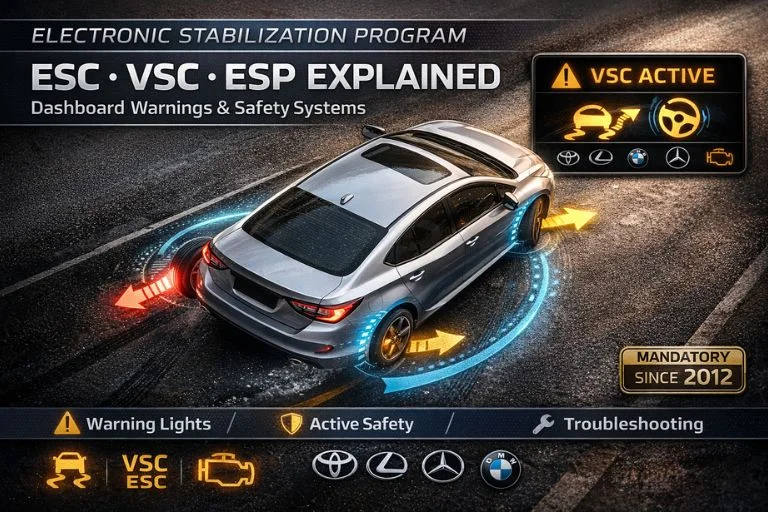
Electronic Stabilization Program (ESP) (which is also called Electronic Stability Control (ESC) or Vehicle Stability Control (VSC)) is a type of active safety system, which is designed to stabilize the loss of traction on its own. Where the system realizes that your car is sliding or moving in a different direction than you want it to go then it implements a level of force to the wheels, and it also reduces the engine torque so that you can get recovered and continue to move in the controlled and stable direction.
Different automakers use different names to refer to more or rather similar technology. It is called VSC by Toyota and Lexus, DSC (Dynamic Stability Control) by BMW, ESP (Electronic Stability Program) by Mercedes-Benz and Volkswagen and AdvanceTrac by Ford. Although the various branding alternatives offered by these systems all appear to be based on the same fundamental principle.
Electronic Stabilization Program by Manufacturer
| Manufacturer | Brand Name | Abbreviation |
|---|---|---|
| Toyota / Lexus | Vehicle Stability Control | VSC |
| GM / Chevrolet | Electronic Stability Control | ESC |
| BMW | Dynamic Stability Control | DSC |
| Mercedes-Benz | Electronic Stability Program | ESP |
| Ford | AdvanceTrac / RSC | ESC |
| Honda | Vehicle Stability Assist | VSA |
| Volkswagen / Audi | Electronic Stabilization Program | ESP |
How Does the Electronic Stabilization Program Work?
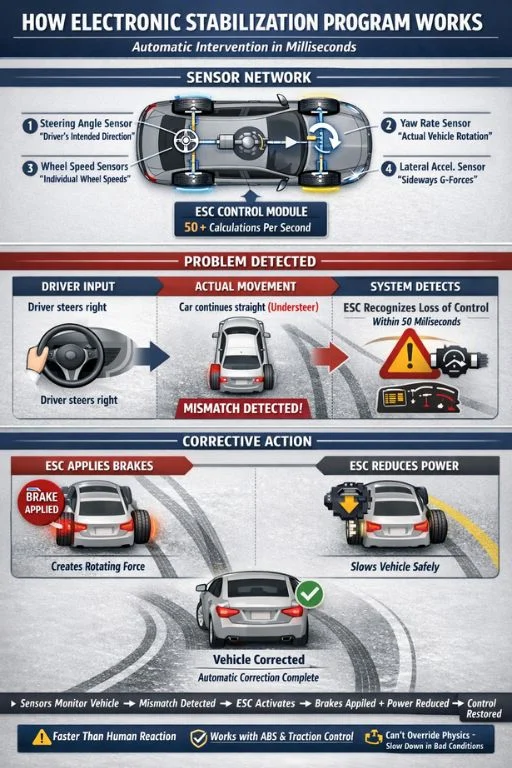
The electronic stabilization program is based on a system of real-time working sensors:
- Speed sensors in the wheel: detect the speed of rotation in every wheel.
- Steering angle sensor: Measures the direction that the driver wants to move.
- Yaw rate sensor: measures the rotation on the vertical axis of the car.
- Lateral acceleration sensor: Sides force on the vehicle.
All these sensors process the data through the ESC control module dozens of times in a second. In the event that it notices a mismatch such as the steering wheel is straight ahead yet the car is turning on the side it automatically initiates corrective action within less than 50 milliseconds.
Understanding the Stability Control System Components
The electronic stabilization program works in conjunction with other critical vehicle systems to maintain control. Similar to how the ABS system prevents wheel lockup during braking, or how the alternator ensures electrical systems remain powered, ESC relies on multiple components working together. Sensor issues in the system may trigger warning lights similar to those from a faulty camshaft position sensor or ignition coil. In severe cases where electronic system failures damage the engine through loss of control, you may need remanufactured engines or replacement transmissions to restore your vehicle.
What Does VSC Mean in a Car?
VSC Vehicle Stability Control VSC is the safety system in the cars that is developed to aid in avoiding skidding and control the car by automatically adjusting engine power and brakes. The flash of the VSC light as the engine starts is normal as it goes through a self-check. But with the light remaining on, then it means that there is a fault with the stability control system. Common causes include:
- a faulty wheel speed sensor,
- a defective steering angle sensor,
- poor battery or charging performance,
- a loose or damaged ABS ring,
- faults in traction control and brake system.
There are situations when even the slightest problem such as a low spare tire or a loose fuel cap can define the red flag. It is, however, a good idea to stay on the safe side and have a qualified technician read the diagnostic codes of your vehicle to determine and correct the issue before it impacts on your driving safety.
Understanding Dashboard Warning Lights
| Warning Light | Meaning | Action Required |
|---|---|---|
| VSC Light (solid) | VSC system is actively engaged | None system working normally |
| Check VSC / VSC OFF | VSC system has been disabled | Re-enable or check owner’s manual |
| Check VSC System | Fault detected in VSC system | Visit a mechanic for diagnosis |
| Service ESC / Service ESC Meaning | ESC/VSC malfunction detected | Schedule service immediately |
| ABS + VSC Together | ABS and stability system fault | Urgent seek professional help |
Steps to Take When the Service ESC Light Appears
- Do not overreact to other safety systems of your car (ABS, brakes) still have to work.
- Slow down, drive carefully, particularly under wet or icy conditions.
- As a calibration reset could be the solution to checking whether the light came out once a battery was replaced.
- Read fault codes using OBD-II diagnostic scanner.
- Check wiring and wheel speed sensors that are visible.
- See an experienced mechanic in case the fault code directs to more serious problem in the system.
ESC vs. Traction Control: Understanding the Difference
Electronic stabilization program is mixed up with Traction Control (TC) by many drivers. Although such systems have similar hardware, they play different roles: Traction Control- The device prevents wheel spinning when accelerating, mostly in slip surfaces. It also controls drive wheel slip. Electronic stabilization program controls all the vehicle yaw action it includes understeer (driving off side), oversteer (rear stepping out), in any driving situation, not only accelerating. Consider traction control to be a sub-set of the entire electronic stabilization program. ESC does contain traction control functionality and much more.
Is It Safe to Drive ESC Disabled?
In the case of the daily commute, the response is no it is not safe to have ESC off. Switching off the system greatly increases chances of skid and loss of control particularly when making abrupt turn or when using wet and icy roads. With this said, certain exceptions are applicable.
In case your car is caught up in mud, sand, or thick snow, it is sometimes necessary to turn off ESC temporarily to get the wheels to turn more freely in order to re-engage. Other situations where the system may be disabled to allow more manual control by the experienced drivers include off-road driving and the use of controlled tracks. In any case other than these, it is always safer to maintain ESC active.
Conclusion
The electronic stabilization program is among the unsung heroes of the contemporary road safety silently operating in the background to avoid accidents that drivers might never know were about to occur. Learning the meaning of VSC displayed on a car, the meaning of a service ESC warning and how to react to a check VSC system alert can be vital to your safety as well as your wallet. You have an ESC warning light and you should not pass over it. Get the system diagnosed immediately, continue to drive carefully in the meantime and bear in mind that despite the system being offline, slow careful driving can do wonders.
Frequently Asked Questions
In a simple explanation, what is the electronic stabilization program?
It is a kind of automatic safety mechanism that realizes when your car begins to skid or lose its control and brakes down on the separate wheels to get the car back on track even quicker than a human could intervene.
What is the meaning of service ESC on my dashboard?
It is an indication that the ESC system has already identified a fault and it is disabled. A mechanic who is able to read the diagnostic codes stored therein should check the vehicle.
What does VSC mean in a car, does it mean the same thing as ESC?
Yes. VSC (Vehicle Stability Control) is the brand name of the identical technology that Toyota and Lexus use that is known as ESC or ESP by other manufacturers. They are exactly the same functionally.
Self-checking of VSC system faults?
A diagnostic scanner connected to your cars diagnostic port (typically under the dashboard) will read the specific fault codes that the ECU has stored which will indicate which specific component requires your attention.
Is it possible to reset the ESC warning light?
In other cases when the fault is caused by changing the battery or a temporary sensor glitch clearing the fault by reconnecting the battery and then reconnecting the sensor can be done. The light will however reoccur in the event that there is an underlying fault. It should never be reset without diagnosing first.
Is ESC mandatory in new cars?
Yes, the US required ESC on all new passenger automobiles since the 2012 model year.