Table of Contents
What Is an ECM (Engine Control Module)?
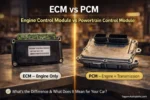
This article is for car owners, DIY mechanics, and anyone facing a check engine light or module failure who wants to understand the difference between an engine control module (ECM) and a powertrain control module (PCM) — and make a smart, informed repair decision before spending a dollar.
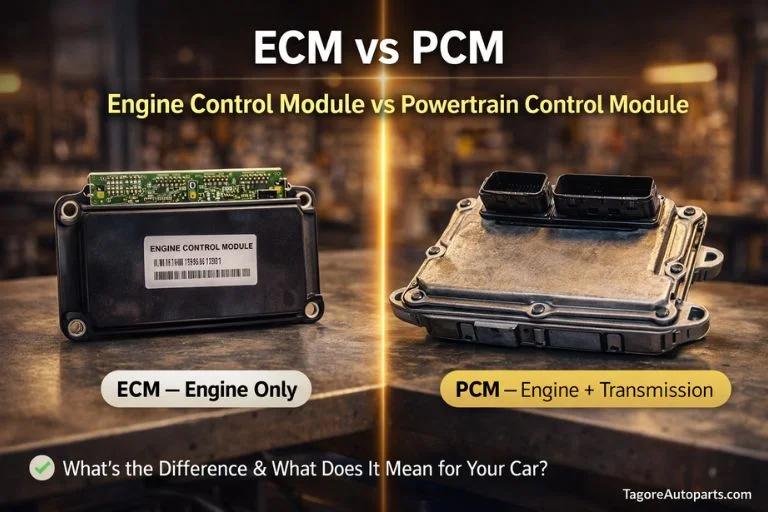
The Engine Control Module (ECM) — also called the Engine Control Unit (ECU) — is the dedicated computer that manages your vehicle’s engine functions and nothing else. Think of it as the brain of your engine. It continuously monitors data from dozens of sensors throughout the engine bay and makes real-time adjustments to keep the engine running efficiently, cleanly, and reliably.
The ECM controls critical engine functions including:
- Fuel injection timing and duration — how much fuel enters each cylinder and when
- Ignition timing — when the spark plugs fire relative to piston position
- Air-to-fuel ratio — maintaining the ideal mixture for combustion efficiency
- Idle speed control — keeping the engine stable at rest
- Emissions controls — managing EGR valves, oxygen sensors, and catalytic converter function
- Variable valve timing — optimizing power and efficiency across RPM ranges
The ECM receives real-time input from sensors including the Mass Airflow Sensor (MAF), Oxygen Sensors (O2), Crankshaft Position Sensor, Throttle Position Sensor (TPS), and Coolant Temperature Sensor. Based on this data, it fires outputs to actuators — injectors, coils, solenoids — dozens of times per second.
In older vehicles (primarily pre-2000), the ECM was a standalone unit focused exclusively on engine management. In most modern vehicles, ECM functions have been absorbed into the larger PCM. If your ECM is severely damaged and beyond repair, it may indicate broader engine stress — in which case reviewing your used engine options is a smart next step before investing in repairs on a high-mileage motor.
What Is a PCM (Powertrain Control Module)?
The Powertrain Control Module (PCM) is an expanded, all-in-one computer that combines the functions of both the Engine Control Module (ECM) and the Transmission Control Module (TCM) into a single integrated unit. Rather than managing just the engine, the PCM oversees the entire powertrain — every system involved in generating and delivering power to the wheels.
The PCM controls everything the ECM does, plus:
- Automatic transmission shift points — when and how the transmission changes gears
- Torque converter lockup — managing the connection between engine and transmission
- Transmission line pressure — regulating hydraulic pressure within the transmission
- All-wheel drive and 4WD engagement — in applicable vehicles
- Traction control integration — coordinating engine output with wheel slip data
- Emissions system oversight — including EVAP system monitoring and OBD-II diagnostic reporting
Because the PCM handles both engine and transmission data simultaneously, it can make more coordinated, efficient decisions than two separate modules communicating with each other. For example, when the PCM detects a wide-open throttle event, it can simultaneously enrich the fuel mixture AND delay the transmission upshift — something a standalone ECM and TCM would have to coordinate over a communication bus.
A failing PCM doesn’t just affect engine performance — it can also cause serious transmission damage over time. If your PCM has been running faulty shift commands for an extended period, it is worth inspecting your used transmission options before the damage compounds further. The PCM became the standard configuration in most domestic vehicles through the mid-to-late 1990s and is now the dominant module type across virtually all major manufacturers.
ECM vs PCM: Key Differences at a Glance
| Feature | ECM | PCM |
| Full Name | Engine Control Module | Powertrain Control Module |
| Also Known As | ECU (Engine Control Unit) | Combined ECM + TCM |
| Controls Engine | ✅ Yes | ✅ Yes |
| Controls Transmission | ❌ No | ✅ Yes |
| Controls AWD / 4WD | ❌ No | ✅ Sometimes |
| Typical Vehicle Era | Pre-2000 (mostly) | 2000–present (mostly) |
| Common Brands | Older Ford, GM, Chrysler | Most modern vehicles |
| Replacement Cost (Used) | $150 – $500 | $200 – $600 |
| Replacement Cost (New OEM) | $600 – $1,200 | $800 – $1,500+ |
| Requires Reprogramming | Usually | Almost always |
How ECM and PCM Work Together
In vehicles that use a separate ECM and TCM (rather than a combined PCM), the two modules communicate constantly over the vehicle’s CAN bus (Controller Area Network). This communication network allows modules to share real-time data — engine load, RPM, throttle position, vehicle speed — so each system can make informed decisions.
However, integrated PCMs have a significant advantage: they eliminate the communication latency between modules. When engine and transmission logic live in the same processor, the PCM can coordinate gear changes with fuel delivery in real time without waiting for inter-module messages. This results in smoother shifts, better fuel economy, and faster response to driver inputs.
According to the Society of Automotive Engineers (SAE), integrated powertrain control has been shown to improve fuel efficiency by 3–7% compared to separate ECM/TCM configurations in equivalent drivetrain setups — one of the primary reasons automakers adopted the PCM standard through the late 1990s and early 2000s.
Which One Does Your Car Have?
Determining whether your vehicle uses an ECM, a PCM, or both is straightforward:
Step 1 — Check your vehicle year:
- Pre-1996: Likely uses a standalone ECM (and possibly a separate TCM)
- 1996–2002: Transitional era — could be either, depending on make and model
- 2003–present: Almost certainly uses a PCM
Step 2 — Check by manufacturer:
| Manufacturer | Module Type | Notes |
| Ford (post-1994) | PCM | Ford standardized PCM early |
| GM / Chevrolet (post-1996) | PCM | Some models use ECM + separate TCM |
| Chrysler / RAM / Jeep | PCM | Integrated since mid-1990s |
| Toyota / Lexus | ECM + TCM (separate) | Toyota commonly keeps them separate |
| Honda / Acura | ECM / PCM varies | Varies by model and year |
| BMW | DME (ECU) + separate TCM | European terminology differs |
| Mercedes-Benz | ME-SFI (ECU) + TCM | Separate modules common |
Step 3 — Use an OBD-II scan tool: A professional scan tool will identify connected modules and their designations. If your scanner shows a single “PCM” module, your vehicle uses an integrated unit. If it shows separate “ECM” and “TCM” entries, your vehicle uses a distributed module configuration.
Signs of a Failing ECM or PCM
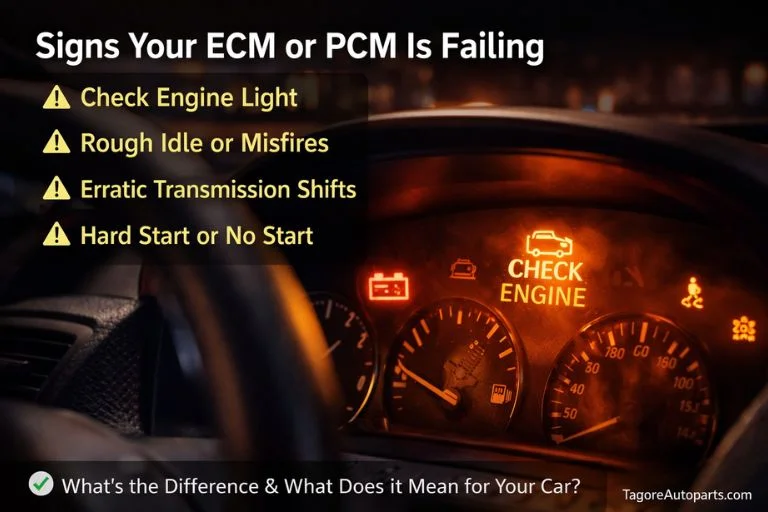
A failing engine control module or powertrain control module will almost always trigger symptoms before complete failure. Catching these early can prevent cascading damage to your engine and transmission. Watch for these warning signs:
Engine-Related Symptoms (ECM or PCM)
- Check Engine Light (CEL) — the most common early indicator; often accompanied by stored fault codes
- Engine misfires or rough idle — the module loses accurate control of fuel and ignition timing
- Hard starting or no-start condition — ECM/PCM fails to initiate the proper start sequence
- Poor fuel economy — inefficient fuel delivery due to faulty sensor data processing
- Engine stalling — especially at idle or low speeds
- Failed emissions test — module unable to maintain proper air-fuel ratio or EGR function
If these symptoms are accompanied by internal engine noises, excessive oil consumption, or loss of compression, the engine itself may be compromised beyond what a module fix can resolve. In that case, explore our guide on signs your engine is failing to understand whether a used engine replacement makes more financial sense.
Transmission-Related Symptoms (PCM Only)
- Erratic or harsh gear shifts — PCM loses accurate shift point data
- Transmission stuck in one gear — limp mode activation due to module fault
- No upshift or downshift response — torque converter or solenoid control failure
- Transmission warning light — in vehicles with dedicated transmission indicators
Persistent PCM-driven transmission faults can accelerate internal wear inside the gearbox. If transmission symptoms have been present for an extended period alongside a PCM fault, read our used transmission price guide by car type to benchmark replacement costs before deciding whether repair or replacement is the better path.
Module-Specific Warning Signs
- Multiple unrelated fault codes — a failing module throws codes across multiple systems simultaneously
- Intermittent symptoms — problems appear and disappear, worsening with heat or vibration
- Symptoms after water intrusion — ECM/PCM exposed to flood or heavy moisture
Important: Before replacing an ECM or PCM, always have a professional diagnose the root cause. Many ECM/PCM “failures” are actually caused by bad sensors, wiring harness damage, or ground faults. Replacing a module without fixing the underlying cause will damage the new unit.
ECM vs PCM: Replacement Cost
Replacement costs vary significantly based on whether you choose used, remanufactured, or new OEM units:
Used ECM / PCM Cost
| Vehicle Type | Used ECM Price | Used PCM Price |
| Economy / Compact Car | $150 – $350 | $200 – $450 |
| Mid-Size Sedan | $200 – $400 | $250 – $500 |
| Pickup Truck | $250 – $500 | $300 – $600 |
| SUV / Crossover | $220 – $480 | $280 – $580 |
| Luxury / European | $400 – $900 | $500 – $1,200 |
Remanufactured ECM / PCM Cost
Remanufactured units typically run $300 – $1,000 depending on vehicle type and come with a 1–2 year warranty. They are tested, reprogrammed, and restored to OEM specifications — a good middle ground between a used unit and a new OEM module.
New OEM ECM / PCM Cost
New dealer units run $800 – $1,500+ for most vehicles, and significantly more for European luxury brands. These are the most expensive option but come with full manufacturer warranty coverage and are pre-programmed for your vehicle.
Labor and Programming Cost
Installation itself is typically $75 – $200 in labor. However, programming and flashing the new module to your vehicle’s VIN adds $100 – $300 at most shops. Some modules require dealer-level programming tools, which can push total labor costs to $300 – $500.
According to RepairPal, total ECM/PCM replacement costs including parts and labor average $450 to $1,500 depending on vehicle make, model, and programming requirements.
Total replacement cost (used module + labor + programming): $400 – $1,000 for most vehicles.
ECM vs PCM vs TCM vs BCM: Full Comparison
Many drivers confuse these four modules. Here is how they differ:
| Module | Full Name | Controls |
| ECM | Engine Control Module | Engine only (fuel, ignition, emissions) |
| PCM | Powertrain Control Module | Engine + Transmission (combined) |
| TCM | Transmission Control Module | Transmission only (separate from ECM) |
| BCM | Body Control Module | Electrical body systems (lights, windows, locks, HVAC) |
Most modern vehicles use one of two configurations:
Configuration A — Integrated (PCM): One module handles engine and transmission. Common in Ford, GM, Chrysler, RAM, and Jeep vehicles.
Configuration B — Distributed (ECM + TCM): Separate modules communicate over the CAN bus. More common in Toyota, Honda, BMW, and Mercedes-Benz vehicles.
Neither configuration is inherently superior — it depends on the manufacturer’s engineering philosophy. What matters for repair purposes is knowing exactly which module your vehicle uses before ordering a replacement or diagnosing a fault.
How a Bad ECM or PCM Can Damage Your Engine and Transmission
This is the section most repair guides skip — and it’s one of the most important.
A failing ECM or PCM does not just cause warning lights and rough running. Left unaddressed, it can cause progressive physical damage to the two most expensive components in your vehicle: the engine and the transmission.
Engine Damage from a Failing ECM
When the ECM loses accurate control of fuel delivery, a rich fuel condition (too much fuel) can wash cylinder walls of lubricating oil — accelerating piston and ring wear. A lean condition (too little fuel) causes combustion temperatures to spike, which can damage pistons, valves, and head gaskets over time. Persistent misfires caused by faulty ignition timing commands can crack pistons and damage catalytic converters.
If ECM-related engine damage has progressed to the point where internal components are worn or failed, a used engine replacement is often more economical than rebuilding individual components. Browse our full inventory of used engines at Tagore Autoparts — every unit is sourced from verified salvage vehicles and backed by a 90-day warranty.
Transmission Damage from a Failing PCM
Because the PCM directly controls transmission shift points, line pressure, and torque converter lockup, a malfunctioning PCM can cause the transmission to shift too hard, too late, or at the wrong RPM — dramatically accelerating wear on clutch packs, bands, and solenoids. In worst-case scenarios, a PCM commanding incorrect line pressure can cause complete clutch pack failure within tens of thousands of miles.
If you are seeing transmission symptoms alongside PCM fault codes, inspect the transmission before assuming the module alone is at fault. Our used transmission price guide by car type will help you benchmark replacement costs, and our full inventory of used transmissions at Tagore Autoparts offers warrantied, low-mileage units ready to ship.
Final Verdict
Understanding the difference between an ECM (Engine Control Module) and a PCM (Powertrain Control Module) is the first step toward a smart repair decision. The ECM manages engine functions only. The PCM integrates both engine and transmission control into one unit. Most vehicles built after 2000 use a PCM, and a failing one can affect both your engine performance and your transmission health simultaneously.
Catching module problems early prevents the kind of cascading damage that turns a $400 module fix into a $2,000 engine or transmission repair. If your diagnostics reveal that engine or transmission damage has already occurred alongside a module fault, sourcing a quality used replacement is the most cost-effective path forward.
At Tagore Autoparts, we specialize in quality used engines and transmissions sourced from verified salvage vehicles — backed by a 90-day warranty and fast shipping nationwide. Whether you need a replacement engine after ECM-related damage or a used transmission after a PCM-driven gearbox failure, we have the inventory to get your vehicle back on the road without breaking the bank.
Frequently Asked Question’s
What is the difference between ECM and PCM?
The ECM (Engine Control Module) controls engine functions only — fuel injection, ignition timing, idle speed, and emissions. The PCM (Powertrain Control Module) is a combined unit that controls both the engine and the transmission in a single module. Most vehicles built after 2000 use a PCM rather than a standalone ECM.
Can I drive with a bad ECM or PCM?
You may be able to drive short distances if the module is partially functional, but it is not recommended. The vehicle may stall unexpectedly, shift erratically, or fail to start. In limp mode, the vehicle limits speed and RPM to prevent damage. Have the module diagnosed immediately if you notice symptoms — a failing PCM can damage both the engine and transmission if left unaddressed.
Do I need to reprogram a used ECM or PCM?
Almost always, yes. ECMs and PCMs are programmed at the factory with vehicle-specific calibrations tied to the VIN. A used module from another vehicle will need to be reflashed or reprogrammed to match your vehicle’s VIN, transmission type, and option codes. Some modules are sold pre-programmed (plug-and-play) for specific applications, but these are the exception rather than the rule.
How long does an ECM or PCM last?
ECMs and PCMs are designed to last the life of the vehicle — typically 150,000 to 200,000 miles under normal conditions. Premature failure is most often caused by voltage spikes, water intrusion, heat damage, or improper jump-starting. Modules in vehicles in hot climates or with engine bay water exposure tend to fail sooner.
How do I know if my PCM is bad or just a sensor?
A bad sensor typically throws one or two specific fault codes related to that sensor circuit. A failing PCM tends to throw multiple unrelated codes across different systems simultaneously, produce intermittent symptoms that worsen with heat, or cause the scan tool to lose communication with the module entirely. Always rule out sensor and wiring issues before condemning the PCM.
Is a PCM the same as an ECU?
Not exactly. ECU (Engine Control Unit) is the European and international term for what Americans call an ECM — both refer to a standalone engine management computer. A PCM is a broader, integrated unit that includes ECM/ECU functions plus transmission control. In casual use, many mechanics use ECU and ECM interchangeably.
What causes an ECM or PCM to fail?
The most common causes of ECM/PCM failure are voltage spikes from jump-starting or alternator failure, water or moisture intrusion into the module housing, heat damage from prolonged high engine bay temperatures, corroded or damaged wiring harness connectors, and short circuits caused by faulty sensors feeding incorrect voltage back into the module.