Table of Contents
When you have ever stood in a car dealership to buy a car, you must have seen the terms such as AWD (All-Wheel Drive) and 4WD (Four-Wheel Drive). They are used interchangeably by a large number of buyers and dealership staff. Nevertheless, understanding the distinction between AWD and 4WD can assist you to make a great choice at all times provided you are going to pass through the snowy city streets, or when you drive in the highway, or through the winding off-road tracks. In any case, this guide is your low-level explanation of both systems so that you can choose the kind of drive that best fits your lifestyle.
How Vehicle Drivetrains Work: The Basics
A vehicle drivetrain is the system of components enabling a vehicle to move by transferring the power of the engine to the wheels. The drives train does not incorporate the engine as opposed to the powertrain. It is made up of components that include the transmission, the torque converter or the clutch, the driveshaft, the differential, the axles, and the CV or universal joints. The transmission controls engine power by various gears whereas the clutch or torque converter links the engine with the transmission.
The power is transmitted by the driveshaft to the differential which divides the torque between the wheels in order to allow them to rotate at varying speeds when turning. Last but not least, this power is then passed to the wheels by the axles and joints making movement smooth and controlled.
What Is All-Wheel Drive (AWD)?
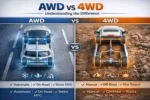
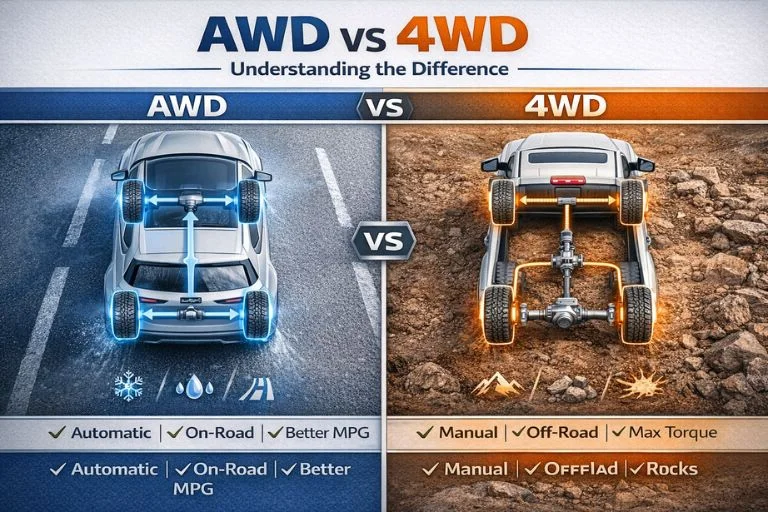
All-Wheel Drive (AWD) is a type of drive system that distributes power to all four wheels of the vehicle to enhance traction and the stability of the vehicle. Most AWD systems are automatic, which is considered a big plus compared to Four-Wheel Drive (4WD) systems, which usually require the driver to switch on the AWD system manually. The system continuously measures the speed of wheels and traction on the road using electronic sensors, a center differentiating mechanism and onboard computer controls.
In the event of detecting wheel slip it automatically distributes the engine torque to the wheels with the greatest grip. AWD may be full time AWD, providing power to all the four wheels at all times, or on-demand AWD, which normally drives in two-wheel mode and activates the remaining two wheels when additional traction is required. It offers a number of benefits such as automatic functionality, better performance on wet roads and in light snow, increased stability at highways, smoother cornering with per-wheel torque control, and lighter weight than the conventional 4WD, which is why it is also used in sedans, crossovers, and SUVs.
What Is Four-Wheel Drive (4WD)?
The Four-Wheel Drive (4WD) is a type of drivetrain system that connects the front and rear axles in a locking transfer case so that the engine power is supplied to all four parts at an equal rate. Compared to AWD systems, which are fully automatic, conventional 4WD is usually manual, with the driver having to switch it on or off with a lever, button, or dial when on-off road. Once this is activated the transfer case divides engine power into front and rear axles in an attempt to enhance traction.
The majority of 4WD systems provide two driving modes: 4-High (4H), which is to be used on slippery roads, or in light off-roading with normal speeds, and 4-Low (4L), which offers the maximum amount of torque at very low speeds to use with very rough terrain. Most of 4WD vehicles are also provided with locking differentials, which compel the two wheels in the same axle to spin at the same rate, providing optimum traction in difficult situations such as deep mud, sand or rocky roads.
Due to its superior design and better traction rates, 4WD is greatly used in serious off-roading, heavy work, towing and going over rocky or steep terrains, though locking differentials must not be used on tarmacs as it may put a lot of strain on the drive system and makes steering hard.
AWD vs 4WD: Side-by-Side Comparison
| Feature | AWD (All-Wheel Drive) | 4WD (Four-Wheel Drive) |
| Activation | Automatic / always-on | Manual or auto engagement |
| Best Use | On-road, light off-road, snow & rain | Serious off-road, extreme terrain |
| Driver Input | None required | Required (lock/unlock transfer case) |
| Fuel Economy | Better (less mechanical drag) | Lower (heavier, more drag) |
| Traction Control | Per-wheel, sensor-driven | Axle-to-axle (lockable) |
| Weight Added | Moderate | Significant |
| Common Vehicles | SUVs, crossovers, sedans | Trucks, body-on-frame SUVs |
| Cornering Impact | Minimal | Stiff at speed – use only off-road |
Choosing which is the Right System for you?
Choose AWD if you:
- Commute in areas with snow, ice, or rain.
- Drive mostly on paved roads but want extra confidence.
- Prefer automatic handling without driver input.
- Prioritize fuel efficiency and smooth on-road dynamics.
- Drive a crossover, SUV, or sedan.
Choose 4WD if you:
- Regularly go off-road on trails, rocks, or in deep mud.
- Drive a truck and tow or haul heavy loads in rough terrain.
- Need maximum torque delivery for steep or technical terrain.
- Want manual control over drivetrain engagement.
- Live or work in remote or extreme-weather environments.
Conclusion
Both 4WD and AWD are developed in different purposes, as the former is designed to operate under extreme conditions, and serious off-road activities, when equal power distribution to all wheels is needed to make a vehicle work over uneven surfaces, mud, or deep snow. Nonetheless, it is heavier, less fuel economy, and usually involves driver involvement hence it is not that practical with daily driving. Conversely, AWD can be used in regular road conditions. It also automatically changes power distribution to wheels where necessary and offers a more comfortable ride in snow and rainy conditions or severe icy weather, without the driver to physically intervene.
This renders AWD to be an easy and a receptive choice among the majority of advanced drivers. In the end, the decision is the best based on the way you are driving and where. In case your car is mostly utilized on paved roads and weather is not often problematic, then AWD is the most suitable choice. However, on heavy off road trips or in rough terrain, 4WD will provide the stability and maneuverability required.
Whether you’re considering vehicles from manufacturers like BYD offering advanced AWD systems or traditional 4WD trucks, understanding your drivetrain needs is crucial. For comprehensive vehicle guidance, check our car maintenance checklist to keep all systems running optimally.
If you need quality replacement transmissions or drivetrain components, Tagore Auto Parts offers reliable OEM and remanufactured parts for all vehicle types. Whether you have a different system or not, tires and safe driving are always vital in keeping traction and control. According to Consumer Reports’ vehicle buying guide, choosing the right drivetrain system is one of the most important decisions in matching a vehicle to your actual driving conditions and lifestyle needs.
Frequently Asked Questions
Is AWD the same as 4WD?
No, AWD (All-Wheel Drive) and 4WD (Four-Wheel Drive) are not similar. AWD typically is automatic and only applies power to four wheels when necessary, whereas 4WD generally remains the choice of the driver to use, and is only meant in serious off-road environments.
Which is more suitable in the day to day driving a AWD or 4WD?
AWD is more practical to normal driving. It automatically sets power adjustments to enhance traction in wet, snowy or icy roads and offers smoother handling in paved roads.
Is AWD good for off-roading?
AWDs are capable of light off-roading like gravel roads, dirt trails or easy snow. Nevertheless, it is not engineered to run in harsh off-road landscapes such as deep mud, rock and steep foot paths which 4WD suits better.
When should I use 4WD?
Driving on rough roads like deep mud, sand, rock tracks or steep slopes should be done in 4WD. It is also applicable in towing or transporting heavy items using harsh climatic conditions.
Does AWD improve safety?
AWD has the ability to enhance traction and stability during slippery roads such as rain, snow or ice. But it does not impinge safe driving habits and correct tires.