Table of Contents
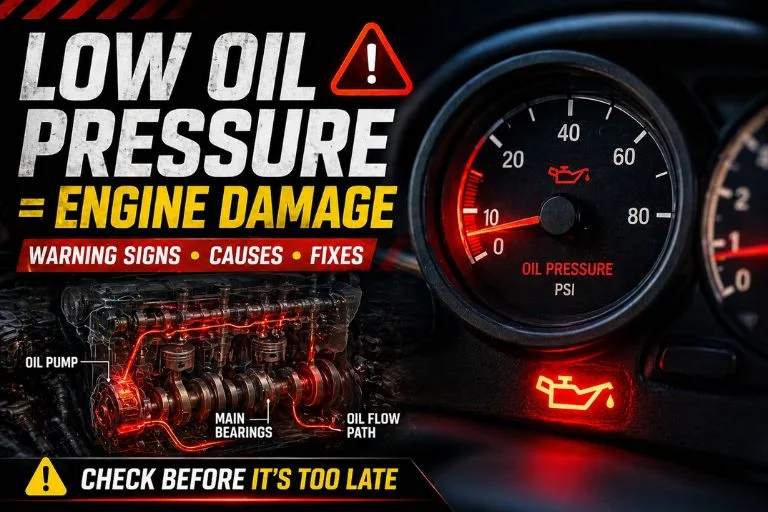
All the information is displayed on the dashboard of your car, full with devices that are intended to tell you how your engine is doing in real-time. The oil pressure gauge is one of the most crucial, and most neglected, among others. Listening to it might save you a small service check and a wallet-busting engine malfunction. As a long-time driver or a new car owner, the knowledge of what your oil pressure gauge is, what low oil pressure is, and what causes it is information that can help you save your engine (and your money). This guide will give you all you should know about the fundamentals of monitoring to the most common causes of pressure drops.
What Is an Oil Pressure Gauge?
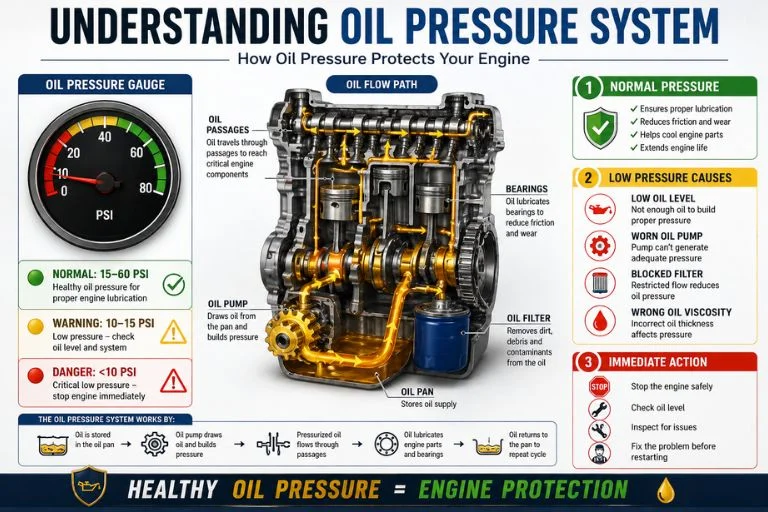
An instrument panel display which measures the hydraulic pressure of engine oil as it circulates through the lubrication system is called an oil pressure gauge. It is usually read in PSI (pounds per square inch) or is a crude L-H (Low-High) arc. Lubricant is pushed through fine openings by the oil pump to lubricate bearings, camshafts and pistons – the gauge will indicate whether or not that system is operating at the required pressure.
The oil pressure gauge gives the amount of force with which the oil is being pumped through the engine unlike the oil level dipstick, which indicates the amount of oil present in the sump. A full sump will allow you to read dangerously low pressure without damage to the pump or passages.
Normal vs. Dangerous Oil Pressure Ranges
Pressure readings vary by engine design, but the table below gives a reliable reference for most petrol and diesel passenger vehicles:
| Condition | Typical PSI | Status | Recommended Action |
| Cold start (idle) | 25–65 PSI | Normal | Allow engine to warm up briefly |
| Warm idle | 15–30 PSI | Normal | No action required |
| Highway cruising | 30–60 PSI | Normal | No action required |
| Below 10 PSI (any condition) | < 10 PSI | Danger | Stop engine immediately |
| Fluctuating or erratic | Varies | Warning | Inspect pump, sensor, and oil level |
Low Oil Pressure Meaning: What the Warning Tells You
When your oil pressure gauge dips into the red zone or the warning light illuminates it signals low engine oil pressure. The low oil pressure meaning is straightforward but urgent: your engine’s moving metal parts are not receiving adequate lubrication. Within seconds of running on critically low pressure, bearing surfaces can overheat, score, or seize. This is not a “drive to the next service station” situation—it demands an immediate response.
What Causes Low Oil Pressure?
Knowledge of the causes of low oil pressure will assist you to identify problems early and avoid disastrous engine failure. This can be caused by the most common factors:
- Insufficient oil level – the most common reason; low sump is unable to sustain pump suction or constant pressure.
- Worn oil pump – internal pump gears wear out with time, and can no longer produce sufficient pressure.
- Poor or wrong oil viscosity – on hot climate use of thin oil or old oil that has deteriorated leads to pressure that is lower than specifications.
- Blocked oil filter or passages – blocked filter causes the oil to pass via a bypass valve at low pressure.
- Worn engine bearings – too large clearances between worn bearing surfaces will cause the oil to leak through, lowering system pressure.
- Failure of oil pressure sensor – When the sending unit is faulty, it may give a false alarm when the pressure is normal.
- Internal oil leak or bursting gasket – oil that is lost internally does not make it to suction pickup of the pump.
Understanding Related Dashboard Warnings and Engine Systems
The oil pressure gauge works alongside other critical dashboard instruments to monitor engine health. Just as understanding signs of a blown motor helps prevent catastrophic failure, monitoring oil pressure prevents bearing damage and engine seizure.When engine damage occurs from oil starvation or neglected maintenance, quality aftermarket suppliers like Tagore Auto Parts provide reliable remanufactured engines and transmissions to restore your vehicle at reasonable costs.
How to Respond to a Low Pressure Warning
IMMEDIATE STEPS
- Take throttle off and find a safe spot to stop.
- Turn off the engine – one minute of operation without pressure could cause permanent bearing damage.
- Test the level of the oil with dipstick; when it is extremely low, refill it with the right grade and then try to start the engine.
- When the gauge shows that oil level is fine and yet the gauge is low, then do not start; call to be recovered and have the system professionally checked.
PREVENTIVE MAINTENANCE
- Replace engine oil and filter as required by the manufacturer.
- Always use the viscosity grade of oil that is given in your owner’s manual.
- Check undercarriage of the vehicle often for leaks.
- Check the oil pressure sensor when the car is being serviced to eliminate false alarms.
- Keep an eye on the tachometer and the oil pressure gauge – unnaturally high idle RPM may cause excessive work on the lubrication system.
What to Do When Your Oil Pressure Gauge Goes Down
Should your oil pressure indicator enter the danger range whilst you are driving, do the following:
- Do not panic, stay calm and signal to pull off the road in a safe manner.
- Slow down and pull over to a safe place.
- Switch off the engine as soon as it can safely be switched off – do not idle with low pressure.
- Wait until the engine has cooled down before opening the bonnet or looking at the dipstick.
- Test the amount of oil with the dipstick – when it is low, fill it with the right oil when there is enough.
- Do not re-start engine and drive until the cause is found.
- Call out a competent mechanic or get a tow to the closest workshop.
Tips to Maintain Healthy Oil Pressure
Prevention is the most effective strategy for oil pressure issues. Some easy tips can make your lubrication system in the best shape over hundreds of thousands of kilometres:
- Change your oil and filter at the recommended times by the manufacturer after every 5,000-10,000 km depending on the type of oil.
- Always use the grade of viscosity as indicated in your owner manual.
- Monitor your oil level once a month – or before long-distance travel.
- Address any oil leakage immediately before it gets too serious.
- Use a good quality oil brand matching the OEM specification of your engine.
- Consider an oil pressure gauge upgrade if your car has only a warning light – early warning saves engines.
Conclusion
The oil pressure gauge is an extremely significant tool on your dashboard, though it is regularly ignored until you see the red warning light. Low engine oil pressure is not a warning, this is an emergency alert, and it should be acted upon. You save what is usually the costliest part of your vehicle by learning the meaning of low oil pressure, the reasons behind low oil pressure and keeping to a rigorous maintenance schedule.
It should be a ritual to check your oil pressure gauge each time you travel, you should ensure your oil is always full and replace it when due and you must never disregard a warning even though it may be a short message. A couple of minutes of preventive care now will save you the cost of an engine change tomorrow.
Frequently Asked Question
Can I drive with low oil pressure if the light just flickers at idle?
No, it is not advised to drive with low oil pressure light as the flickering light means your engine’s oil is about to get finished, which can cause severe, permanent engine damage within minutes.
What is a tachometer, and why does it matter for oil pressure?
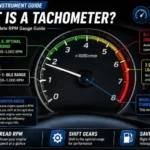
A tachometer is a device used to measure the rotational speed of an engine or shaft in revolutions per minute (RPM). Higher RPMs require higher oil pressure to maintain proper lubrication.
How much does it cost to fix low engine oil pressure?
Generally, it requires $100 and $2,500+, depending on the causes and the issue occurred. Simple sensor replacement costs $100-$300, while oil pump or bearing replacement can exceed $2,000.
Is a faulty sensor the same as actual low oil pressure?
No, the faulty sensor is not the same as the actual low oil pressure. A bad sensor may show false low readings while actual pressure is normal. Always verify with a mechanical gauge.
What oil viscosity should I use to maintain correct pressure?
Always follow the grade specified in your vehicle’s owner’s manual. Using thinner grade than recommended during high temperature can lead to pressure drop.