
Table of Contents
Wanting a truck for a short period? Signing up a commercial truck insurance policy can be often impractical as well as expensive and that’s where one-week truck insurance comes in to provide flexibility and helping you stay covered and be in compliance without having to commit you into a long-term contract. It offers you short term commitment so that your truck stays safe and legally protected. Well, this guide will break down all you need to know about one-week truck insurance: What it covers, how it relates to standard policies, its cost, and when it is the most appropriate in your business.
What Is One Week Truck Insurance?
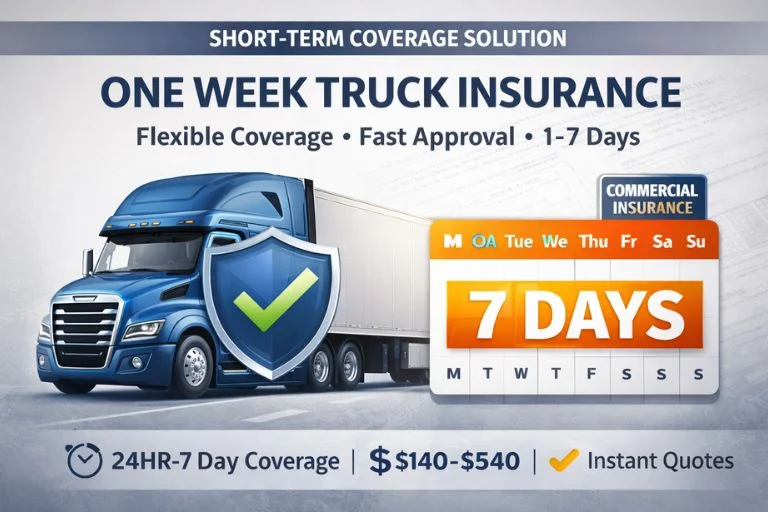
Short-term truck insurance also known as one-week truck insurance, temporary commercial vehicle insurance or short-term truck insurance is a commercial auto insurance that ensure coverage for the period of one to seven days. Unlike standard commercial truck insurance which is generally based on a six- to twelve-month term; these policies are designed for business or operator who requires protection but not over a long period.
It works in the same way as a standard commercial truck policy: it includes liability, physical damages and in certain instances cargo or medical payments. The most important distinction is the duration and in certain instances, the cost per day.
What Does One Week Truck Insurance Cover?
Temporary commercial vehicle insurance typically includes the same core coverages as a full-term commercial policy, though availability may vary by insurer and state regulations. Common coverage types include:
- Liability Coverage (Required): Covers bodily injury and property damage if you’re at fault in an accident. This is required in most states for commercial vehicles.
- Physical Damage Coverage: Includes collision (damage from accidents) and comprehensive (theft, fire, hail, vandalism) coverage for your truck.
- Medical Payments (MedPay) / Personal Injury Protection (PIP): Covers medical expenses for you and your passengers after a covered accident.
- Uninsured/Underinsured Motorist Coverage: Protects you if the at-fault driver in an accident doesn’t have sufficient insurance.
- Cargo Insurance: Covers the goods or freight being transported, if included in your policy.
- Non-Owned Trailer Coverage: Useful if you’re hauling a trailer you don’t own.
One Week Truck Insurance vs. Annual Commercial Truck Insurance
Understanding how temporary coverage compares to a standard commercial truck insurance policy helps you make the right call for your situation.
| Feature | One Week Truck Insurance | Annual Commercial Truck Insurance |
| Policy Duration | 1–7 days | 6–12 months |
| Cost Per Day | Higher per-day rate | Lower per-day rate |
| Commitment | None – pay for days used | Fixed-term contract |
| Coverage Scope | Same core coverages | Same core coverages |
| Deductibles | Often higher | Standard range |
| Availability | Specialty insurers only | Most major insurers |
| Best For | Temporary or one-off needs | Regular/ongoing operations |
When Do You Need One Week Truck Insurance?
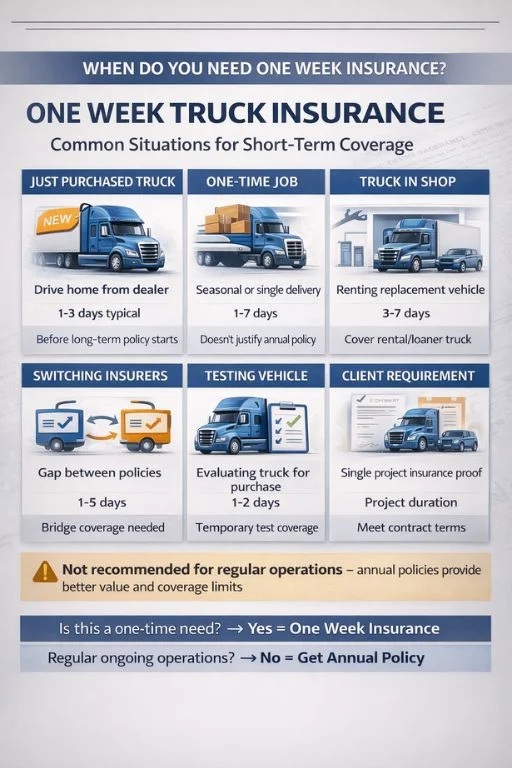
Short-term or single truck insurance temporary commercial vehicle coverage is a practical option in several specific situations:
- You just purchased a truck and need to drive it home or to your yard before a long-term policy kicks in.
- You have a one-off or seasonal transport job that doesn’t justify a full annual policy.
- Your primary commercial truck is in the shop and you’re renting or borrowing a replacement.
- You’re switching commercial insurance providers and need bridge coverage during the transition.
- You’re testing a vehicle for a potential purchase or lease.
- You need to meet a client’s insurance requirements for a single project.
However, one-week truck insurance should not become your default solution for regular operations. As industry experts caution, claims can exceed the limited coverage caps often included in short-term policies, leaving you underinsured.
How Much Does One Week Truck Insurance Cost?
The cost of one-week truck insurance varies based on the insurer, the vehicle, your driving history, and the coverage selected. On a per-day basis, short-term policies often cost more than a prorated daily rate from an annual policy. Here’s a sample pricing breakdown from a specialty provider for semi-tractor insurance and commercial truck insurance:
| Coverage Duration | Estimated Cost |
| 24 Hours | ~$140 |
| 48 Hours | ~$240 |
| 72 Hours | ~$340 |
| 5 Days | ~$540 |
For context, standard commercial truck insurance from providers like The Hartford ranges from $150 to $500+ per month, meaning the per-day cost is generally lower with an annual policy. One-week truck insurance trades long-term savings for short-term flexibility.
Key Factors That Affect Your Rate
- Type of truck (semi-tractor, box truck, flatbed, etc.)
- Truck value and age
- Your driving and claims history
- Business use and cargo type
- Location and operating radius
- Coverage limits and deductibles selected
Where to Buy One Week Truck Insurance
It is not as easy as dialing your normal auto insurer in order to get temporary commercial vehicle insurance. Most of the large carriers do not have short-term commercial truck policies. You will be required to search on specialty providers or independent brokers. Option often includes:
- National Independent Truckers Insurance Company (NITIC): This provides 24 hours, 48-hour, 72 hour and 5-day owner-operator and small fleet commercial truck policies.
- Classic Truck Insurance: This company offers short-term trucking liability insurance, non-trucking liability insurance, and broker bonds and other services to independent truckers.
- Independent insurance brokers: There are brokers specializing in commercial trucking and they can provide you with the best rate available to your needs.
How to Get One Week Truck Insurance: Step-by-Step
The short-term single truck insurance purchase process is the same as that of buying a normal policy. Here’s how to do it:
Step 1: Specify What You Need: Decide on the number of days of coverage, and the type of truck to insure (e.g. semi-tractor; box truck; pickup).
Step 2: Gather your information: You need to have your vehicle VIN, truck information, driver license, business details and intended use.
Step 3: Verify Compliance Requirements: Use to verify state minimum liability requirements and other coverage required by clients or federal regulations.
Step 4: Obtain several quotes: Compare at least two to three providers with similar coverage, limits and deductibles of the same to make sure that you are getting the best.
Step 5: Read the Policy Terms: Be sure to read the policy and note deductibles, maximum liability and any restrictions on the use of the vehicle.
Step 6: Buy Policy: The majority of specialty providers will either sell to you online or via an agent with same-day approval.
Conclusion
One-week truck insurance is a good and flexible solution to companies, owner-operators and drivers who need to cover a short time. Rather than entering into a long term commercial truck insurance policy, you can use this temporary cover to keep your insurance legally valid as you attend to the short term requirements like moving a newly purchased truck, completing a one-time job, or filling a lapse of policy to policy ratio.
It usually has the basic protections of liability, physical damage, and optional cargo coverage and covers a lot of the same benefits as an ordinary policy but over a far lesser period.Nevertheless, the ease of rapid approval and the ability to enter into a commitment shortly is usually accompanied by an increase in the daily rate and potential restrictions on coverage. A commercial truck insurance policy that is long term is usually cheaper to businesses that have continuous trucking business.
While you’re ensuring your truck has proper insurance coverage, don’t forget about regular vehicle maintenance to keep your commercial vehicle running reliably. For trucks requiring mechanical work, Tagore Auto Parts provides quality replacement engines and transmissions for commercial vehicles.
Finally, assessing your actual requirements, comparing prices offered by professional specialized service providers, and choosing appropriate coverage will assist in making sure that you will get the most optimal flexibility, protection, and worth of your trucking business. According to Consumer Reports’ insurance buying guide, understanding your specific coverage needs and comparing multiple quotes is essential for finding the right insurance solution at the best price.
Frequently Asked Questions
Is one-week truck insurance available for semi tractors?
Yes, semi-tractor insurance is available on a short-term basis through specialty providers. However, coverage terms and costs may differ from standard commercial truck policies, so confirm that the policy meets federal motor carrier requirements if applicable.
Is it possible to simply purchase an average policy and cancel it a week later?
Yes but not advisable. Premature termination may lead to a flag being raised to prospective commercial insurers and pricing. Most of the policies are also subject to minimum earned premiums, which implies that you will still incur a payment of the premium despite an early cancellation.
Is one-week truck insurance compliance with FMCSA guidelines?
It may, when the policy fulfills the minimum limits of liability required by the Federal Motor Carrier Safety Administration (FMCSA). This should be verified with the provider prior to buying this, particularly in the interstate operations.
Is short term commercial car insurance costlier than yearly cover?
Yes one-week truck insurance is generally more expensive on a per-day basis as compared to an annual commercial truck insurance policy. But, as you are only paying the number of days required, overall out of pocket expenses may be less in cases of very short term requirement.
How quickly can I get covered?
Most specialty providers offering one-week truck insurance can issue a policy on the same day you apply, sometimes within hours. This makes it ideal for urgent, last-minute coverage needs.