Table of Contents
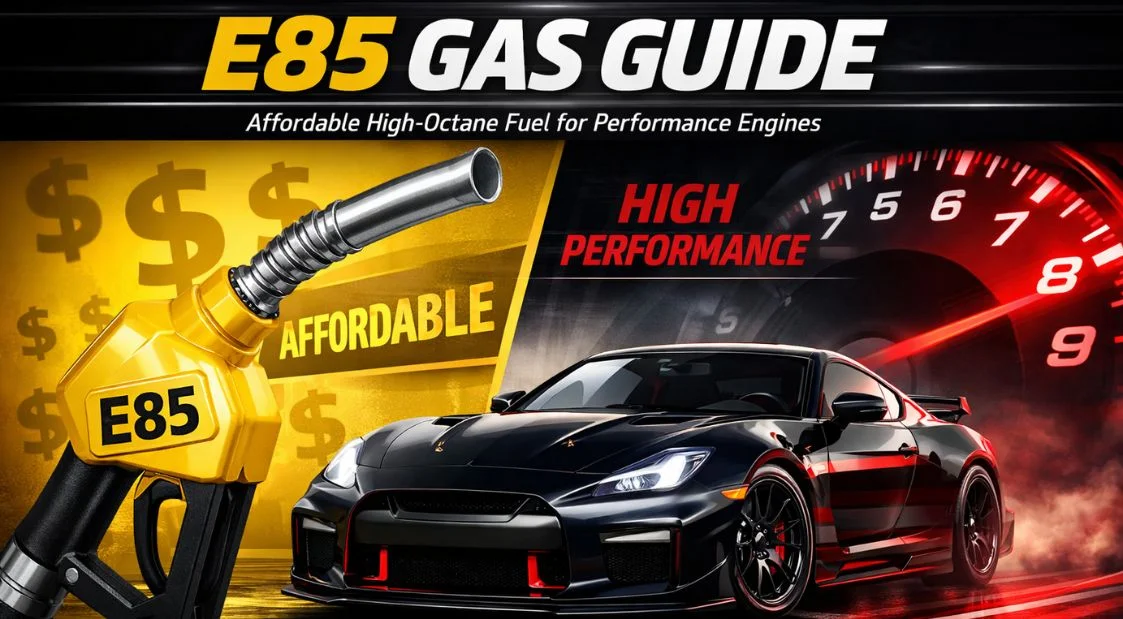
When you pulled up to a pump and saw a yellow nozzle on it marked E85 Gas, you may have wondered whether it is cheap gas or not. To car enthusiasts, the use of E85 fuel is usually referred to as poor man race fuel due to its extreme performance possibilities. It is a bewildering choice to the common commuter who will find it less expensive per gallon but burning quicker. In this guide we will dissect specifically what is E85 fuel, what its effects are on your engine and whether you should be adding it to your tank.
Understanding E85: Composition and Characteristics
In terms of the technicality, E85 is a blend of biofuel, which is a combination of ethanol and gasoline (15: 85). The letter E denotes the ethanol and the number 85 is the highest percentage of ethanol in the mixture. This is in contrast to the usual e85 petrol (which is a commonly used term in Europe and Australia) since the particular blend can in fact change according to season in the United States. In cold winters, the ethanol %age could be reduced to approximately 51 % in order to make the cars easier to start yet it is still indicated as E85.
The most valuable ingredient, the ethanol fuel, is an alcohol-based renewable fuel manufactured using plant substances such as corn or sugar cane. Since it contains oxygen molecules that gasoline does not, the way it burns is different, cleaner and colder and carries a distinct aroma which every car enthusiast picks up immediately. High-performance vehicles like the Coyote engine and Hellcat engine are designed to leverage E85’s superior octane rating for maximum turbocharged efficiency.
What Does Flex Fuel Mean? Is It Usable?
You cannot fill an E85 in any sedan you like and drive away. Performing such actions in an ordinary car may break fuel lines, corrode seals, and cause a Check Engine light since the engine is running too lean. This leads us to the term of Flex Fuel. So, what is flex fuel? A Flex Fuel Vehicle (FFV) is developed to have a unique fuel system which is capable of resisting the corrosive properties of ethanol. What is more important is that it has a sensor that indicates the exact %age of ethanol in the fuel line.
This is the essence of the flex fuel meaning; the capacity of the computer (ECU) to flex or change the fuel injection and spark timing on the fly either when you simply put 100 % of regular gas or E85. When you have a flex fuel badge on your trunk or a yellow gas cap, then your car can take E85 gas. For detailed engine maintenance guidance after switching to E85, review our comprehensive transmission fluid change guide to ensure optimal drivetrain performance.
The Fuel Economy Trade-Off: Why Your MPG Takes a Hit
Suppose that E85 gas produces more power and costs less at the pump, why not everybody uses it? The catch is energy density. Ethanol has approximately 30 % less energy per gallon as compared to pure gasoline. Your engine will need to add about 30 % more E85 to the cylinders to generate the same amount of power. This will result in a seriously reduced your Miles Per Gallon (MPG) – typically by about 25 to 30 miles per gallon.
When you drive a daily commuter, it tends to even out the difference in the lower price at the pump and the worse mileage which leaves the cost-per-mile to be approximately the same. However, when you are on a road trip, you will be filling up a lot more frequently. Performance turbocharged engines benefit most from E85’s high octane rating, making it ideal for tuned vehicles seeking maximum efficiency. Learn more about fuel system maintenance in our fuel pressure regulator guide for optimal E85 compatibility.
Not Flex Fuel? You May Require an E85 Conversion Kit
If your car is not a flex fuel than you surely require a E85 conversion kit which is a package that normally includes a sensor and an auxiliary computer that can assist your standard ECU to understand ethanol has been availed by the aftermarket community. However, to transform it appropriately, a sensor is not necessarily enough. E85 requires more of the fuel and this means that you must upgrade your:
- Fuel Injectors (to larger types)
- Fuel Pump (to a high-flow unit)
- Fuel Lines (to ethanol-safe PTFE lines)
These supporting mods are sufficient to make sure that you have a starving engine and a high RPM when an E85 conversion kit is installed without these supporting mods. For turbocharged builds, pairing E85 conversion kits with high-performance engines like the LS7 engine unlocks exceptional power potential while maintaining fuel system integrity.
E85 Vs Gasoline: Comparison
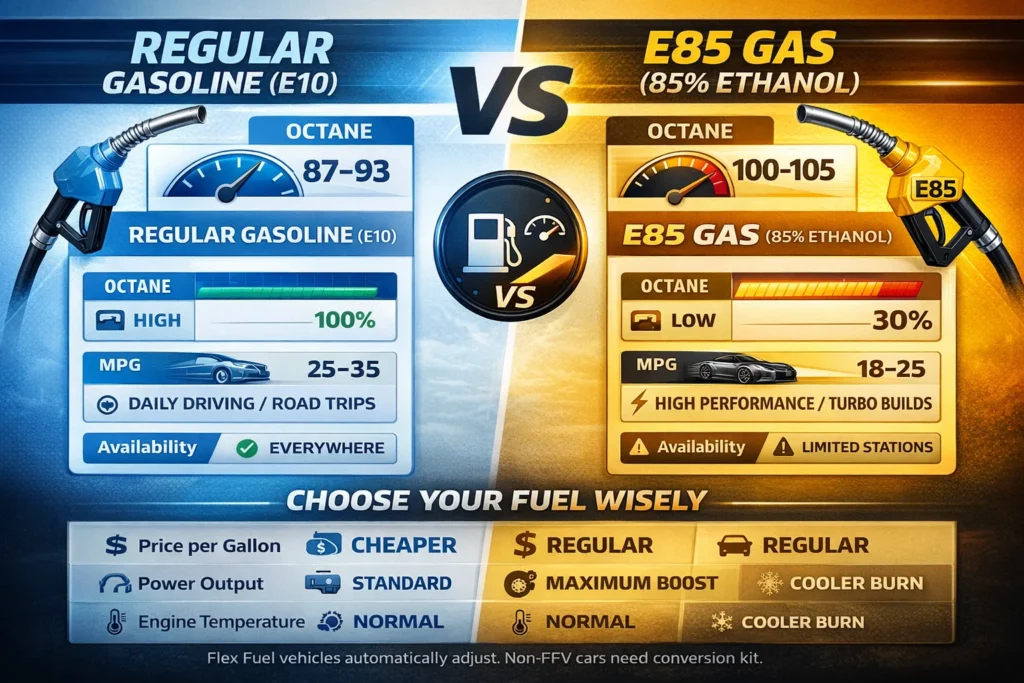
The following is a concise overview that will allow you to determine whether to use e85 gas or not.
| Characteristic | Regular Gasoline (E10) | E85 Gas |
| Blend Component | 90 % Gasoline / 10 % Ethanol | 51-85 % Ethanol / Remain Gasoline |
| Octane Rating | 87 – 93 | 100 – 105 |
| Energy Density | High | Low (about 30% of gas) |
| Engine Temperature | Normal | Burning Cooler |
| Best Use Case | Daily Driving / Road Trips | High Performance / Turbo Builds |
| Availability | Everywhere | Limited Stations |
Conclusion
The E85 gas occupies a special position in the automobiles market. To the typical driver, it is a green alternative that helps in domestic agriculture although its reduced MPG makes it a financial drawback. To the enthusiast it is liquid gold–at the same price as regular unleaded, it is the e85 octane rating of racing fuel. It is important to know the trade-offs whether your factory Flex Fuel truck or your tuned sports car has an E85 conversion kit. But always keep this in mind, when you have not the yellow cap or the melody, use the black handle at the pump!
Frequently Asked Question
Is E85 gas safe for any car?
No. You should only use E85 if your vehicle is a designated Flex Fuel Vehicle (FFV) or has been modified with an E85 conversion kit.
Does E85 clean your engine?
Yes, ethanol fuel is an excellent solvent. It can help clean carbon deposits from intake valves and fuel injectors, keeping the engine internals cleaner than standard gasoline.
Why is my E85 mileage so bad?
E85 has lower chemical energy than gasoline. Your engine must burn about 30% more of it to produce the same power to move your car, resulting in lower fuel economy.
What happens if I mix E85 and regular gas?
If you have a Flex Fuel vehicle, nothing bad happens! The computer adjusts automatically. If you do not have a Flex Fuel car, mixing them can dilute the fuel mixture and cause the engine to run poorly or trigger a warning light.
Does E85 go bad if it sits too long?
Yes, and faster than regular gasoline. Ethanol fuel is hygroscopic, meaning it naturally absorbs moisture from the air.