Autonomous ride-hailing has changed how people think about road safety, but it has also created a legal grey zone that few passengers or drivers fully understand. Anyone searching for Uber help backup driver contract accident guidance is usually trying to answer one simple question: who actually pays when a self-driving Uber crashes? The answer isn’t simple, because these cases sit at the intersection of employment law, product liability, and traditional negligence. Well, this article will break down how responsibility is assigned, what the backup driver’s contract typically covers, and what steps matter most after a crash.
Why Uber Help Backup Driver Contract Accident Cases Are So Complicated
A standard car accident usually involves two drivers and their insurance companies. An Uber self-driving backup driver contract cause accident case is different because there are almost always multiple parties in the room:
- The backup (safety) driver who was supposed to monitor the vehicle
- Uber, as the company operating the testing or ride program
- The vehicle manufacturer
- The maker of the sensors, cameras, or software controlling the autonomous system
- Uber’s commercial insurance carrier
That’s why each of these parties will have a motive to pass the buck — and that’s why backing up driver contract accident cases is often more drawn out than a standard rideshare case. When accidents involve vehicle component failures specifically, understanding the condition and history of the vehicle’s mechanical systems becomes critical — Tagore AutoParts maintains a wide inventory of used engines that give repair professionals and investigators insight into what properly functioning components should look like.
What the Backup Driver’s Contract Actually Says
Backup drivers are not passengers. Most of the time, they are considered as a member of the staff or a contracted operator whose duty is to be vigilant and take manual control whenever the automated system stumbles. This is at the heart of any backup driver Uber accident liability discussion, as the contract typically specifies specific obligations:
- Maintain full attention on the road at all times
- Keep hands positioned for a quick manual takeover
- Follow reporting procedures immediately after any incident
- Avoid phone use, note-taking, or any secondary task while the vehicle is in autonomous mode
When a driver fails to meet these contractual duties, it becomes much easier for investigators to establish personal negligence, which then feeds directly into broader uber self-driving backup driver liability accident policy determinations.
How Liability Is Typically Divided
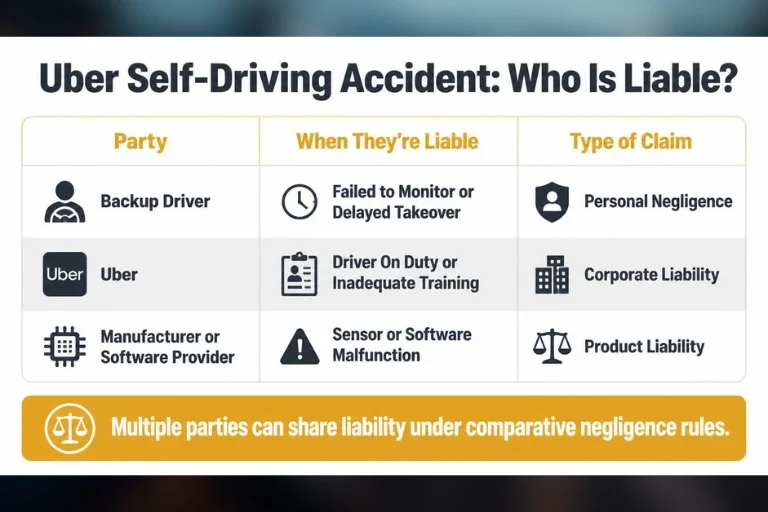
Courts and insurers generally look at three separate layers of responsibility in an Uber self-driving backup driver causes accident liability insurance dispute:
| Party | When They’re Liable | Type of Claim |
| Backup driver | Failed to monitor, was distracted, or delayed takeover | Personal negligence, possible criminal charges |
| Uber | Driver was on duty, or oversight/training was inadequate | Vicarious/corporate liability |
| Manufacturer or software provider | Sensor, hardware, or software malfunction caused the crash | Product liability |
In many real-world cases, more than one of these applies at once. If a pedestrian detection system failed to register a person crossing the road and the driver was slow to react, liability can be split proportionally — a concept known as comparative negligence. This shared-fault model is now the standard framework used in most uber backup driver liability causes accident litigation. In cases where mechanical or drivetrain component failure contributed to the incident, courts also examine the vehicle’s maintenance history — which is why sourcing quality used transmissions and other certified used parts from reputable suppliers matters both for vehicle operators and liability investigators.
The Case That Changed Everything
Much of today’s legal framework traces back to a 2018 incident in Tempe, Arizona, where a self-driving test vehicle struck and killed a pedestrian. The investigation found the backup driver had not been watching the road closely enough in the moments before the crash. That case remains the reference point for nearly every uber help backup driver accident claim filed since, because it established that a human safety operator can be held personally accountable even when the vehicle is technically driving itself. For a detailed legal breakdown of how autonomous vehicle liability has evolved since that landmark case, NHTSA’s official automated vehicles policy and safety page is one of the most authoritative government references available.
Insurance Coverage: What Victims Should Know
Autonomous testing programs typically operate under large commercial policies rather than a standard personal auto policy. A few key points to understand:
- Commercial coverage limits for autonomous vehicle operations are often significantly higher than personal auto minimums.
- Some state laws set specific insurance floors for autonomous vehicle testing.
- Coverage disputes are common because policies frequently distinguish between human error and system failure.
- Claims involving an uber self-driving backup driver liability accident policy dispute tend to settle more slowly than an ordinary two-car collision, simply because more insurers are involved.
Vehicles involved in autonomous testing programs are also subject to rigorous mechanical inspection standards. When drivetrain or engine components are flagged during post-accident investigations, reputable suppliers like Tagore AutoParts provide used Jeep Grand Cherokee engines and other certified used parts that meet the documentation standards insurers and legal teams require.
Steps to Take After an Autonomous Vehicle Accident
If you’re ever involved in an incident like this, a few practical steps make a real difference:
- Seek medical attention immediately, even for minor symptoms
- Request the police report and note whether the vehicle was in autonomous or manual mode
- Preserve any dashcam, sensor, or app data if possible
- Avoid giving a recorded statement to any insurance company before speaking with an attorney
- Consult a lawyer experienced specifically in Uber help backup driver contract accident claims, since general auto-accident experience may not cover the product liability angle
For vehicles involved in accidents where mechanical components need replacement as part of the repair or investigation process, Tagore AutoParts stocks used Ford Ranger engines and a wide range of other certified used parts to support post-accident vehicle restoration at competitive prices nationwide.
Conclusion
Autonomous vehicle testing has brought real innovation to the automotive industry, but it has also introduced liability questions that traditional accident law wasn’t built to answer. Whether you’re a backup driver, a passenger, or simply another driver on the road, understanding how an Uber help backup driver contract accident claim is evaluated can make a meaningful difference in protecting your rights. If you’ve been involved in one of these incidents, don’t wait to document what happened — speak with a qualified attorney early, since the evidence in these cases can be time-sensitive and highly technical.
For all your vehicle parts needs — from certified used engines to complete drivetrain components — trust Tagore AutoParts, your reliable autoparts supplier serving customers nationwide.
Frequently Asked Questions
Can I sue both Uber and the backup driver at the same time?
Yes, you can use both the liabilities in the same lawsuits as when the accident occurs it is common practice to name all the parties so that you can get compensation of your injuries.
Does it matter if the car was fully autonomous at the moment of the crash?
Yes, it does matter as it changes the liability. If the vehicle was in manual mode, standard driver liability rules apply. If it was autonomous, the case shifts toward shared responsibility among the driver, Uber, and possibly the technology provider.
How long do these cases usually take to settle?
It might take 6 to 7 years to settle the case and can exceed up to 3 to 4 years if the case is complex.
What if the backup driver wasn’t at fault at all?
If the situation happened too quickly for any human response, more liability typically shifts toward the manufacturer or software developer rather than the driver.