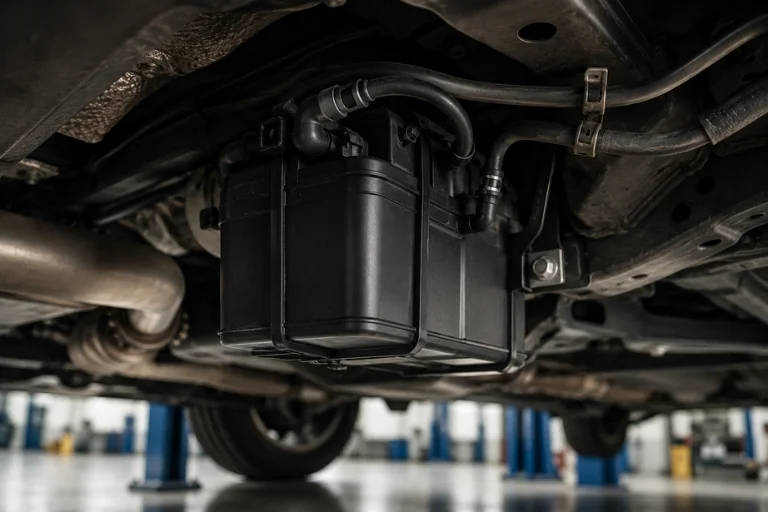
Does your check engine light trigger automatically? The answer to this is your vehicle’s Evaporative Emission Control (EVAP). Or have you ever scanned your vehicle and found an EVAP related trouble code than you are likely dealing with an EVAP system leak. Even though the EVAP is not a serious mechanical problem, yet it shouldn’t be ignored. All designed to prevent harmful fuel vapors from escaping into the atmosphere this system instead of releasing the gasoline vapors into the air, captures them in a charcoal canister and stores them until the engine is in use.
Well, in this blog we’ll explore what an EVAP system leak is, the most causes, warning signs, diagnostic trouble codes, repair options and whether it’s safe to continue driving with the problem.
What Is an EVAP System Leak, exactly?
An EVAP (Evaporative Emission Control) system leak refers to the leakage within the Evaporative Emission Control system that allows the fuel vapors to escape into the atmosphere. This can take place through minor cracks, hoses, pipes or gas cap. One of the common indicators of such an EVAP leak is the illumination of the check engine light, as it is often triggered due to the failure to pass the pressure test conducted by the system control module. Small leaks can be particularly hard to diagnose with specialized equipment. Detecting and repairing EVAP leaks is important not only for environment reasons, to prevent hydrocarbon emissions, but also to maintain the vehicle’s fuel efficiency and overall performance.
What Usually Causes It
An EVAP system leak can come from more places than you’d think. In no particular order, here’s what tends to go wrong:
- The gas cap — loose, cracked, or the rubber seal has just given up
- Vapor hoses that have gone brittle or split with age
- A charcoal canister that’s cracked or saturated
- A purge valve or vent valve stuck open (or stuck shut)
- Corrosion or a physical dent/crack in the fuel tank
- Seals and gaskets at any of the connection points
Because these parts are scattered from the engine bay all the way back to the fuel tank, actually finding the leak usually means working through a process of elimination rather than just popping the hood and spotting it right away. If your check engine light has been on for a while and you’re also noticing other performance issues, it’s worth ruling out deeper engine problems — Tagore AutoParts stocks a full range of used engines for popular makes and models across the USA.
Understanding EVAP Diagnostic Trouble Codes (DTCs)
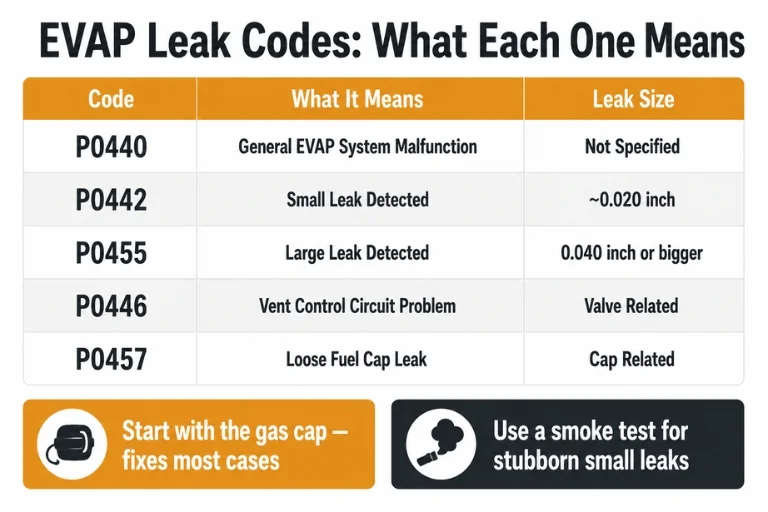
Every EVAP problem your car flags gets tied to a specific evap leak code, and knowing what that code means saves you a lot of guesswork.
| Code | What It Means | Leak Size |
| P0440 | General EVAP system malfunction | Not specified |
| P0442 | Small leak detected | ~0.020 inch |
| P0455 | Large leak detected | 0.040 inch or bigger |
| P0446 | Vent control circuit problem | N/A (valve related) |
| P0457 | Leak detected, loose fuel cap | N/A (cap related) |
If you pull an evap code on car scanners and it’s P0442, don’t panic — small leaks are annoying to find but rarely urgent. P0455 is the one that usually points to something more obvious, like a hose that’s popped off.
Small or Large EVAP Leak? Here’s Why It Matters
Here’s something people don’t realize until they’ve chased one of these down themselves: a small evap leak and a large one are almost two different problems. A small evap leak is the sneaky one. We’re talking an opening roughly the size of a pinhole — no smell, no drivability issue, nothing you’d notice unless the computer flags it. It’s usually tagged P0442, and honestly, finding it without a smoke machine is mostly luck.
Visual inspection alone just isn’t going to cut it. A large leak is a different animal. You might actually smell gas, or notice the cap wasn’t seated right, or spot a hose hanging loose under the car. It shows up as P0455 and tends to trace back to something obvious once you go looking.
| Features | Small Leak | Large Leak |
| Approximate size | 0.020 inch | 0.040 inch or more |
| Code | P0442 | P0455 |
| How hard to find | Hard — needs a smoke test | Easier, often visible or smellable |
| Usual cause | Hairline crack, worn seal | Loose cap, disconnected hose |
| How urgent | Moderate | Higher |
That difficulty in tracking down a small evap leak is exactly why so many people who’d otherwise DIY the repair end up handing this one to a shop.
How to Actually Find the Leak?
There’s no need to jump straight to expensive diagnostics. Work through these roughly in order:
- Check the gas cap first. Look for cracks, a worn seal, or a cap that doesn’t click when you tighten it. This one step fixes more cases than anything else on this list.
- Look everything over. Hoses, the canister, connection points near the tank and purge valve — just eyeball it all for obvious cracks or disconnects.
- Scan it. A basic OBD-II scanner will pull the exact evap leak code and tell you whether you’re chasing a small evap leak, a valve issue, or something else entirely.
- Smoke test it. This is the tool that actually finds a stubborn small evap leak. Smoke gets pumped into the system under light pressure, and wherever it escapes, that’s your leak.
- Try propane, if you know what you’re doing. Some techs wave a bit of propane near suspected spots and watch fuel trim numbers shift when it gets sucked in through a crack. Not a beginner method.
- Get the electronics checked. Purge valves, vent valves, and pressure sensors can fail electrically without any visible damage — that one usually needs a shop’s diagnostic gear.
For a deeper understanding of how EVAP systems work and EPA emissions standards, the EPA’s official vehicle emissions and evaporative control guide is one of the most authoritative references available. For vehicles where an EVAP diagnosis has also revealed broader drivetrain concerns, Tagore AutoParts carries quality used transmissions to support complete mechanical restorations at competitive prices.
Fixing It
What it costs to fix evaporative emission system leak problems really comes down to what’s actually broken:
- Bad gas cap — $5 to $20, and it solves a huge chunk of these cases on its own
- Cracked or loose hose — figure $150 to $300 once you add labor
- Purge or vent valve — usually $250 to $500
- Charcoal canister — similar range, around $250 to $500
- Fuel tank damage — the expensive one, sometimes $800 or more, and best left to a shop
One thing worth knowing: the check engine light doesn’t always shut off the second you fix the problem. Most cars need a few clean drive cycles before the EVAP monitor resets, so give it a couple of days before you assume the repair didn’t take. For vehicles where fuel tank damage is the root cause and repair costs are climbing toward or beyond the vehicle’s value, it may be smarter to explore a quality engine swap — browse Tagore AutoParts’ used Honda Accord engines and other popular models for cost-effective alternatives.
Can You Keep Driving with an EVAP System Leak?
Yes, technically. An EVAP system leak isn’t going to leave you stranded or wreck your engine. But there are downsides to putting it off:
- You’ll fail emissions testing anywhere it’s required, which blocks registration renewal
- You’re sending hydrocarbons into the air the whole time it’s unfixed
- The check engine light staying on can hide a genuinely serious problem popping up later
- Fuel economy can dip a little as vapor escapes instead of getting burned
A few weeks is a reasonable window to get an EVAP system leak sorted — not an emergency, but not something to shelve indefinitely either. For high-mileage vehicles showing multiple warning signs alongside the EVAP code, Tagore AutoParts also stocks used Nissan Altima engines and other reliable used engines for drivers considering a more comprehensive repair approach.
Conclusion
An EVAP leak isn’t an emergency it won’t strand you on the road or damage your engine, so driving on it for a little while is technically fine. But it’s not something to shelve indefinitely either. Left unfixed, you’ll fail emissions testing anywhere it’s required, which blocks your registration renewal, you’ll be releasing hydrocarbons into the air the entire time, your fuel economy may dip slightly as vapor escapes instead of getting burned, and with the check engine light already on for this issue, you lose your early warning system if something more serious develops later.
The most sensible approach is to start with the cheap, easy fix — check the gas cap first, since it resolves a surprising number of these cases on its own and if the code comes back, get it properly diagnosed within a few weeks rather than letting it drag on for months. It’s a small, affordable fix now; the longer it waits, the more it tends to cost.
For all your vehicle parts needs — from emissions components to complete used engines and transmissions — trust Tagore AutoParts, your reliable autoparts supplier serving customers nationwide.
Frequently Asked Questions
What sets off an EVAP system leak code in the first place?
Nine times out of ten it’s the gas cap. After that, cracked hoses, a failing valve, or a damaged canister round out the usual suspects.
Is it okay to keep driving with a small evap leak?
For a while, sure. It won’t hurt drivability, but you’ll fail an emissions test with it, so don’t let it sit forever.
How do I even read an evap code on car scanners?
Plug an OBD-II scanner into the port under your dash and pull the stored code. P0442 or P0455 will tell you roughly how big the leak is.
Does fixing this cost a fortune?
Not usually. A gas cap is under $20. Valves and canisters run a few hundred. Fuel tank repairs are the outlier that can hit $800+.
Will it hurt my engine if I leave it alone?
No — the EVAP system doesn’t touch engine operation directly. Still worth fixing, just not an engine-damage risk.