Table of Contents
Have you ever wondered or found yourself asking “How many cylinders does my car have?” Well, the number of cylinders in your engine will have a direct effect on the performance, fuel economy, power output and even long-term maintenance costs. Knowing the type of engine your vehicle has will provide you with a good idea on how your vehicle performs and what to expect when it requires some repairs.
This is a comprehensive guide that will step you through all that you need to know about engine cylinders including how to identify engine size, what type of cylinder does my car use and how different configurations compare. In this blog we will walk you through all the aspects you need to know about engine cylinders, what different cylinder configurations mean and how to identify its type.
What Is an Engine Cylinder?
The engine cylinder is a chamber in which fuel combustion takes place enabling the piston to move up and down. The resulting explosion causes the piston to move downwards and changes chemical energy into mechanical energy – the force that eventually turns your wheels. The total number of the cylinders determines how many combustion events take place in sequence. Generally, having more cylinders leads to greater power output and higher fuel consumption. The configuration of the engine—may it be inline, V-shaped or flat (boxer)—determines the overall size, weight distribution and vibration characteristics.
How Many Cylinders Does My Car Have?
The answer to this question depends upon the make, model and the trim level of your car:
- 3-cylinder engines: Often found in smaller city cars and hybrid powertrains.
- 4 cylinders: Found in economy and midsize cars.
- 6-cylinder engines: Usually found in high-performance or premium vehicles that provide more power and efficiency.
- 8-cylinder engines: Typically found in trucks, muscle cars and full-size SUVs that deliver strong performance.
How to Find Engine Size and Cylinder Count
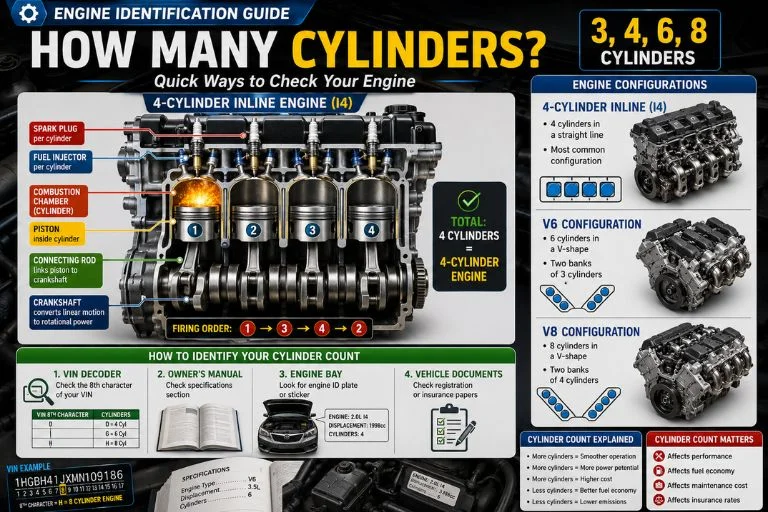
It is not as difficult as it may appear to know how to locate engine size and the number of cylinders. These are the surest techniques:
STEP 1: Check the Owner’s Manual Your vehicle’s owner’s manual lists complete engine specifications including cylinder count, displacement (liters), and configuration type.
STEP 2: Check the Engine Bay Pop the hood and look for stickers or labels on the engine cover, valve cover, or under the hood that display engine size and specifications.
STEP 3: Refer to the VIN Number The Vehicle Identification Number contains encoded engine information. The 8th character typically indicates engine type and size.
STEP 4: Apply Online VIN Decoder Use free online VIN decoder tools by entering your 17-digit VIN to get detailed engine specifications.
STEP 5: Check Vehicle Registration Document Your vehicle registration or title document often lists engine size and configuration.
STEP 6: Use an Online VIN Decoder Tool Websites like VINCheck.info or the manufacturer’s website can decode your VIN for free.
STEP 7: Consult a Mechanic or Dealership When in doubt, a professional mechanic or dealership service department can quickly identify your engine specifications.
Engine Configuration Comparison Chart
| Engine Type | No. of Cylinders | Common Vehicles | Typical Power Output |
| I3 (Inline-3) | 3 | City cars, small hatchbacks | 60-130 hp |
| Inline-4 (I4) | 4 | Sedans, compact SUVs | 100–200 hp |
| Inline-6 (I6) | 6 | Sports cars, premium sedans | 200–350 hp |
| V6 | 6 | Midsize SUVs, trucks | 200–350 hp |
| V8 | 8 | Muscle cars, full-size trucks | 300–700+ hp |
| V10 | 10 | Supercars, heavy-duty trucks | 500–850 hp |
| V12 | 12 | Luxury & exotic cars | 600–1000+ hp |
What Cylinder Is in My Car? Understanding Engine Configurations
After you have learned how many cylinders your car has, the next thing you need to know is how the cylinders are positioned. The design influences all features from the size of engine bay to performance balance.
- Inline (I): Cylinders are in one straight line. Common layouts: I3, I4, I6. Compact and efficient.
- V-shaped (V): Two rows of cylinders in V shape. Common: V6, V8, V10, V12. Stronger and smaller than inline with large numbers of cylinders.
- Flat/Boxer (H): Cylinders are located in horizontal direction on opposite sides. Used by Subaru and Porsche. Offers a low center of gravity.
- W-shaped (W): Three rows in a W formation. In a few Bugatti and Volkswagen Group (W12, W16) models; rare configuration.
Therefore, the engine in your Toyota Camry 2.5L is an inline-4 (I4) engine—four cylinders in a row. Assuming you are driving a Chevrolet Silverado with a 5.3L, you have a V8—eight cylinders arranged in a V.
How Cylinder Count Affects Performance and Fuel Economy
Understanding how many cylinders a car has is directly related to knowing the performance characteristics of your car:
- Fewer cylinders = Good fuel economy, less weight, lower emissions.
- More cylinders = More power, smoother high-speed performance, higher fuel consumption.
- Small turbocharged engines = Can be as powerful as larger naturally aspirated engines with better efficiency.
Advanced automotive engineering has erased the traditional boundaries. A turbocharged 3-cylinder engine in a Ford Fiesta EcoBoost can offer the performance of a naturally aspirated 4-cylinder with better fuel consumption. Similarly, cylinder deactivation technology in V8 trucks allows the engine to run on 4 cylinders under light loads to achieve significant improvement in highway fuel economy.
Understanding Engine Components and Vehicle Selection
Knowing your engine’s cylinder count connects to broader vehicle knowledge and maintenance planning. When comparing vehicles like Honda HRV vs CRV or researching 2026 F-150 smart tech features, engine cylinder count becomes a critical specification.When engine replacement becomes necessary, quality aftermarket suppliers like Tagore Auto Parts provide reliable remanufactured engines in all cylinder configurations from 3-cylinder to V8 powerplants at reasonable costs.
Why Does Knowing Your Engine’s Cylinder Count Matter?
In addition to mere curiosity, the knowledge of how many cylinders your car has has useful consequences:
- Insurance & Registration: In some areas, insurance costs or road tax depends upon engine size and the number of cylinders.
- Maintenance Planning: The number of cylinders defines how many spark plugs, ignition coils, and fuel injectors your engine uses, affecting service needs and costs.
- Parts Compatibility: Knowing your engine is essential to ensure you purchase the right oil filter, air filter and engine parts.
- Performance Upgrades: Performance tuning, exhaust, and intake upgrades are specific to your engine setup.
- Resale Value: Engine specs are among the most important factors that customers consider when analyzing used cars.
Conclusion
Understanding how many cylinders your car has is more than a technical curiosity—it’s essential knowledge for every car owner. Whether it is in maintenance planning, performance upgrades, insurance consideration, and fuel economy expectations, the number of cylinders in your engine defines your overall driving experience. You may be able to save time, money and confusion in the long run by either finding the answer in the owner’s manual, using a VIN decoder, or just by looking at the engine bay.
Frequently Asked Question
What is the number of cylinders in a typical family sedan?
Most family sedans have 4-cylinder engines, though higher trim levels may offer an optional V6 for better performance and towing capability.
Can I tell engine size by VIN number?
Yes, you can tell your engine size through VIN number, as characters 4-8 on a VIN showcase the vehicle’s manufacturer, engine size and type. The 8th character specifically indicates engine configuration.
How to find engine size?
The engine size is mainly found on the sticker under the hood, driver’s side doorjamb or by checking the 8th character of the VIN number. Your owner’s manual also lists complete engine specifications.
What do the 17 digits in a VIN mean?
The 17 digits or characters in a VIN act as an identifier for the vehicle, displaying the car’s unique features and characteristics including manufacturer, model year, plant location, and engine type.
Can I convert my engine to have more cylinders?
Technically it is possible but highly impractical and not cost-effective. Engine swaps require extensive modifications to mounts, wiring, cooling, exhaust, and computer systems, often costing more than buying a different vehicle.
How do I know if my car has cylinder deactivation?
Check your owner’s manual for features like “Active Fuel Management” (GM), “Multi-Displacement System” (Chrysler), or “Variable Cylinder Management” (Honda). Your dashboard may also show when cylinders deactivate during light load driving.