Table of Contents
One of the most common yet overlooked part on your dashboard is the tachometer. The little dial with the numbers and the red line tells you how fast the engine is running, or how much work it’s doing. Knowing how to read it can improve your driving experience, saving money on fuel and maintaining engine health is a prime task. So, whether you’re a recent driver or an enthusiast who wants to know the meaning of RPMs, then you are at the right destination—here we will explain what a tachometer is, how it works and why it’s worth keeping an eye on while driving.
What Is a Tachometer?
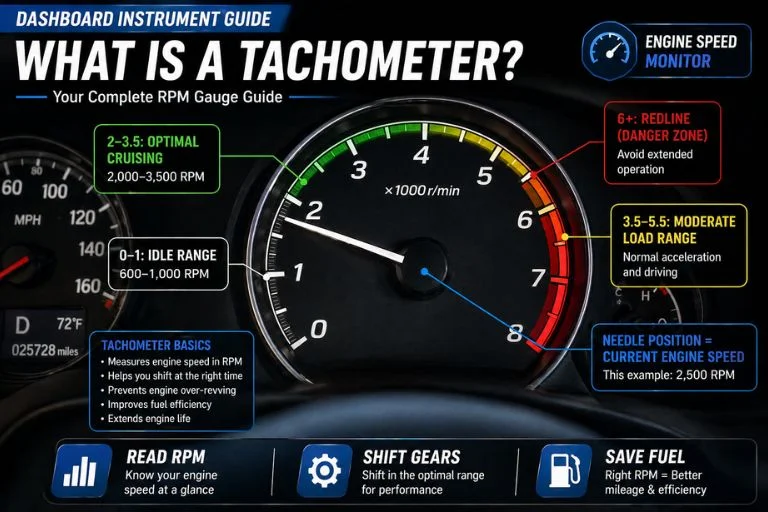
A tachometer is a device that is used to measure the speed of the rotation of a crankshaft in revolutions per minute (RPM). In other words, it tells you how quickly your engine is rotating. The word “tachometer” is derived from a Greek word “tachos” which means speed and “metron” which means “measure“. Your speedometer may indicate your speed in kilometers per hour or miles per hour, but the tachometer indicates how fast various components of your engine are spinning. The tachometer is usually represented in most modern cars as the analogue gauge often found on the right or left side of the speedometer.
How Does a Tachometer Work?
A tachometer is fed electrical impulses from an engine control unit (ECU) or the ignition system itself. These relate to the speed at which the engine’s crankshaft turns. The gauge then transforms these signals into a number which is displayed on a dial, typically marked from 0 to 8 or 9 (thousands of RPM). There are two main types of automotive tachometers:
| Type | How It Works | Common In |
| Analogue Tachometer | Relies on a needle that moves in response to electrical pulses from the ignition coil or ECU | Traditional and vintage vehicles |
| Digital Tachometer | Shows the RPM in a numerical format on the ECU or digital display | New and luxury cars |
Understanding RPM: What the Numbers Mean
RPM is an abbreviation for Revolutions Per Minute. When your engine is at rest – this means when you are sitting still with the engine on – you will usually see the RPM on your tachometer gauge between 600 and 1,000. As you press the accelerator your engine begins to work harder and the RPM will increase. Here’s a rough breakdown of different RPM figures for most passenger vehicles with petrol engines:
| RPM Range | Engine Status | Driver Action |
| 600 – 1,000 RPM | Idle — engine running, car stationary | Normal; no action needed |
| 1,000 – 2,000 RPM | Light load — gentle driving or starting off | Smooth, efficient driving range |
| 2,000 – 3,500 RPM | Normal driving — cruising on roads | Optimal zone for fuel economy |
| 3,500 – 5,000 RPM | Higher load — overtaking or acceleration | Acceptable for short durations |
| 5,000 – Red Zone | High stress — approaching engine limits | Shift up or ease off throttle |
| Red Zone (varies) | Dangerous — risk of engine damage | Immediately reduce RPM |
How to Read the Tachometer in a Car
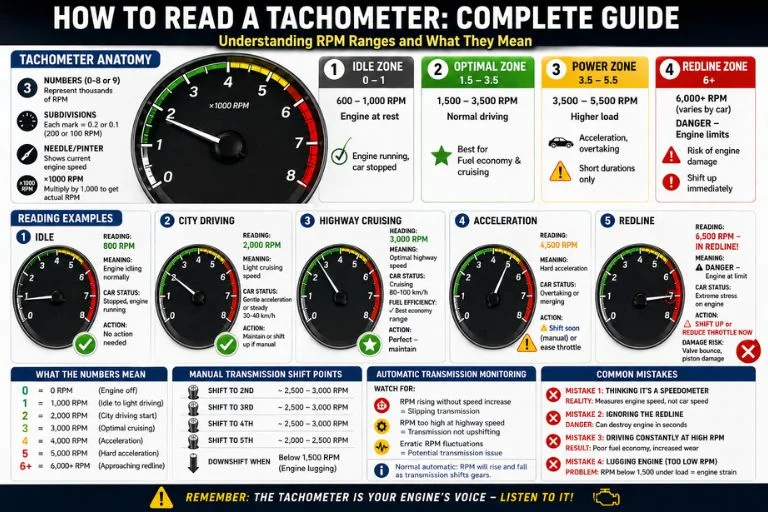
The RPM gauge is easy to read. The gauge is numbered from 1 to 8 (or 9) and each number representing 1,000 RPM. Therefore, if the needle is pointing to ‘3,’ this means the engine is running at around 3,000 RPM. Another critical component of the tachometer is the red zone – a distinct area at the top of the dial. This area, which typically starts at around 5,500 to 7,000 RPM, depending on the car, marks the highest safe engine speed – the redline. Running the engine in or above the red zone for extended periods can cause severe engine damage, such as valve bounce, piston damage and bearing failure.
Understanding Dashboard Instruments and Engine Monitoring
The tachometer works alongside other critical dashboard gauges to provide complete engine monitoring. Similar to how the oil pressure gauge monitors lubrication system health, the tachometer tracks engine rotational speed to prevent over-revving damage. When engine damage occurs from over-revving or neglected maintenance, quality aftermarket suppliers like Tagore Auto Parts provide reliable remanufactured engines and transmissions to restore your vehicle at reasonable costs.
Why the Tachometer is Important
The tachometer is important as it includes the following points:
- Helps with smooth gear shifting – Know exactly when to shift for optimal performance
- High fuel-efficiency – Staying in the 1,500-2,500 RPM range maximizes fuel economy
- Assists in performance driving – Track engine load during acceleration and overtaking
- Acts as an early warning system – Unusual RPM behavior indicates potential problems
- Enhances overall driving control – Better understanding of engine-transmission coordination
Tachometer in Automatic vs Manual Cars
Tachometer in Manual Cars (Essential)
- Allows the driver to decide the best RPM (typically 2,000 to 3,000) to shift the gear.
- Avoids engine damage from redlining (too high RPM)
- Enhances driving comfort by synchronising engine and vehicle speed
- Allows the driver to control acceleration and speed
Tachometer in Automatic Cars (Informational)
- Shows engine load while driving
- Assists in diagnosing problems such as slipping transmission (RPM increases, but not speed)
- Helps with manual override (paddle shifters) to select gears
- Helps in maintaining fuel efficiency by keeping RPMs lower during driving
Tachometer vs Speedometer: Key Differences
| Feature | Tachometer (RPM Gauge) | Speedometer |
| Measures | Engine crankshaft rotation speed | Vehicle road speed |
| Unit | RPM (Revolutions Per Minute) | km/h or mph |
| Purpose | Engine load and health monitoring | Road speed compliance |
| Relevance | Manual gearing, performance, engine care | Legal speed limits, navigation |
| Critical Feature | Redline / red zone | Maximum speed indicator |
Common Signs Your Tachometer May Be Faulty
Tachometers, like any gauge, can go awry. Here are a few signs that your tachometer may be on the fritz:
- The needle jumps around when you are driving at a steady speed
- The tachometer always reads zero even when the engine is running
- The tachometer is displaying a constant RPM even when the engine isn’t running
- The tachometer shows a delay in response to the engine
- The tachometer warning light comes on
These faults can be due to a broken tachometer wire, a faulty crankshaft position sensor, or a software problem with the engine control unit (ECU). If any of these symptoms are noticed, it is recommended to take the car to a mechanic for diagnosis.
Conclusion
The tachometer is one of the most overlooked features on your car’s dashboard that connects you directly to your car’s engine performance. This tool often enables how to read the RPM gauge and how it makes a huge difference in your driving experience. By having the knowledge of interpreting RPM readings correctly you can take your ride to the next level with confidence, along with optimized fuel consumption. By understanding what it is not only makes your driving easier but also allows you to gain the confidence you need while driving.
Frequently Asked Question’s
What is a tachometer used for?
Tachometer is an instrument that is used to measure the rotational speed of a shaft, disk or engine in revolutions per minute (RPM). Generally used for monitoring machinery performance and optimal gear shifting.
What’s a good RPM when driving?
Mostly the RPM range between 1,500 and 2,500 RPM is considered to be good when driving for optimal fuel efficiency and engine longevity.
Is the tachometer signal AC or DC?
The tachometer can be AC or pulsed DC, depending on the application. Modern vehicles typically use pulsed DC signals from the ECU.
Do automatic cars need a tachometer?
No, automatic cars do not need traditional tachometer as the vehicle’s computer manages engine RPM and gear shifts to prevent damage. However, it’s still useful for monitoring engine load and diagnosing transmission issues.
Will a tachometer save fuel?
Yes, the tachometer can save fuel as it helps you monitor the RPM to keep them in lower range (1,500-2,500 RPM) for optimal fuel economy.
Do electric cars have a tachometer?
No, electric cars don’t have tachometers as they lack internal combustion engines that need RPM monitoring. Electric motors don’t have the same RPM limitations or redline concerns.